



ChatGPT’s dominance in generative AI has fallen sharply from 77.6% in May 2025 to 53.7% in April 2026. Generative AI, or gen AI, is a branch of artificial intelligence that produces original content in response to user prompts. During the same period, Gemini’s website traffic share has surged from 7.27% to 26.7%.
These figures suggest that between ChatGPT Vs Gemini, ChatGPT has been gradually losing ground. However, ChatGPT still has an edge in many key performance areas. Here is how ChatGPT and Gemini compare across features, pricing, and real-world use cases.
ChatGPT vs Gemini: Quick Comparison
| Feature | ChatGPT | Gemini |
| Developer | OpenAI | Google DeepMind |
| Latest Model | GPT-5.5 Pro | Gemini 3.1 Pro |
| Free Plan | Limited access to multiple features, including GPT-5.5 Instant, Codex, and Deep Research. | Access to basic features, including standard Gemini models, Gems (custom AI experts), and Canvas. |
| Paid Plans | Go ($8/month), Plus ($20), Pro ($100), Business Codex (Usage pricing), Business ChatGPT & Codex ($20/user/month), and Enterprise (Custom pricing). | Google AI Plus ($7.99/month), Google AI Pro ($19.99/month), and Google AI Ultra ($249.99/month). |
| Context Window | Up to 1 million tokens | Up to 2 million tokens |
| Video Generation | Native AI video generation via Sora has been discontinued. | Creates videos using Veo 4 and Veo 3.1. |
What Is ChatGPT?
ChatGPT is a conversational AI tool developed by OpenAI, an AI research firm headquartered in the United States of America (USA). Launched in November 2022, ChatGPT is built upon the Generative Pre-trained Transformer (GPT) family, OpenAI’s proprietary large language models (LLMs). LLMs are neural networks trained on massive datasets to understand natural language and generate human-like responses.
While ChatGPT was initially based on GPT-3.5 and designed to generate only text responses, it gradually evolved to utilize advanced LLMs. These include GPT-4, GPT-4o, GPT-5, and the latest GPT-5.5. Each model introduced enhanced multimodal capabilities, enabling ChatGPT to create and analyze text, code, speech, and images seamlessly.
You can access ChatGPT through the web, mobile app, or application programming interface (API). Using the API, developers can integrate ChatGPT into their websites, software systems, and applications to develop AI-driven solutions.
What Is Gemini?
Gemini is Google’s flagship AI assistant with a multimodal structure. Built by Google DeepMind, Gemini is designed to handle multiple types of inputs, including text, audio, video, and images. It also seamlessly integrates into Google’s ecosystem. Thus, it serves as your trusted AI companion inside Google Workspace apps such as Google Sheets, Docs, Slides, and Gmail.
Starting from Gemini 1.0, Google successively released newer models, each offering higher multimodal processing, reasoning, and context-handling capabilities. Context handling refers to an AI chatbot’s ability to track, process, and remember information across longer conversations.
ChatGPT vs Gemini: Pricing & Plans
Free Plan Comparison
ChatGPT’s free plan offers limited access to GPT-5.5 Instant and Codex. It also comes with limited memory, context, and deep research capabilities. Moreover, it restricts the number of images you can generate, the files you can upload, and the messages you can send. As of May 2026, free users can send up to 10 messages every 5 hours with GPT-5.5. Once you hit the limit, your chat automatically switches to a lower-tier model (GPT-4 or GPT-4o) until the 5-hour limit resets.
Conversely, if you’re a Gemini free-tier user, you can access Gemini Flash, the default mode that generates text responses. You can also build custom AI assistants tailored to your unique needs and preferences using Gems. Additionally, you can use Canvas to code, write, and edit with AI. However, Gemini has prescribed usage and context window limits for free-tier users. Premium features like Deep Research may be locked or heavily restricted.
Paid Plan Comparison
ChatGPT offers paid plans starting from $8 per month for individuals and businesses.
- Go ($8/month): It is an entry-level plan that offers expanded access to ChatGPT’s basic features.
- Plus ($20/month): It offers higher usage limits than Go and access to advanced features like custom GPTs and GPT-5.5 Thinking. You’ll also gain early access to new features.
- Pro ($100/month): It is the highest individual tier that offers expanded access to advanced reasoning, unlimited image generation, and maximum context.
- Business Codex: It is a pay-as-you-go pricing model specially designed for development-focused teams. It provides flexible access to Codex, helping businesses automate tasks and build multi-agent workflows.
- Business Codex & ChatGPT ($20/user/month): It is a per-seat pricing plan designed for startups and growing businesses. It provides access to collaboration and business features such as data analysis, shared projects, and canvas. Additionally, ChatGPT can connect to 60+ third-party apps like Google Drive, Slack, and GitHub. Therefore, it can easily pull an organization’s data and help teams work with it directly in the chat.
- Enterprise: ChatGPT offers custom pricing to businesses operating at scale. This plan provides advanced security, the largest context window, and 24/7 priority support.
As opposed to ChatGPT, Gemini offers only three paid plans starting from $7.99 per month.
- Google AI Plus ($7.99/month): It grants expanded access to premium features, including Gemini 3 Pro, Nano Banana Pro, Veo, and Flow Music.
- Google AI Pro ($19.99/month): By subscribing to this plan, you’ll unlock additional features like Google Antigravity (an agentic development platform). If you’re a developer, you can enjoy higher limits for various tools like Jules and Gemini Code Assist. Besides, you’ll get early access to new features.
- Google AI Ultra ($249.99/month): You’ll gain the highest access to Gemini 3 Pro and enjoy maximum usage limits for premium features. US-based users will also get the earliest access to Gemini Agent and Deep Think features.
ChatGPT vs Gemini: Writing & Content Creation
1. Long-Form Writing Quality
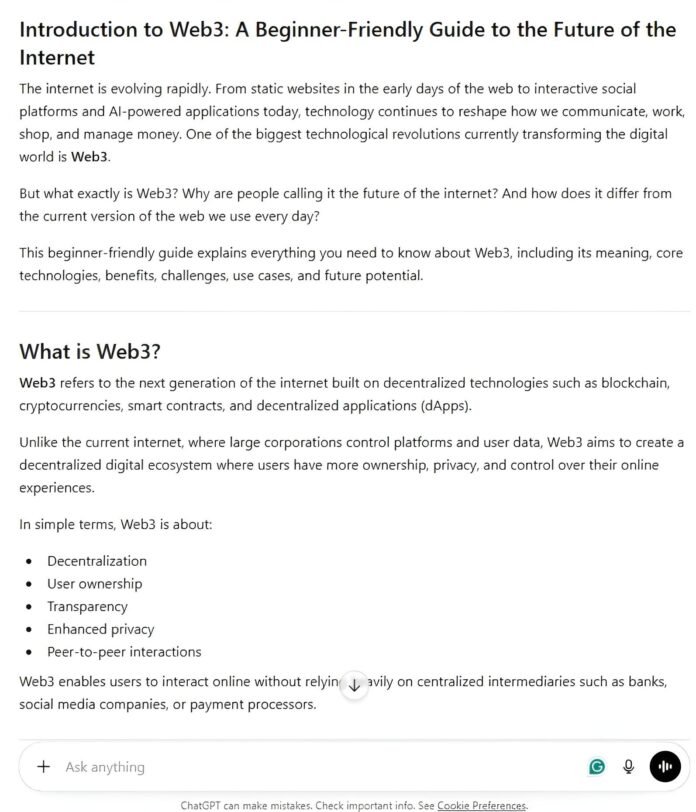
ChatGPT’s output

Gemini’s output

To assess the quality of content produced by ChatGPT and Gemini, we asked both tools to draft a 2000-word blog on Web3. We also specified additional parameters, such as ensuring the article remained clear, concise, engaging, and search engine-optimized.
While ChatGPT instantly generated the blog, Gemini took a couple of minutes to complete the task. However, Gemini displayed a brief analysis of the blog post, outlining the key points it covers. It also presented the blog in a portable document format (PDF) file.
Content-wise, ChatGPT’s blog had a more engaging introduction and covered more points related to Web3. However, it presented most concepts in bullet points without properly explaining each one. Conversely, Gemini’s version was less compelling, highlighted fewer points, but described every concept in greater detail.
In essence, ChatGPT generates long-form content faster and covers more aspects of a topic, but may lack detailed explanations. Gemini’s content may not easily hook readers, but it contains better descriptions of every element. Based on our evaluation, Gemini performs better when it comes to long-form content creation.
2. Creative Writing and Storytelling
ChatGPT’s output

Gemini’s output

For the creative writing test, we asked both the AI chatbots to curate a short thriller story. While both delivered stories that conformed to our specifications, ChatGPT’s story stood out in terms of creativity. It brought the characters to life with a powerful narrative, enabling readers to visualize the story effortlessly. Also, the twist that unfolded in the climax was surprising.
Coming to Gemini’s story, the plot was reasonably good but lacked originality, cinematic depth, and immersive storytelling. However, Gemini used short section titles throughout the story, making the overall storyline easier to follow and understand at a glance.
In short, ChatGPT excels in creative writing with superior word choice, natural sentence flow, and an engaging style. But if you need to quickly review multiple storylines, Gemini’s presentation style is helpful.
3. Instruction Following and Tone Control
From creating Telegram posts to drafting professional emails and case studies, we assigned various tasks to both tools to analyze their performances. While both followed instructions well, Gemini struggled to curate content with a promotional or friendly tone. Its outputs maintained a formal, robotic tone, making it less suitable for creating marketing copies, social media content, and ad scripts. However, if you want to create educational content that informs users, Gemini could be your best bet.
Overall, ChatGPT’s responses flowed more naturally, making them more engaging and easier to read. Its content effectively captured the emotional undertones needed for different types of writing. It could also adjust its tone to suit the purpose and target audience. Gemini’s articles are more factual, informative, concise, and well-structured, but less compelling.
ChatGPT vs Gemini: Coding
Both ChatGPT and Gemini support vibe coding, meaning you can describe what you need in plain language. Based on your prompt, AI will generate code. After you run the code, you can also debug and fine-tune the output using follow-up prompts. While both tools have made it easier for non-programmers and beginners to build applications, they differ in the quality of code produced.
SWE-bench & Real Benchmark Results
SWE-bench Pro is a benchmark that tests the ability of LLMs and AI agents in resolving real-world software issues. These issues are collected from GitHub, a cloud-based platform that enables developers to store, share, and manage their code. GPT-5.5’s SWE-Bench Pro score is 58.6%, while that of Gemini 3.1 Pro is 54.2%.
To evaluate how the chatbots fare on real software engineering tasks, we asked them to develop a currency converter using Python. While ChatGPT’s code produced accurate results, Gemini’s program threw a network error. When we asked Gemini to debug the program, it displayed revised code that also triggered an API key error. Google Gemini failed to debug the program, while ChatGPT’s code ran without errors and produced the expected output.
Overall, ChatGPT demonstrates stronger technical clarity and attention to detail when writing programs, particularly in Python, JavaScript, and SQL. It is also efficient in debugging programs and provides an in-depth root cause analysis for each bug.
Which Is Better for Developers?
ChatGPT is better suited for developers seeking debugging support, workflow automation, and coding versatility across multiple programming languages. Features like Codex and custom GPTs make it highly conducive for exploring new libraries and building customized applications.
Conversely, Gemini performs better when analyzing large repositories/codebases and integrating coding workflows directly within Google’s ecosystem. For developers who primarily work with Vertex AI, Google Colab, or Workspace tools, Gemini’s deep integration helps streamline the development process.
ChatGPT vs Gemini: Reasoning and Research
ChatGPT’s Output

Gemini’s Output

To evaluate reasoning capabilities, we asked both tools to summarize the latest crypto-related news and explain their implications for the broader market. While both tools successfully identified recent updates, Gemini’s response stood out in terms of presentation and clarity. However, it overlooked a crucial aspect: the potential impact of recent regulatory developments on the crypto market.
Next, we tested the deep research capabilities of both tools by asking them to prepare a research report on the latest AI trends. In this task, Gemini was the clear winner. It not only gathered and synthesized up-to-date information but also explained the latest AI developments precisely. Moreover, its research report included source citations. Contrarily, ChatGPT’s version lacked reference links to original sources of information as well as proper explanations for the key trends.
ChatGPT vs Gemini: Multimodal Capabilities
While Gemini was designed to deliver multimodal creativity from the ground up, ChatGPT gradually expanded its multimodal capabilities with every iteration.
1. Image Understanding and Generation
ChatGPT’s Output

Gemini’s Output

We uploaded a breathtaking visual of the Iguazu Waterfalls during sunset. Both ChatGPT and Gemini described the picture accurately. However, ChatGPT’s version was more appealing and beautiful to read. When it came to granular analysis, Gemini performed better. It identified the key elements correctly and provided a more eloquent explanation for each one.
ChatGPT’s Output

Gemini’s Output

To test their image-generation capabilities, we asked them to create a peaceful living room with minimal yet aesthetic vibes. We also wanted the image to reflect positivity. On this front, ChatGPT was superior, even if both tools used similar color palettes.
2. Video Generation: Sora vs Veo 3
OpenAI discontinued ChatGPT’s standalone video generation app, Sora, on April 26, 2026. It will also sunset the Sora API on September 24, 2026. ChatGPT can no longer generate videos natively unless integrated with external tools or frameworks. If you want a native video-generation experience, Gemini becomes the default option. Its Veo 3.1 video generator can produce scintillating visuals, cinematic effects, and well-synced audio from a simple text prompt. However, you need to upgrade to a paid plan to use Veo.
3. Voice Mode Comparison
Voice mode is a unique feature that enables natural, real-time conversations with an AI copilot. Instead of typing prompts, you can simply speak your requests, making interactions more effortless and intuitive. In our experience, conversations with both Gemini and ChatGPT felt smooth and fluid. We were also able to interrupt the chatbots mid-conversation to switch topics or ask follow-up questions. Additionally, the minimal lag time ensured that interactions felt responsive rather than clunky.
4. Document & PDF Analysis
For the document and PDF analysis test, we asked both AI tools to summarize Bitcoin’s whitepaper. Gemini performed better by identifying the key concepts and simplifying their explanations, enabling laypersons to understand the document easily. ChatGPT also extracted the pivotal concepts and presented their explanations in bullet points. If you’re seeking a structured and coherent reading experience, Gemini is more conducive. If you want to skim through a document quickly, ChatGPT’s analysis is preferable.
To study their task summarization ability, we asked both Gemini and ChatGPT to summarize Wirestock’s recent fundraising round in 3 sentences. ChatGPT accurately stated the total amount of capital Wirestock has raised ($23M), its vision, and what the funding reflects. Contrarily, Gemini stated the funds raised, what the company does, and how it plans to use the capital. Overall, ChatGPT’s summary was more concise and referenced the source link.
ChatGPT vs Gemini: Context Window & Memory
Context window refers to the amount of text that an AI model can remember or hold in memory at one time. It comprises your input/prompt and the model’s output, measured in tokens, which are small chunks of text. While GPT-5.5 supports a context window of up to 1 million tokens, Gemini 3.1 Pro supports up to 2 million tokens.
Based on our experience, Gemini is more proficient at handling larger datasets, lengthy documents, and extensive context windows. However, ChatGPT performs better for fluid conversations and follow-ups due to its sharper memory. It not only remembers previous chats but also recalls tones, instructions, and conversational preferences.
ChatGPT vs Gemini: Ecosystem & Integrations
ChatGPT offers broad third-party integrations across tools and APIs within OpenAI’s ecosystem. It also seamlessly connects to 60+ applications, including productivity apps and creativity platforms for workflow automation. For example, Codex helps developers write, analyze, and debug code faster. Similarly, ChatGPT’s integration with Canva allows you to create and edit designs within a chat.
Conversely, Gemini is deeply embedded within Google Workspace apps, enabling in-app summarizations and task automations. Its Google Search integration helps Gemini pull out real-time information from the web and conduct up-to-date research.
ChatGPT vs Gemini: Agentic Capabilities
ChatGPT Agentic Features
- Deep Research: ChatGPT conducts extensive, multi-step web research and synthesizes information from multiple sources to generate comprehensive, analyst-level reports with citations. This feature is primarily designed for users performing knowledge work in fields like science and engineering that require trustworthy research. Moreover, users can connect Deep Research to any application or Model Context Protocol (MCP) to limit web searches to authentic sources. MCP is an open-source standard that helps users connect AI applications with external systems.
- Autonomous task execution: ChatGPT Agent offers a unified agentic system that combines the strengths of Operator, Deep Research, and ChatGPT’s conversational fluidity. While Operator can seamlessly interact with browsers and self-correct using advanced reasoning capabilities, Deep Research can effectively collate information. Therefore, ChatGPT is equipped to independently navigate websites, create reports, evaluate information, and build workflows using its own virtual computer environment.
- Agent mode: From creating presentations and generating research reports to planning travel, ChatGPT can handle a wide range of tasks. Moreover, you’ll always remain in control, as the agent seeks your permission before taking important actions. However, you need to upgrade to a paid plan to access the “Agent Mode” feature.
Gemini Agentic Features
- Deep Research: Gemini offers two research configurations tailored to different workflows and user requirements: Deep Research and Deep Research Max. If you prioritize speed, efficiency, low latency, and high-quality research at modest costs, Deep Research fits the bill. Conversely, if you seek the highest-quality reports alongside advanced reasoning, refinement, and information synthesis, Deep Research Max is the better choice.
- Live Streaming: Gemini allows users to observe its thinking process and intermediate reasoning steps in real time, including thought summaries. It also displays text or image outputs as soon as they are generated.
- Native Visualizations: Along with written reports, Gemini can create attractive visualizations, including graphs, charts, and infographics. This makes it easier for users to interpret complex datasets and research findings.
- Collaborative Planning: Before the AI agent starts executing tasks, you can review, guide, alter, and fine-tune the research plan. This creates a more collaborative workflow while giving you granular control over the investigation process.
- Multimodal Research Support: You can upload multiple file types, including PDFs, spreadsheets, videos, and audio files, to help Gemini better understand the research context.
- MCP Support: Gemini’s agentic framework allows you to connect Deep Research with custom datasets or specialized data providers.
- Advanced Tool Integration: Gemini can simultaneously use multiple tools, such as Google Search, Code Execution, and MCP servers. If needed, it can even work with your custom data without using the web.
ChatGPT vs Gemini: Limitations and Risks
Pitfalls of ChatGPT
- Outdated Knowledge: Training cutoffs vary across GPT models. Older iterations of the model typically have earlier knowledge cutoffs, making them susceptible to outdated information. For example, GPT-4o has a knowledge cutoff of October 2023, while GPT-5.5 is trained on significantly newer datasets. Without access to external tools or plugins, ChatGPT may not reflect the most recent developments.
- High Usage Costs: If you choose paid plans or heavily use premium models through the API, your expenses may increase substantially. Developers must also track token usage carefully.
- Ethical Issues and Biases: As AI chatbots are trained on internet data, biases are unavoidable. On sensitive topics, ChatGPT may sometimes generate polarized viewpoints. Additionally, AI-generated articles carry higher risks of privacy and copyright violations.
- Overdependence: Excessive reliance on conversational AI tools may weaken your critical thinking and manual content refinement abilities. Moreover, ChatGPT outputs often contain generalized information rather than domain expertise or specialized insights.
- Hallucinations: Many AI models, including ChatGPT, hallucinate frequently. They may generate incorrect responses, make up information, or misunderstand prompts. Therefore, you must manually verify facts and ensure all information is accurate.
- Poorer Workflow Integration: Unless you install the necessary plugins or APIs, ChatGPT largely functions as a standalone application. Integration challenges may also arise if your workflow depends on multiple tools.
Pitfalls of Gemini
- Privacy Concerns: As Gemini is tightly integrated into Google’s ecosystem, large amounts of user data may become accessible to the AI assistant. Unlike ChatGPT, Gemini doesn’t currently offer a temporary chat option. The only way you can ensure enhanced privacy is by accessing Gemini in incognito mode.
- Best-suited for the Google ecosystem only: Gemini’s biggest strength is its seamless integration with Google’s ecosystem, making it highly effective for individuals/businesses using Google Workspace. However, it may become a friction point for workflows dependent on other ecosystems.
- Heavy Computational Power: Video and audio generation, advanced LLMs, and long context windows consume significant computing resources. Consequently, expenses may increase, and device performance may decline, potentially causing productivity bottlenecks. This may also adversely impact the maintenance costs of enterprise-scale applications.
- Erroneous Outputs: Though Gemini is recognized for its multimodal architecture and ability to process diverse inputs, outputs still need verification. Like other AI models, Gemini also hallucinates and often generates inconsistent responses.
- Higher Dependence on Prompt Quality: Compared to ChatGPT, Gemini generally needs more specific prompts to produce accurate outputs.
Common Mistakes When Using ChatGPT or Gemini
- Not Verifying Outputs: All AI tools, including ChatGPT and Gemini, tend to hallucinate, fabricate data, and produce outputs that sound correct. Hence, users must verify outputs, especially business content and research reports, for factual accuracy. Coding is another area where AI models frequently generate faulty programs that throw errors during execution. Reviewing, refining, and validating outputs is therefore essential.
- Ambiguous or Generic Prompts: The stronger your prompt-engineering skills, the higher the quality of outputs generated by AI tools. To achieve the best results, specify objectives, output formats, target audiences, and contextual details precisely. Generic prompts rarely produce desired outcomes, particularly for complex tasks.
- Relying on a single AI assistant: Each AI tool possesses unique strengths. Depending on only one tool may reduce efficiency, versatility, and productivity.
- No Structured Learning: To gain AI mastery, follow a structured, step-by-step learning path. Learning through random tutorials or fragmented resources often leads to incomplete understanding. You’re also unlikely to develop a proper grasp of prompt engineering, workflow creation, evaluation methods, and research strategies.
- Inadequate Practice: Using AI tools daily or weekly for activities like email generation, content planning, and brainstorming ideas significantly improves your proficiency. Those who use AI only occasionally often struggle to write effective prompts, troubleshoot issues, build workflows, or identify factual inaccuracies.
Should You Use Both ChatGPT and Gemini?
Using both ChatGPT and Gemini can boost productivity, workflow efficiency, and creativity considerably. ChatGPT excels at content generation, workflow automations, brainstorming, coding, and storytelling.
On the other hand, Gemini is better at handling multimodal tasks and conducting in-depth research. Its native integration with Google’s ecosystem eliminates the need to switch between the chat interface and the tools you use daily. It also enhances cross-application contextual awareness, an AI system’s ability to generate responses based on surrounding information across different applications.
Our Verdict: ChatGPT or Gemini?
Both ChatGPT and Gemini have distinct strengths and weaknesses. ChatGPT benefits from a larger user base and widespread adoption. Conversely, Gemini stands out for its deep research capabilities and tight integration with Google’s ecosystem. However, the ultimate choice depends on your needs, preferences, and workflow.
FAQs
Is ChatGPT better than Gemini in 2026?
If you want to conduct deep research, analyze multimodal inputs, create music or videos, or integrate AI into Google workflows, Gemini is superior. If you want to generate engaging blogs, marketing copies, and social media posts, choose ChatGPT. It also excels in creative writing, storytelling, document analysis, report summarization, brainstorming, and coding.
What is the difference between ChatGPT and Gemini?
ChatGPT delivers consistent performance for text-heavy workflows, creative writing, task automation, coding, document summarization, and context-aware responses. It also provides a standalone interface alongside custom GPTs and third-party integrations like Codex and Canva. Conversely, Gemini is more suitable for real-time research, Google Workspace integrations, and handling larger context windows.
Which is better for coding: ChatGPT or Gemini?
ChatGPT is better for coding, as well as identifying, analyzing, and fixing bugs. It offers detailed root cause analyses, debugging solutions across multiple programming languages, and code breakdowns. However, if you want to analyze extremely large codebases, Gemini may serve as a better AI sidekick.
Does Gemini have a larger context window than ChatGPT?
Like GPT-5.5, Gemini Flash models come with a context window of up to 1 million tokens. However, Gemini Pro models have a much larger context window of up to 2 million tokens.
Which is better for Google Workspace users: ChatGPT or Gemini?
Gemini is undoubtedly better for Google Workspace users because it is deeply integrated into Google’s ecosystem. Whether you want to refine reports, automate workflows, or summarize emails within Gmail, Docs, Slides, or Sheets, Gemini does the job instantly.
Which is better for students: ChatGPT or Gemini?
If students need simplified explanations for complex concepts with practical examples, ChatGPT is better. It also helps summarize study materials, extract key points, and generate flashcards for faster recall. However, Gemini conducts deeper research and has advanced multimodal capabilities, making it suitable for writing dissertations and academic papers.
The post ChatGPT vs Gemini 2026: Which AI Assistant Is Actually Better? appeared first on Memeburn.