


BitMEX co-founder Arthur Hayes has revealed that Zcash (ZEC) is now his largest crypto holding outside Bitcoin, framing privacy coins as the single most asymmetric opportunity in today’s market. Hayes confirmed he has been actively selling Bitcoin to buy Zcash through his fund Maelstrom, a move that underscores just how convicted he is. His reasoning centers on a thesis that few in the crypto media have explored deeply: AI-powered surveillance is making blockchain transparency a liability, not a feature.
In a May 13 interview on the Unchained podcast, Hayes argued that artificial intelligence, big tech platforms, and government agencies have reached a point where stripping anonymity from public blockchain transactions is almost effortless. That capability gap, he believes, creates urgent demand for a dedicated privacy layer separate from Bitcoin.
The timing is notable. Hayes’ comments landed alongside a wave of institutional interest in Zcash, including Multicoin Capital’s disclosed accumulation since February, Grayscale’s filing for the first-ever U.S. spot privacy coin ETF, and a broader market reassessment of what financial privacy means in an era of AI-driven analytics.
Why Hayes Picked Zcash Over Monero
Hayes was direct about his preference. He called Zcash’s zero-knowledge proof cryptography the strongest among privacy coins, placing it ahead of Monero (XMR) in his portfolio thesis.
He acknowledged he is not a cryptographer himself but said his conviction was shaped by conversations with developers working on privacy systems and by reading the competing technical arguments.
Key points from his thesis:
- Bitcoin should remain transparent. Hayes argued that Bitcoin’s public ledger provides accountability and should not be modified for privacy. Instead, a separate asset should serve the role of “internet cash.”
- Zcash’s zk-SNARK technology enables fully encrypted transactions where the sender, receiver, and amount are all hidden, while still allowing the network to verify validity.
- Monero’s ring signatures have shown cracks. Hayes referenced reports that Japanese authorities were able to partially de-anonymize Monero transactions, strengthening his case for Zcash’s approach.
- Shielded adoption is real, not theoretical. Approximately 30% of ZEC’s circulating supply now sits in shielded addresses, up from roughly 8% in early 2024. That growth signals genuine usage rather than speculative holding.
Hayes described the setup as “asymmetric” because privacy coins remain priced at a fraction of Bitcoin’s value while the demand catalyst (AI surveillance) is accelerating exponentially.

The AI Surveillance Catalyst No One Is Talking About
This is where Hayes’ argument diverges from standard crypto commentary and enters territory more familiar to tech and AI observers.
His core claim is simple: the better AI gets at pattern recognition, the less private any public blockchain becomes. Every Bitcoin transaction, every Ethereum interaction, every on-chain swap leaves a permanent, searchable trace. Chain analysis firms already use machine learning to cluster wallets, identify users, and flag transactions. As these tools scale with more powerful AI models, pseudonymity on public chains effectively vanishes.
Hayes framed it bluntly during the podcast: AI, big tech, and big government together make de-anonymization trivial. The implication is that financial privacy is shifting from a philosophical preference to a practical necessity for anyone who doesn’t want their complete transaction history exposed to algorithmic scrutiny.
This argument resonates beyond crypto. It connects directly to broader debates about AI-powered surveillance in fintech, social media data harvesting, and government monitoring programs. The EU’s DAC8 directive, which requires crypto service providers to collect user tax data, and California’s proposed wealth tax legislation both illustrate the regulatory direction Hayes is betting against.
For Hayes, Zcash is not just a crypto trade. It’s a bet that the intersection of AI capability and government ambition will drive a new category of financial product: provably private digital money.

The Macro Thesis: Money Printing Meets Privacy Demand
Hayes didn’t stop at AI. He connected his Zcash position to a broader macroeconomic framework that ties privacy demand to inflationary monetary policy.
His argument follows a clear chain of logic:
- Wars, AI infrastructure spending, and supply chain restructuring are all inflationary. Governments will continue to spend aggressively on defense, AI capex, drones, pipelines, and commodity stockpiles.
- Central banks will print money to cover the gap. Whether through traditional quantitative easing or newer mechanisms like the Fed’s proposed “Reserve Management Purchases,” policymakers will expand credit.
- An AI-driven deflationary bust is possible if mid-tier knowledge workers lose their jobs and default on consumer debt. But even in that scenario, Hayes expects central banks to print enough to fill the hole.
- Either way, risk assets benefit. Bitcoin rises on liquidity expansion. And privacy coins rise on the same liquidity plus the additional catalyst of surveillance anxiety.
In his latest Substack essay, titled “The Butterfly Touch” and published May 11, Hayes wrote that Bitcoin had bottomed at $60,000 earlier in 2026 and that a move back to its October 2025 record of $126,000 is now inevitable if fiat liquidity keeps expanding. He identified $90,000 as the level where options market dynamics would force call option writers to buy spot Bitcoin, accelerating the move higher.
His fund, Maelstrom, holds three primary positions outside Bitcoin: Hyperliquid (HYPE), Zcash (ZEC), and a growing allocation to NEAR Protocol, which Hayes plans to connect to his privacy thesis through intent-based cross-chain execution. In an April 2026 interview, Hayes confirmed that he sold Bitcoin specifically to buy Zcash and Hyperliquid, not to return to fiat currency.
Institutional Momentum Is Building Fast
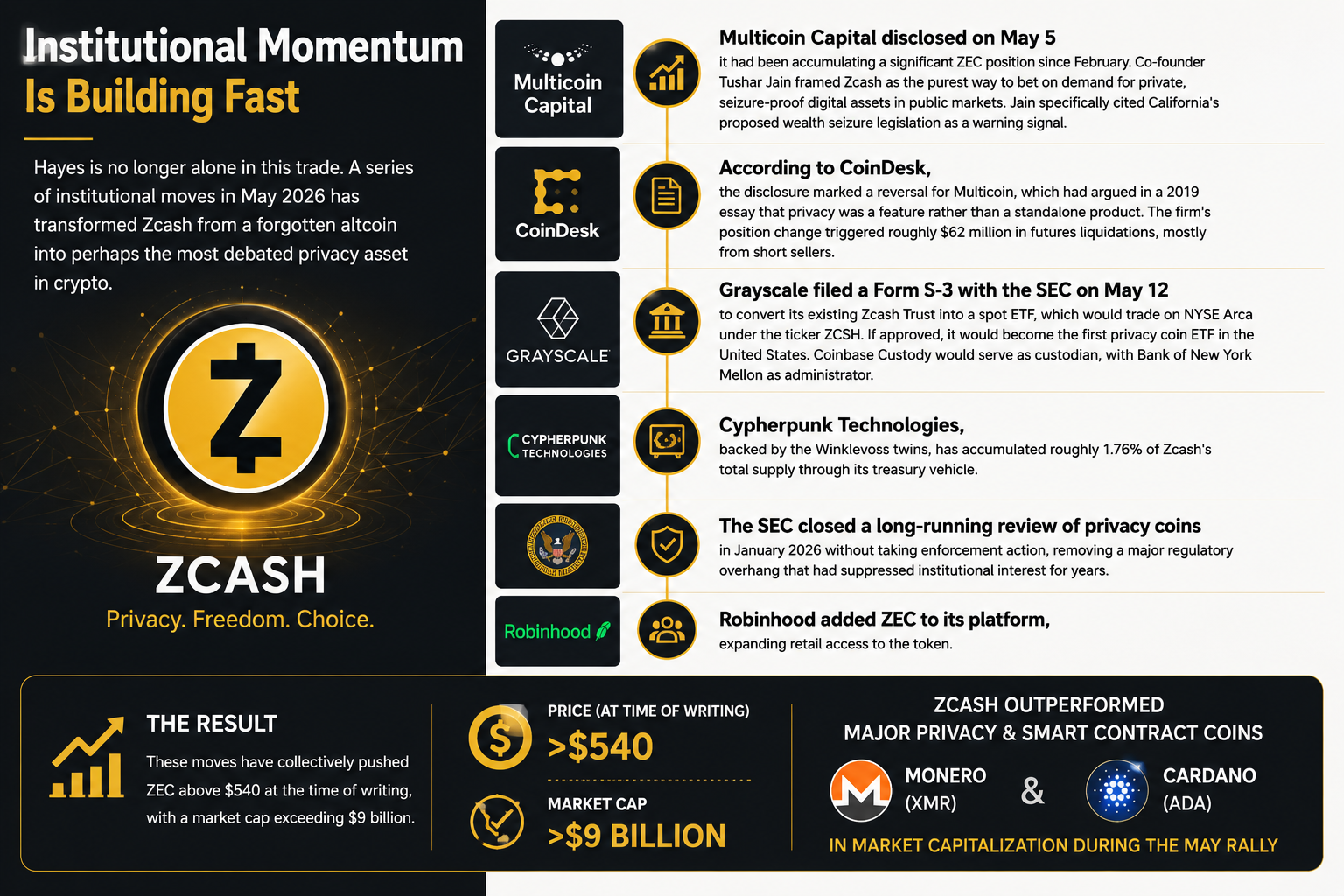
Hayes is no longer alone in this trade. A series of institutional moves in May 2026 has transformed Zcash from a forgotten altcoin into perhaps the most debated privacy asset in crypto.
Multicoin Capital disclosed on May 5 that it had been accumulating a significant ZEC position since February. Co-founder Tushar Jain framed Zcash as the purest way to bet on demand for private, seizure-proof digital assets in public markets. Jain specifically cited California’s proposed wealth seizure legislation as a warning signal.
According to CoinDesk, the disclosure marked a reversal for Multicoin, which had argued in a 2019 essay that privacy was a feature rather than a standalone product. The firm’s position change triggered roughly $62 million in futures liquidations, mostly from short sellers.
Grayscale filed a Form S-3 with the SEC on May 12 to convert its existing Zcash Trust into a spot ETF, which would trade on NYSE Arca under the ticker ZCSH. If approved, it would become the first privacy coin ETF in the United States. Coinbase Custody would serve as custodian, with Bank of New York Mellon as administrator.
Cypherpunk Technologies, backed by the Winklevoss twins, has accumulated roughly 1.76% of Zcash’s total supply through its treasury vehicle.
The SEC closed a long-running review of privacy coins in January 2026 without taking enforcement action, removing a major regulatory overhang that had suppressed institutional interest for years.
Robinhood added ZEC to its platform, expanding retail access to the token.
These moves have collectively pushed ZEC above $540 at the time of writing, with a market cap exceeding $9 billion. Zcash briefly overtook both Monero and Cardano in market capitalization during the May rally.

How to Buy Zcash and What to Know First
For those looking to buy Zcash after the Hayes and Multicoin endorsements, several practical points matter.
Where to buy Zcash: ZEC is available on major exchanges including Coinbase, Kucoin, Kraken, MEXC and now OKX. However, anyone trying to accumulate a large position will face thin OTC liquidity. Hayes himself said that when he attempted to acquire a sizable holding, only two out of nine OTC brokers were willing to quote him. That illiquidity works both ways: it can amplify gains on the way up but also magnify losses on the way down.
Shielded vs. transparent addresses: Most centralized exchanges only support transparent Zcash addresses, meaning transactions remain fully visible on-chain. To actually use ZEC’s privacy features, users need to withdraw to a self-custodial wallet like Zashi and shield their tokens. Hayes explicitly urged holders to do this, warning that keeping ZEC on exchanges defeats the purpose of owning a privacy coin.
Upcoming catalysts to watch:
- Grayscale’s spot ETF approval timeline (SEC review ongoing)
- Zcash’s Tachyon upgrade, which would reduce block times from 75 to 25 seconds
- Quantum-recoverable wallets expected in June 2026
- The EU’s 2027 Anti-Money Laundering Regulation and its impact on privacy coin exchange access
Risk factors remain significant. Privacy coins face ongoing delisting pressure from exchanges under AML scrutiny. Fewer trading venues mean sharper price swings and reduced liquidity. The regulatory environment could shift abruptly if governments decide to crack down harder on privacy-preserving technologies.
The Bigger Picture: Privacy as a Tech Narrative, Not Just a Crypto One
What makes Hayes’ thesis particularly relevant for tech observers is that it reframes financial privacy as a downstream consequence of AI advancement. This isn’t just about crypto traders wanting anonymity. It’s about what happens when AI systems can reconstruct your entire financial history from public data, link your wallets to your identity, and feed that information to government agencies, advertisers, or bad actors.
Hayes isn’t the only one connecting these dots. Naval Ravikant has publicly backed Zcash with a similar framing, and a16z crypto posted in late 2025 that privacy needs are growing as crypto reaches mainstream audiences.
The question for investors, builders, and policymakers is whether privacy-preserving technology will be treated as a legitimate financial tool or as a regulatory target. Hayes is betting heavily on the former. His Zcash position, now his largest outside Bitcoin, is the clearest expression of that bet.
Whether ZEC reaches the 10% to 20% of Bitcoin’s value that Hayes has publicly targeted remains highly speculative. But the thesis itself touches on something that extends well beyond any single token: as AI makes surveillance cheaper and more powerful, the market for tools that preserve privacy will only grow.
The post Arthur Hayes Is Buying Zcash as AI Surveillance Threatens Crypto Privacy appeared first on Memeburn.