



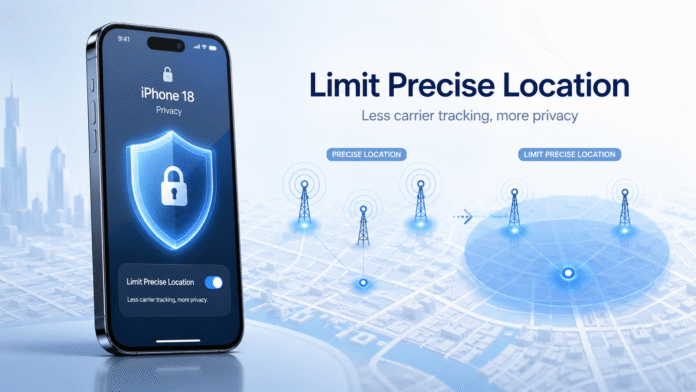
Your wireless carrier knows exactly where you are right now, down to the street you’re standing on. That’s about to change.
Apple is preparing to roll out its in-house C2 modem across the entire iPhone 18 lineup this fall, and the upgrade carries a privacy benefit that most people haven’t heard about. Every iPhone 18 model will support a feature called Limit Precise Location, which restricts how accurately cellular carriers can pinpoint your device. Instead of tracking you to a specific address, carriers would only see the general neighborhood where your phone is located.
The feature first appeared in iOS 26.3 earlier this year, but it was limited to a handful of devices running Apple’s own C1 and C1X modem chips. With the iPhone 18 Pro, iPhone 18 Pro Max, and the long-rumored iPhone Fold all expected to ship with the next-generation C2 modem in September 2026, this privacy control is about to reach millions more users.
But there’s a catch. Major U.S. carriers like AT&T, Verizon, and T-Mobile still don’t support it, and they may have very little incentive to change that anytime soon.
What Is Limit Precise Location and Why Does It Matter?
Every time your phone connects to a cell tower, it shares data that allows your carrier to estimate where you are. This process, known as cell site triangulation, has been standard practice since long before smartphones existed. In dense urban areas where towers are packed closely together, that estimate can be accurate enough to identify your exact street address.
Unlike app-based location tracking, this kind of surveillance has historically been impossible for users to control. You could turn off GPS, deny every app permission, and your carrier would still know your movements.
Apple’s Limit Precise Location setting changes this at the hardware level. When enabled, the modem itself restricts certain data before it reaches the carrier’s network, reducing location accuracy from street-level precision to a much broader neighborhood estimate.
A few important details worth noting:
- Signal quality remains unaffected. Apple has confirmed that enabling the feature does not degrade call quality or data speeds.
- Emergency calls still transmit precise coordinates to first responders, so safety is not compromised.
- The feature only targets carrier-level data. It has no effect on location information shared with apps through iOS Location Services, which is governed by separate privacy settings.
According to Apple’s support documentation, the setting is found under Settings > Cellular > Cellular Data Options on compatible devices.

Why Apple Needed to Build Its Own Modem to Make This Work
This isn’t a software toggle that any phone could offer. Limit Precise Location requires Apple’s custom C-series modem silicon, which is why Qualcomm-powered iPhones like the iPhone 17 Pro and iPhone 17 Pro Max cannot use the feature despite running the same iOS version.
Apple has not disclosed the exact technical mechanism, but the architecture tells a clear story. By designing both the modem and the operating system, Apple controls what data leaves the device at the radio level. Qualcomm modems operate as third-party components with their own firmware, giving Apple far less control over what information gets transmitted during the cellular handshake process.
The company’s modem journey started with the C1 chip in the iPhone 16e in early 2025. That first-generation modem focused on power efficiency and reliability rather than raw speed. Independent testing by Ookla later showed that the improved C1X modem in the iPhone Air achieved real-world performance parity with Qualcomm’s X80 in download speeds and actually surpassed it in latency across 19 of 22 global markets tested.
The upcoming C2 modem is expected to take another leap forward. It will reportedly support mmWave 5G for the first time in an Apple-designed chip, along with NR-NTN (New Radio Non-Terrestrial Networks), a standard that would allow iPhones to connect directly to low-earth orbit satellites for internet access. According to MacRumors, the C2’s NR-NTN capability could let future iPhones maintain data connections in areas with zero cellular coverage.
But the privacy implications of Apple’s modem independence may prove just as significant as the performance gains.
The Carrier Problem: Who Supports It and Who Doesn’t
Limit Precise Location doesn’t work unless your carrier cooperates. And right now, the list of participating carriers remains short.
Carriers currently supporting Limit Precise Location (as of iOS 26.5, May 2026):
| Country | Carrier | Supported Since |
| United States | Boost Mobile | iOS 26.3 (Feb 2026) |
| United Kingdom | EE | iOS 26.3 |
| United Kingdom | BT | iOS 26.3 |
| United Kingdom | Sky | iOS 26.5 (May 2026) |
| Germany | Telekom | iOS 26.3 |
| Denmark | YouSee | iOS 26.5 |
| Austria | A1 | iOS 26.5 |
| Ireland | Sky | iOS 26.5 |
| Thailand | AIS | iOS 26.3 |
| Thailand | True | iOS 26.3 |
Notable carriers NOT supporting it: AT&T, Verizon, T-Mobile, and virtually every other major U.S. provider.
The absence of the three largest U.S. carriers is striking but not surprising. In April 2024, the FCC fined AT&T, Sprint, T-Mobile, and Verizon a combined $200 million for illegally sharing customers’ real-time location data with third-party data brokers without consent. According to the FCC’s enforcement action, the carriers sold access to location information to aggregators who then resold it for profit.
The fine, while headline-grabbing, represents a fraction of what these companies earn. AT&T, Verizon, and T-Mobile together generate over $300 billion in combined annual revenue. A $200 million penalty barely registers as a cost of doing business.
Technical barriers also play a role. Supporting Limit Precise Location requires modern 5G Standalone (SA) network infrastructure. Many major carriers still run mixed deployments of older Non-Standalone (NSA) architecture alongside newer SA networks, and upgrading every cell site to recognize Apple’s privacy protocols would be a multi-billion dollar investment, according to a detailed technical analysis published by Redact.
Boost Mobile’s early adoption makes more sense in this context. The carrier operates on modern Open RAN and 5G SA infrastructure, making it technically simpler to implement software-defined privacy features without the legacy hardware constraints that burden larger networks.

iPhone 18 Expands the Privacy Shield to Every Model
When Apple launches the iPhone 18 Pro, iPhone 18 Pro Max, and iPhone Fold this September, all three devices will feature the C2 modem. The standard iPhone 18, expected in spring 2027, is also rumored to use Apple silicon for its modem, potentially ending the company’s dependence on Qualcomm entirely.
The foldable model is especially important because it could mark Apple’s first major form-factor shift in years, not just another modem upgrade. We covered the latest design, launch, and feature rumors in our guide to Apple’s first foldable iPhone.
This means Limit Precise Location will be available across the entire iPhone 18 lineup for the first time, transforming it from a niche feature on budget and mid-range devices into a mainstream privacy control.
The timing matters for several reasons:
- The Salt Typhoon breach exposed just how vulnerable carrier location data can be. In 2025, China-backed hackers spent months inside AT&T and Verizon’s networks, accessing call records and location data of senior U.S. officials. Apple’s feature makes that kind of carrier-level surveillance significantly harder.
- Regulatory pressure is building. The European Union has already shown willingness to mandate privacy protections for users, and multiple EU-based carriers have adopted Limit Precise Location support. If Apple can demonstrate mass adoption across its lineup, it strengthens the case for regulators to require carrier cooperation.
- Consumer awareness is growing. Most iPhone users understand app-level location permissions, but few realize their carrier maintains an entirely separate tracking layer that operates regardless of their privacy settings. With the feature on every new iPhone, Apple has a stronger platform to educate users.
Beyond Privacy: What Else the C2 Modem Brings to iPhone 18
While carrier location blocking is the headline privacy story, the C2 modem carries several other significant upgrades:
- mmWave 5G support. Neither the C1 nor C1X supported mmWave frequencies, which deliver the fastest 5G speeds in dense urban areas. The C2 is expected to close this gap, offering download speeds that rival Qualcomm’s latest chips in ideal conditions.
- Improved battery efficiency. The C2 will be manufactured on TSMC’s 2nm process and integrated more tightly with the A20 Pro chip. Fewer data paths between components mean less heat and lower power consumption, which could translate to 30 to 60 extra minutes of daily battery life according to early analysis.
- 5G satellite connectivity. The C2 reportedly supports NR-NTN, which would allow iPhones to treat low-earth orbit satellites like distant cell towers. If implemented, users could maintain data connections in remote areas without any cellular coverage.
- Better congestion handling. Because Apple controls both the modem and the processor, the two chips can communicate directly to prioritize time-sensitive data during network congestion, making the phone feel more responsive even on crowded networks.

How Does Android Compare?
Apple isn’t alone in recognizing carrier-level location tracking as a privacy problem. Google introduced a Location Privacy hardware abstraction layer (HAL) with Android 15 in 2024, designed to achieve a similar goal.
However, Android’s approach faces a fundamental challenge. Google doesn’t manufacture most of the modems in Android phones. Qualcomm, MediaTek, and Samsung supply the cellular chips, and each vendor must independently cooperate for the privacy feature to function. Most have not.
Apple’s vertical integration gives it a structural advantage here. By owning the modem, the operating system, and the hardware design, Apple can ship privacy features without waiting for third-party cooperation at the silicon level. The only external dependency is carrier support, and even that barrier shrinks as more carriers adopt 5G SA infrastructure.
What Should iPhone Users Do Now?
If you currently own an iPhone Air, iPhone 16e, iPhone 17e, or M5 iPad Pro, you can check whether Limit Precise Location is available on your carrier right now. Navigate to Settings > Cellular > Cellular Data Options and look for the toggle.
For everyone else, this is one more reason to pay attention to Apple’s modem transition when evaluating the iPhone 18 lineup this fall. The privacy benefits of Apple’s in-house modems may not generate the same excitement as camera upgrades or design changes, but they address a form of surveillance that has been silently operating on every smartphone since the dawn of cellular networks.
Apple is expected to announce the iPhone 18 Pro, iPhone 18 Pro Max, and iPhone Fold at a September event. WWDC 2026, scheduled for June 8, may also reveal additional privacy features tied to the C2 modem and iOS 27.
The era of carriers having unrestricted access to your precise movements may finally be approaching its end. But only if they agree to participate.
The post iPhone 18’s Hidden Privacy Feature: How Apple’s New Modem Blocks Carrier Location Tracking appeared first on Memeburn.