


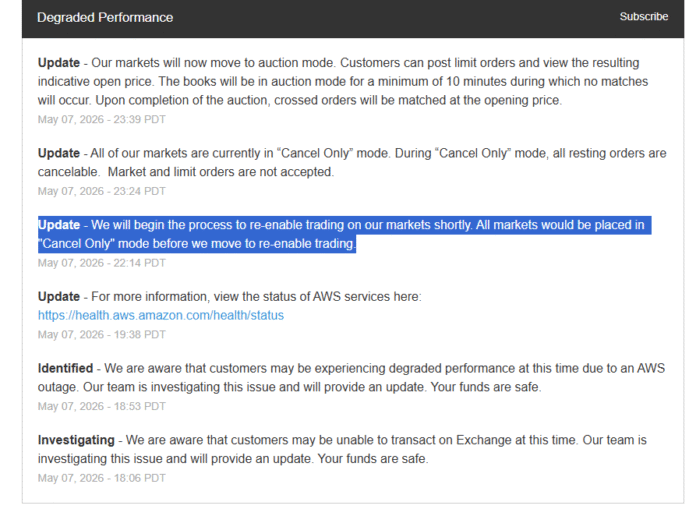
Coinbase, one of the largest crypto exchanges in the United States, experienced a trading outage lasting more than 5 hours after AWS – Amazon Web Services, reported an issue at a data center in Northern Virginia. The incident left many users unable to trade, while Coinbase’s status page also redirected users to an AWS error page.
According to updates from AWS and Coinbase, the issue was related to Availability Zone use1-az4 in the US-EAST-1 region. AWS said it was working to restore temperatures to normal levels after increasing cooling capacity, while Coinbase placed markets into “Cancel Only” mode before reopening full trading.
This was not a minor interface bug. Coinbase is one of the most important crypto trading gateways in the United States. When a cloud infrastructure issue can prevent users from trading for several hours, the story is not only “Coinbase down.” It is also about the resilience of crypto trading infrastructure in a 24/7 market.
What Is “Cancel Only” Mode?
During the recovery process, Coinbase said all markets would be placed into “Cancel Only” mode before trading was reopened. This means users could cancel existing open orders, but could not place new orders or trade as usual.
Coinbase Support wrote that the exchange would begin the process of reopening trading shortly, that all markets would be moved into “Cancel Only” mode before trading was re-enabled, and that user funds remained safe.
For regular users, “Cancel Only” may simply look like a waiting stage while the system recovers. But for traders, especially those who need to react quickly to price volatility, being unable to place new orders or exit positions at the right time can create real risk.

How Were Traders Affected?
During the outage, there was a point when the BTC chart on Coinbase appeared frozen for around 75 minutes. Some users also reported that Coinbase’s orderbook showed prices hundreds of USD higher than Binance and Hyperliquid.
https://x.com/lukecannon727/status/2052578191747772491
This is a serious issue for an exchange. If the orderbook does not reflect the real market or trading is frozen while other exchanges continue operating, traders may not be able to enter or exit positions at the right time.
For users with high leverage, the risk is not only “inconvenience.” It can become direct financial damage if they are trapped in a position while the market moves.
Many users also said they could not place orders on web, mobile, Simple Trade, and Advanced Trade. This is why the incident triggered a stronger reaction than a normal login issue: it directly affected users’ access to liquidity.
The Outage Happened While Coinbase Was Already Under Earnings Pressure
The AWS outage happened shortly after Coinbase reported weaker than expected earnings. According to Reuters, Coinbase reported a net loss of $394.1M in Q1/2026, compared with a profit of $65.6M in the same period last year. Total revenue fell to around $1.43B from $2.03B, while transaction revenue dropped 40% to $756M.
COIN shares fell around 5% in after hours trading following the report. That made this outage more sensitive: investors were already concerned about weakening trading volume, while users then witnessed a major trading disruption at a time when operational trust was being tested.
In other words, the outage was not the only reason COIN came under pressure. But it happened at a moment when Coinbase was already facing closer scrutiny over operational efficiency, AI strategy, layoffs, and its ability to maintain large scale financial infrastructure.
https://x.com/brian_armstrong/status/2051616759145185723
Why Does the AWS Outage Matter for Crypto?
This incident was not a hack, not a smart contract bug, and not an on-chain problem. It was a cloud infrastructure issue. But that is exactly what makes the story important.
Crypto is often promoted through ideas such as decentralization, 24/7 trading, and self-custody. However, most users still go through centralized gateways like Coinbase. If these gateways depend on a major cloud provider, the final trading experience can still be disrupted by a data center, a cooling system, an Availability Zone, or a failover issue.
This point is especially important because Coinbase experienced a similar incident in October 2025. In its retrospective, Coinbase said users experienced 3 hours and 17 minutes of degraded performance because of an AWS us-east-1 outage, with impacts ranging from login failures to trading issues. Coinbase said at the time that it would review its regional deployment approach to reduce the impact of similar incidents.
That is why the new incident raises a harder question: was this just an isolated incident, or is it a sign that major crypto exchanges are still not resilient enough against centralized cloud risk?

What Does Coinbase Need To Prove After This Outage?
Coinbase’s challenge is not only restoring systems after an outage. What users and investors want to see is whether trading can remain available when part of its cloud infrastructure fails.
Instead of broadly saying Coinbase needs to “diversify cloud providers,” the more important point is real failover capability.
- If one Availability Zone is affected, how quickly can the trading system, orderbook, API, and status page move to another zone?
- If a major cloud region goes down, can users still place and cancel orders?
- And if full trading cannot be maintained, does the exchange have enough protection mechanisms to prevent traders from being trapped in risky positions?
This is the longer term question after the latest Coinbase outage. User funds may still be safe, but for a 24/7 exchange, “safe” is not enough. Users also need to know they can access the market at the right time, especially during the most volatile periods.
The post Coinbase Faces Trading Outage After AWS Overheating Issue appeared first on Memeburn.