



OpenAI IPO 2026 speculation is heating up again after more than 600 current and former employees reportedly sold shares before the ChatGPT maker has gone public.
The employee cashout is the easy headline. The deeper question is whether OpenAI can justify one of the largest private-market valuations in technology history before retail investors ever get a chance to buy the stock.
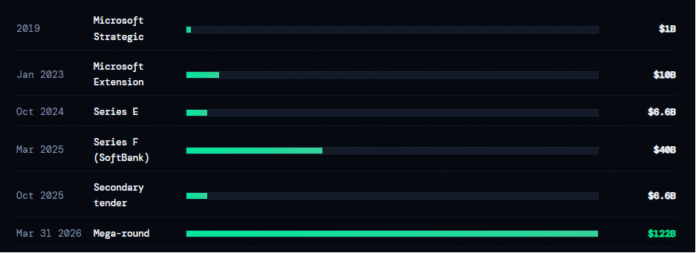
OpenAI confirmed in March 2026 that it had closed a $122 billion funding round at an $852 billion post-money valuation. The company said the capital would support AI infrastructure, product development, enterprise deployment, and wider access to its tools. OpenAI also said it is now generating about $2 billion in revenue per month, up from $1 billion per quarter at the end of 2024.
That makes OpenAI unusual. It is still private, but it is already being valued like a public mega-cap. A future OpenAI IPO would not simply be another tech listing. It would test how much public markets are willing to pay for AI growth, compute infrastructure, and platform control.

OpenAI Has No Official IPO Date Yet
OpenAI has not confirmed an official IPO date.
However, Reuters reported in October 2025 that the company was laying the groundwork for a potential IPO that could value it at up to $1 trillion. The report said OpenAI had considered filing with regulators as soon as the second half of 2026, although the timing, valuation, and fundraising plans were still preliminary.
The timeline later became more complicated. In November 2025, Reuters reported that OpenAI CFO Sarah Friar said an IPO was not in the company’s near-term plans, adding that OpenAI was focused on scaling into its size rather than rushing toward a listing.
By April 2026, the IPO discussion had returned. Reuters reported that Friar told CNBC OpenAI planned to reserve part of a future IPO allocation for individual investors, while noting that OpenAI was “gearing up” for a highly anticipated U.S. listing.
So the cleanest reading is this: OpenAI has no official IPO date, but the company is increasingly behaving like a business that may eventually need public-market access.
Why The Employee Sale Matters
The October 2025 tender offer matters because it shows that OpenAI already has deep private-market liquidity.
Reuters reported that current and former employees sold roughly $6.6 billion worth of shares in a secondary sale that valued OpenAI at about $500 billion. The deal reportedly included major investors such as Thrive Capital, SoftBank, Dragoneer, MGX, and T. Rowe Price.
The Wall Street Journal later reported that more than 600 current and former OpenAI employees participated, with some allowed to sell up to $30 million each. About 75 people reportedly sold the maximum amount.
Some newer outlet summaries have cited a valuation closer to $400 billion for the same employee liquidity event. The difference appears to depend on reporting source, timing, and valuation assumptions. Reuters’ original October 2025 report cited $500 billion, while some follow-up coverage referencing the WSJ story used approximately $400 billion.
The bigger point is not whether the tender offer was priced at $400 billion or $500 billion. It is that OpenAI employees were able to access IPO-scale liquidity before the company listed.
That changes the investment story. If OpenAI eventually goes public near a trillion-dollar valuation, retail investors may not be entering at the early stage of the AI boomI. They may be entering after private investors, employees, and insiders have already captured a large share of the upside.
OpenAI Valuation Is Now The Real IPO Question
The real debate is no longer whether OpenAI is important. It clearly is.
The debate is whether its valuation already prices in too much future success.
At $852 billion, OpenAI is valued at roughly 35 times annualized revenue, based on its own disclosure of about $2 billion in monthly revenue. That is a very rich multiple, even for a company growing at historic speed.
For comparison, the market usually gives premium software companies high revenue multiples when they have strong recurring revenue, high gross margins, and clear operating leverage. OpenAI has some of those qualities, but not all of them.
The bullish case is strong. ChatGPT has massive consumer distribution, OpenAI has growing enterprise adoption, developers are building on its APIs, and AI agents could expand the company’s market far beyond chatbots.
But OpenAI is not a normal SaaS business. Its growth depends on costly model training, inference, data centers, chips, cloud contracts, and elite AI talent. That means revenue growth alone is not enough. Public investors will want to know whether OpenAI can eventually turn scale into strong margins.
That is the central IPO question: is OpenAI a software platform with temporary infrastructure costs, or an AI utility that will always need enormous capital just to keep growing?
The Cash Burn Problem
OpenAI’s biggest risk is not demand. It is the cost of serving that demand.
Reuters reported in October 2025 that OpenAI was expected to reach about $20 billion in annualized revenue by the end of that year, but also said losses were mounting as the company funded huge AI infrastructure plans. The same report said CEO Sam Altman had indicated an IPO was likely because of the company’s capital needs.
That is the tension behind the OpenAI IPO story. The company is growing extremely fast, but each new wave of users, enterprise customers, coding agents, and API workloads can increase compute demand.
Traditional internet platforms often benefited from very low marginal distribution costs. OpenAI’s model is different. More usage can mean more inference cost. More advanced models can mean more training cost. More enterprise demand can mean more infrastructure commitments.
The bearish view is more direct: if AI usage keeps rising but compute costs do not fall fast enough, OpenAI may remain dependent on very large funding rounds for longer than investors expect.
Why OpenAI May Still Need Public Markets
OpenAI may not need an IPO for brand recognition. It already has one of the strongest brands in technology.
But it may need public markets for capital.
AI infrastructure is becoming one of the most expensive investment races in tech history. Training frontier models, expanding inference capacity, building data center access, and securing chips all require huge funding.
Reuters’ October 2025 report said OpenAI was preparing for a potential IPO partly because of these rising capital needs, and that the company could seek to raise at least $60 billion initially.

A public listing could help OpenAI raise more capital, create a liquid acquisition currency, provide broader employee liquidity, and give investors more transparency.
That last point is important. Public markets would force OpenAI to disclose much more about revenue mix, gross margin, losses, cloud commitments, governance, and risk factors. Those details are exactly what investors need before assigning a valuation near $1 trillion.
What Investors Should Watch Next
The next OpenAI IPO signal will not just be another valuation headline.
Investors should watch for a confidential or public S-1 filing. That would give the market its first serious look at OpenAI’s financials.
They should also watch revenue quality. OpenAI’s $2 billion monthly revenue figure is impressive, but the market needs to know how much comes from consumer subscriptions, enterprise contracts, API usage, coding tools, licensing, and newer products.
Gross margin will be even more important. If OpenAI can show that inference costs are falling and enterprise revenue is scaling profitably, its valuation becomes easier to defend. If costs rise too closely with usage, the IPO case becomes harder.
Governance is another major issue. OpenAI’s structure is unusual because it grew out of a nonprofit research mission while building a massive for-profit business. Public investors will want clarity on control, profit rights, foundation ownership, and long-term decision-making.
Finally, investors should watch competition. If Anthropic, Google, Grok, Meta, or open-source AI models pressure pricing or pull enterprise customers away, OpenAI’s revenue multiple could face compression before it even lists.
Conclusion
The OpenAI IPO 2026 story is not really about whether employees became rich before the company went public. That already happened. The more important question is whether OpenAI can grow into the valuation private markets have already assigned to it.
At $852 billion, OpenAI is priced like a future pillar of the global technology economy. Its revenue growth is extraordinary, and its consumer reach is difficult to ignore.
But the company also faces heavy compute costs, rising competition, governance questions, and pressure to prove that AI demand can become durable profit. That makes a future OpenAI IPO both exciting and difficult to value.
The post OpenAI IPO 2026 Speculation Grows After $6.6B Employee Sale appeared first on Memeburn.