



Bitcoin has surged more than 37% since early April, breaking back above $80,000 and briefly touching $82,000 in early May. That marks its highest level since late January. After a punishing Q1 that saw BTC slide from its October 2025 all-time high near $128,000 down to the $60,000 range, the world’s largest cryptocurrency is showing renewed strength, driven by spot Bitcoin ETF inflows, corporate accumulation, and a deepening supply squeeze.
But is this bitcoin price rise sustainable, or is it just a bear market bounce?
Record-Breaking Bitcoin ETF Inflows in 2026
The biggest catalyst behind this move has been the return of institutional money through spot Bitcoin ETFs.
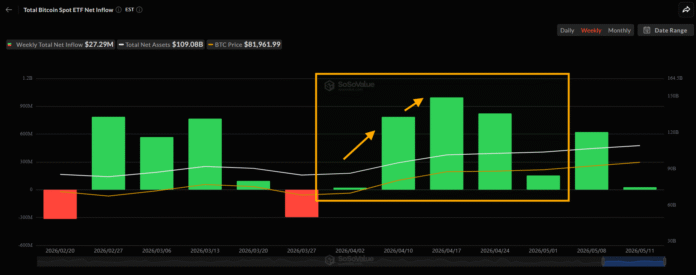
April 2026 closed as the strongest month of the year. U.S.-listed spot Bitcoin ETFs drew $1.97 billion in net inflows according to SoSoValue data, nearly 44% above March’s $1.37 billion and sharply reversing Q1’s heavy outflows. Much of that total came from a nine-day consecutive inflow streak in the second half of April.
The momentum has carried into May:
- May 1 recorded $629 million, one of the strongest single-day prints of the year
- May 4 added $532 million, with BlackRock’s IBIT pulling $335 million and Fidelity’s FBTC contributing $185 million
- A six-week inflow streak starting April 2 has now absorbed nearly $3.4 billion in fresh capital
BlackRock’s iShares Bitcoin Trust (IBIT) continues to dominate the market. IBIT captured roughly 70% of all Bitcoin ETF inflows in April, with cumulative flows now at $66.1 billion. That makes it one of the most successful ETF launches in financial history.

Why Do Bitcoin ETF Flows Matter So Much?
ETF inflows represent real spot buying, not leveraged speculation. When capital enters these funds, issuers must purchase actual Bitcoin to back the shares, directly removing BTC from circulating supply.
The scale is staggering. In April, spot Bitcoin ETFs absorbed approximately 19,000 BTC over nine days, roughly nine times the amount mined in that same period. With daily mining output at just 450 BTC after the 2024 halving, ETF demand now vastly outpaces new supply creation.
Cumulative net inflows since the January 2024 launch have surpassed $58 billion, positioning these products among the most successful ETF categories ever.
Strategy Keeps Stacking Bitcoin
Corporate treasury buying continues adding fuel to the rally.
Michael Saylor’s Strategy (formerly MicroStrategy) holds 818,869 BTC as of May 12, 2026, acquired for roughly $61.86 billion at an average cost of about $75,540 per coin. Even after a significant Q1 net loss, the company purchased another 535 BTC for $43 million on May 12.
In a May 2026 research note, JPMorgan analysts led by Nikolaos Panigirtzoglou projected that Strategy’s 2026 purchases could reach $30 billion by December if the current pace holds. The firm now holds roughly 3.9% of Bitcoin’s total maximum supply, making its accumulation a meaningful force in tightening available liquidity.

Bitcoin Exchange Reserves Hit Multi-Year Lows
Perhaps the most structurally bullish signal is the ongoing decline in exchange reserves.
On-chain data shows Bitcoin held on centralized exchanges has fallen to approximately 2.69 million BTC. That is down 170,000 BTC over six months and sits near levels not seen since 2018.
Key details:
- Binance, OKX, and Gemini have lost roughly 100,000 BTC from reserves since February 2026
- Coins are moving to private wallets, cold storage, and ETF custody rather than being held for trading
- Whale wallets (1,000+ BTC) have grown by 142 addresses over six months
When exchange reserves decline, it typically signals holders are choosing long-term storage over selling. Combined with ETF demand absorbing 15,000 to 20,000 BTC per week, the tradeable supply is shrinking rapidly. Many analysts now describe this dynamic as a bitcoin supply crunch.
What Could Threaten the Rally?
Despite bullish momentum, several risks remain.
Another short-term signal to watch is whether old Bitcoin whales are starting to move coins again, especially after a Bitcoin OG moved $41 million in BTC following 12 years of dormancy.
Strategy’s role in this rally also matters because Michael Saylor recently explained how MSTR could pay dividends without selling Bitcoin, reinforcing the idea that its BTC stack may stay off the market.
CryptoQuant’s Head of Research has cautioned that realized profit levels remain far below bull market norms. The current 30-day realized profit of 20,000 BTC is well short of the 130,000 to 200,000 BTC range seen in confirmed bull cycles. He described the move as a “bear market rally” rather than a new uptrend.
Other warning signs include:
- Rising profit-taking. Daily realized profits hit 14,600 BTC on May 4, the highest since December 2025
- Leveraged positioning. Perpetual futures demand, rather than fresh spot accumulation, is driving much of the buying
- Hot inflation data. April CPI rose 3.8% year-over-year, keeping rate cut expectations in check
- Mixed sentiment. Whale sentiment remains in “Fear” even as price indicators flash “Greed”
This disconnect between price action and underlying sentiment suggests Bitcoin could face a correction if leveraged positions unwind near the $82,000 to $85,000 resistance zone.

What Comes Next for Bitcoin Price?
BTC is trading around $80,500, holding key support after briefly touching $82,000 earlier this month. The next major resistance sits at $85,000, aligning with the 200-day exponential moving average.
The bull case rests on continued ETF inflows, corporate accumulation, and a structural supply squeeze that shows no signs of slowing. The bear case highlights overleveraged futures, rising realized profits, and macroeconomic uncertainty.
What’s undeniable is that the bitcoin price rise in 2026 is fundamentally different from past rallies. Institutional capital, regulated financial products, and corporate treasury strategies have reshaped how demand flows into the market. Whether this translates into a sustained recovery or proves to be a temporary reprieve will depend on how these forces balance out in the weeks ahead.
The post Why Is the Bitcoin Price Rising? Supply Crunch Fuel BTC’s 2026 Rally appeared first on Memeburn.