


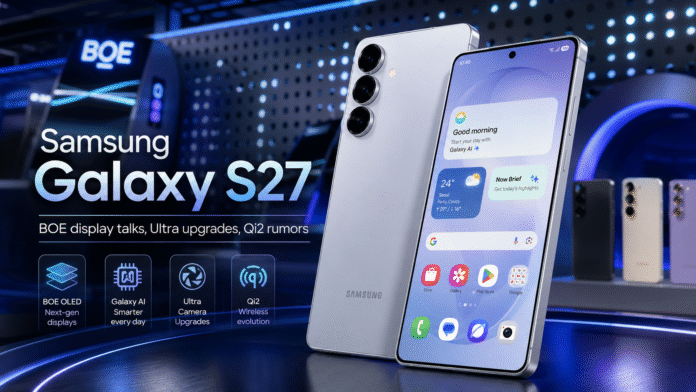
The Samsung Galaxy S27 is shaping up to be one of the most talked-about smartphones of 2027, and Samsung has not said a single official word about it yet. With the Galaxy S26 series barely two months old, supply chain reports and leaker claims are already offering a glimpse at what may come next.
Important note: Samsung has not officially announced the Galaxy S27 series. All details in this article are based on early industry leaks, supply chain reports, and analyst speculation. Specific features, pricing, and timelines may change significantly before any official announcement.
When Will the Samsung Galaxy S27 Come Out?
Samsung typically reveals its Galaxy S flagships in the first quarter of each year. The Galaxy S26 series was unveiled on February 25, 2026, and went on sale March 11, so a similar window, likely February 2027, seems reasonable for the Galaxy S27. Wednesdays in February 2027 fall on the 17th and the 24th, making those the most probable dates for a Galaxy Unpacked event if Samsung sticks to its pattern.
There is also early speculation about a Samsung Galaxy S27 Pro joining the lineup. ETNews first reported in April 2026 that Samsung plans to add a fourth model positioned between the S27 Plus and S27 Ultra, featuring Ultra-level specs without the S Pen. However, it is worth noting that similar rumors about a Galaxy S26 Pro surfaced last year and never materialized, and the Galaxy S25 Edge, Samsung’s previous attempt to expand the S-series lineup, saw disappointing sales. This rumor should be taken with a grain of salt until stronger evidence emerges.
Why Samsung May Use BOE Displays, and What It Means for the Galaxy S27 Price
The most significant story around the Samsung Galaxy S27 right now is not about what is being added, but about what might be cut.
According to a SigmaIntel report cited by ZDNet Korea, Samsung is reportedly in discussions with Chinese panel maker BOE about supplying OLED screens for the standard Galaxy S27. If this happens, it would mark the first time a non-Samsung Display panel has appeared in a Galaxy S flagship device.
The Economics Behind the Decision
The driving force is cost pressure. Rising DRAM and storage prices, fueled by surging demand from AI data centers, have squeezed margins across the smartphone industry. According to Gadget Hacks, a TrendForce analysis pointed to skyrocketing memory costs as the dominant risk factor hanging over the entire smartphone display supply chain in 2026. Samsung Display’s own president also warned that market conditions were unfavorable and could worsen in the second half of the year.
The Galaxy S26 already launched at $899 for the base model, representing a price hike over the S25. Samsung appears to be looking for ways to avoid yet another increase with the S27 generation.
Here is the twist that makes Samsung’s situation unusual: Samsung’s mobile division does not receive any internal discount on display panels. Because the phone-making arm and the display arm operate as independent business units, Samsung MX ends up paying the same market rate as any outside customer. As Phandroid noted, BOE is able to manufacture OLED panels at a noticeably lower price point, which makes the cost-saving argument hard to ignore even if the branding implications are uncomfortable for Samsung.

Will the Samsung Galaxy S27 Screen Quality Suffer?
This is where things get nuanced. BOE panels have historically trailed Samsung Display on brightness and power efficiency, though Android Authority reports the gap has narrowed considerably in recent years. The base Galaxy S27 is also expected to continue using M13 OLED material, the same generation found in the current Galaxy S26, rather than the newer M14 material reserved for the Ultra.
That said, several factors could soften the impact. According to PhoneArena, Samsung would reportedly hold BOE to stricter quality standards than it applies to mid-range supply. And critically, this potential change would only apply to the standard Galaxy S27. The S27 Plus and S27 Ultra are expected to retain Samsung Display panels.
There is also the possibility that BOE panels may only appear in certain regional markets rather than across the entire global production run. The practical impact on any individual buyer will not be clear until teardown reports confirm the panel sourcing after launch.
Another complication worth watching: if BOE begins supplying Galaxy S flagship panels, it could weaken Samsung Display’s exclusive negotiating position with major clients like Apple. This internal corporate dynamic may ultimately prevent the deal from going through, even if the cost savings are attractive on paper.
Samsung Galaxy S27 Ultra Camera: Finally, a Meaningful Upgrade?
While the base model’s display has dominated headlines, the Samsung Galaxy S27 Ultra camera rumors have generated real excitement among photography enthusiasts. The Ultra’s main camera hardware has remained essentially unchanged since the Galaxy S23 Ultra launched in 2023, so any meaningful sensor upgrade would be long overdue.
A New 200MP Sensor With LOFIC Technology
Multiple credible leakers point to a new main sensor. According to Gizchina, leaker Ice Universe confirmed Samsung is developing a 200MP sensor called the ISOCELL HP6 featuring LOFIC (Lateral Overflow Integration Capacitor) technology. LOFIC captures highlight detail that conventional sensors discard in high-contrast scenes by routing overflow electrons into a dedicated capacitor, resulting in significantly better dynamic range.
Separately, tipster Digital Chat Station has suggested a potentially larger ISOCELL HPA sensor at 1/1.12 inches, as PhoneArena reported. Ice Universe believes Samsung may use a modified version, the HP6 at 1/1.3 inches, that retains the larger sensor’s performance characteristics. It is still unclear which sensor, if either, will make it into the final product.
Fewer Cameras, but Possibly Better Ones
Ice Universe has also indicated that the Galaxy S27 Ultra may drop the 3x telephoto camera, potentially moving from four rear cameras to three. Whether Samsung replaces it with a different focal length or consolidates around the existing 5x periscope telephoto remains unclear.
Additionally, leaker Smart Pikachu claims the new main sensor may feature variable aperture, a technology Samsung last used on the Galaxy S9 in 2018. If true, this would allow the lens to physically adjust its opening size for better low-light shots and more natural depth-of-field effects.
The front camera is also tipped for an upgrade, with multiple sources pointing to a 24MP selfie sensor with improved autofocus, a significant jump from the current 12MP unit.
None of these camera changes have been confirmed by Samsung. The sensor details come primarily from supply chain analysis and well-known leakers whose track records are strong but imperfect, so the final camera configuration could look quite different.

Samsung Galaxy S27 Specs: Early Chip, Storage, and Battery Rumors
It is still very early for concrete hardware details, and much of what has surfaced falls into the category of educated speculation rather than hard leaks. Here is what the rumor landscape looks like so far.
Processor and Storage
The Galaxy S27 series is widely expected to continue Samsung’s regional chipset strategy. The S27 and S27 Plus may ship with the Exynos 2700 in most markets and the Snapdragon 8 Elite Gen 6 in the United States, with the Ultra likely using the Snapdragon chip globally.
Tipster Digital Chat Station has also mentioned a more powerful Snapdragon 8 Elite Gen 6 Pro variant with LPDDR6 RAM support and a larger GPU cache, according to Tech Advisor. Some early speculation has attached ambitious clock speed figures to this chip, but these performance claims are unverified and should be treated as highly preliminary. It has not been confirmed whether the S27 Ultra would use this Pro variant.
On the storage side, Sammy Fans reported that Samsung may introduce UFS 5.0 with the Galaxy S27 series. The report suggests this could be limited to premium models, though exactly which models would qualify remains unclear. As Notebookcheck noted, no smartphones currently use UFS 5.0, and competing Android brands may adopt the standard before Samsung does.
Battery and Charging
The Galaxy S27 Ultra is tipped for a 5,500mAh silicon-carbon battery, representing a 10% increase over the S26 Ultra’s 5,000mAh cell. Silicon-carbon technology allows higher energy density in a similar physical footprint, which would help Samsung close the gap with Chinese competitors that have already pushed past 6,000mAh and beyond.
Across the entire lineup, one of the most anticipated upgrades is Qi2 magnetic wireless charging. This feature was widely rumored for the S26 but did not make the cut, leaving Samsung at a disadvantage against the Pixel 10 series and iPhones that already support magnetic charging.
Samsung’s recent One UI 8.5 rollout also gives an early clue to where the Galaxy S27 software experience may go, with heavier Galaxy AI features, refreshed visuals, and stronger cross-device integration.

Samsung Galaxy S27 Design: A Horizontal Camera Layout?
Early prototype reports suggest Samsung may be testing a horizontal camera layout for the S27 series. Leaker Ice Universe shared a speculative render on X showing this concept for the S27 Ultra, reminiscent of the Galaxy S10’s design language from 2019.
The motivation appears functional: repositioning the cameras would free up space on the rear panel for a Qi2 magnetic ring and eliminate the table-wobble that the current off-center vertical camera bump causes.
That said, it is important to emphasize that this remains at the prototype stage. No actual design leak for the Galaxy S27 has emerged yet. Samsung could easily settle on an entirely different direction before production begins. The speculative renders circulating online are just that: speculation.

Should You Wait for the Samsung Galaxy S27?
If you are not in urgent need of a new phone, waiting could be worthwhile, especially for the Ultra model. A new camera sensor with LOFIC technology, a silicon-carbon battery, and a next-generation processor would represent a more substantial generational leap than the S26 offered over the S25.
For the standard Galaxy S27, the outlook is more mixed. The potential BOE display sourcing and continued M13 OLED material suggest Samsung is prioritizing cost management at the base tier. If screen quality is your top priority, the S27 Plus or Ultra may justify the premium, though pricing details are still completely unknown.
The post Samsung Galaxy S27: Release Date, BOE Display Controversy, Rumored Specs appeared first on Memeburn.