


After years of speculation, patents, and prototype leaks, the foldable iPhone appears to be getting closer. Apple is expected to unveil its first folding smartphone later this year, in what Bloomberg’s Mark Gurman has described as the most significant overhaul in iPhone history. Whether the device is eventually called the iPhone Fold, iPhone Ultra, or something else entirely, it could reshape the premium smartphone market and put Apple in direct competition with Samsung’s established Galaxy Z Fold lineup.
Here is everything currently known about when the foldable iPhone could launch, what it may look like, how much it may cost, and why Apple took so long to enter the foldable phone market.
When Will Apple Release a Foldable iPhone?
The foldable iPhone release date is one of the most anticipated timelines on the 2026 tech calendar. According to Bloomberg, Apple’s foldable phone remains on track for a September 2026 introduction alongside the iPhone 18 Pro and iPhone 18 Pro Max, making it part of Apple’s major fall hardware event.
However, the exact shipping date remains uncertain. According to MacRumors, Barclays analyst Tim Long suggested that the folding iPhone will likely ship in December, a couple of months after the expected September announcement.
Reports from DigiTimes indicate that mass production has been pushed back from June to August, which could lead to limited availability at launch. Apple analyst Ming-Chi Kuo has also warned that production challenges could cause shortages extending well into 2027, meaning early adopters may need to pre-order as soon as possible.
Especially in the recent context, rumors that Apple’s AI AirPods could launch soon with built-in cameras have made Apple fans even more excited.

iPhone Fold or iPhone Ultra? The Naming Debate
For years, the tech community referred to this device as the iPhone Fold. More recent leaks, however, suggest Apple may choose the iPhone Ultra name instead. Mark Gurman reported in early 2026 that the foldable will sit among Apple’s “Ultra” products, while Chinese leaker Digital Chat Station claimed the official name will indeed be iPhone Ultra.
This branding would make sense. The “Ultra” label already represents Apple’s highest-end tier across the Apple Watch Ultra and M-series Ultra chips. Positioning the foldable above even the Pro Max would signal a new premium category rather than simply following Samsung’s naming convention. The official name remains unconfirmed, but momentum behind the iPhone Ultra branding continues to build.
Apple Foldable iPhone Design: A Unique Book-Style Form Factor
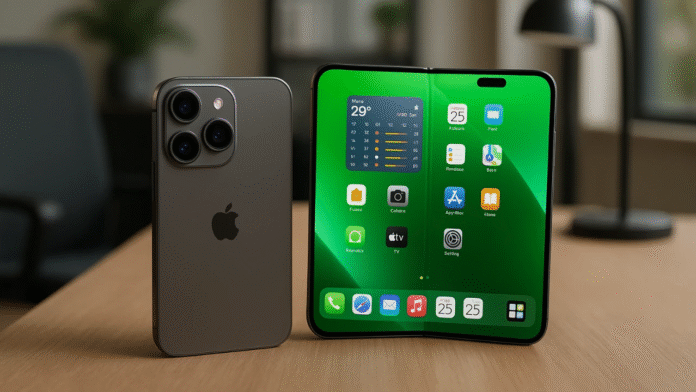
Unlike Samsung’s taller and narrower Galaxy Z Fold series, Apple has reportedly chosen a wider and shorter book-style design that resembles a passport when closed. When folded, the foldable iPhone is expected to feature an outer display of approximately 5.3 to 5.5 inches.
According to MacRumors, when unfolded, the inner display expands to roughly 7.7 to 7.8 inches with a 4:3 aspect ratio, making it feel closer to an iPad mini than a stretched-out phone screen.
Dummy units shared by leaker Sonny Dickson and tech YouTuber Vadim Yuryev appear to support this wide, book-like form factor. Side-by-side comparisons with the Galaxy Z Fold 7 show how different Apple’s approach could be, with a noticeably shorter and wider design that prioritizes a more tablet-like experience when opened.
The frame is rumored to combine titanium for structural rigidity with aluminum for heat dissipation and weight management. When unfolded, the device reportedly measures just 4.5mm thick, which could make it the thinnest iPhone ever. Its folded thickness is expected to sit at approximately 9 to 9.5mm.

The Crease-Free Display: Apple’s Biggest Breakthrough
The visible crease down the center of foldable screens has been one of the biggest complaints among foldable users, and Apple has reportedly made eliminating it a top priority. According to supply chain analyst Ming-Chi Kuo, Apple pursued crease elimination “regardless of cost,” developing new material properties that could make the fold line nearly invisible.
The technology reportedly combines Samsung Display’s laser-drilled metal support plate, stress-dispersing components from South Korean supplier Fine M-Tec, and ultra-thin glass from Lens Technology using Corning raw materials.
According to TrendForce, advances in optically clear adhesive, or OCA, also play a crucial role. Modern formulations can stay pliable during bending while stiffening under sudden impact for structural support. Production specifications reportedly call for a crease depth under 0.15mm and a crease angle under 2.5 degrees.
Foldable iPhone Specs: What to Expect Under the Hood
The expected Apple foldable iPhone specs suggest a device that makes deliberate trade-offs to achieve its ultra-thin design. According to Macworld, the device will run:
- Apple’s A20 chip with 12GB of RAM.
- Storage options of 256GB, 512GB, and 1TB.
- Battery capacity is rumored to range between 5,000 and 5,800 mAh using silicon-carbon anode technology, which would be significantly larger than the Samsung Galaxy Z Fold 7’s 4,400 mAh cell.
The camera system is one of the most notable compromises. The foldable iPhone is expected to feature a dual 48MP rear camera setup with no telephoto lens, putting it behind Samsung’s triple-camera system in terms of versatility. Apple is likely betting on computational photography to close the gap, but for users who rely on optical zoom, this would be a real sacrifice.
Another expected trade-off is biometric authentication. The foldable iPhone will reportedly use Touch ID through a side-mounted power button rather than Face ID, since the TrueDepth camera system requires too much internal space for the thin chassis.

Foldable iPhone Colors: Only Two Options at Launch
According to GSMArena, Apple is taking a conservative approach to color options for its first foldable. The device is expected to launch in only two colors: white and one additional “subdued color,” likely silver or navy blue.
This aligns with earlier reporting from Mark Gurman, who indicated that the foldable iPhone would arrive in dark gray or black and white or silver. For a first-generation product with complex manufacturing requirements, limiting color SKUs makes practical sense, even if it disappoints fans hoping for more options.
How Much Will the Foldable iPhone Cost?
The foldable iPhone price remains debated, but estimates are narrowing. According to PhoneArena, the most credible reports point to a starting price of approximately:
- $1,999 for 256GB
- $2,199 for 512GB
- $2,399 for 1TB.
That would put it in direct competition with the Samsung Galaxy Z Fold 7, which starts at the same $1,999 entry point. Some analysts expect a higher price, with Barclays’ Tim Long projecting $2,299 and Ming-Chi Kuo earlier suggesting a range of $2,000 to $2,500. Regardless of where the final price lands, Apple’s foldable iPhone is expected to be the most expensive iPhone in the 2026 lineup.
Foldable iPhone vs Samsung Galaxy Z Fold: How Do They Compare?
With Samsung preparing the Galaxy Z Fold 8 for a July 2026 launch, the foldable smartphone market is about to face its biggest competitive shift yet.
Samsung’s advantages include its triple-camera system with a 200MP main sensor, seven generations of foldable software refinement, and an earlier launch date. According to Tom’s Guide, the Galaxy Z Fold 8 may also introduce a “Wide” variant that directly responds to Apple’s wider form factor.
Apple is expected to counter with crease-free display technology, a larger battery, faster A20 silicon, and tight hardware-software integration. The foldable iPhone will reportedly run iOS with iPad-style app layouts, split-screen multitasking, and smooth transitions between displays.
However, this would still be version 1.0 of Apple’s foldable software competing against Samsung’s years of iteration. TrendForce estimates that Apple could capture close to 20% of the foldable market in its first year, compressing Samsung and Huawei to roughly 30% each.
Recently, Samsung’s One UI 8.5 update was also released, improving the performance of Samsung phones.

What Comes Next for Apple’s Foldable Lineup?
Apple’s late entry into the foldable market appears to reflect deliberate patience rather than reluctance. The company has reportedly researched foldable technology since at least 2017 but refused to ship a product until it could solve the fundamental problems that have kept foldables niche, including display creasing, durability concerns, and design compromises.
According to AppleInsider, Apple is already planning a second-generation foldable iPhone for 2027 and exploring foldable iPads and MacBooks with foldable OLED displays. The company is also testing a flip-style clamshell design that could eventually compete with Samsung’s Galaxy Z Flip lineup. The foldable iPhone launching in 2026 may be just the beginning of an entirely new product category for Apple.
Should You Wait for the Foldable iPhone?
If you are already invested in the Apple ecosystem and want an iPad-like experience in your pocket, the foldable iPhone could be worth the wait. The combination of a crease-free display, Apple silicon performance, and deep iOS integration is unlikely to be matched easily by Android competitors.
However, if camera versatility is your top priority or you want a foldable right now, the Samsung Galaxy Z Fold 7 remains an excellent choice that is already available. The foldable iPhone represents one of Apple’s most ambitious hardware projects in years, and consumers will find out whether it delivers when it finally lands in their hands later this year.
The post Foldable iPhone: Everything We Know About Apple’s First Folding Smartphone in 2026 appeared first on Memeburn.