



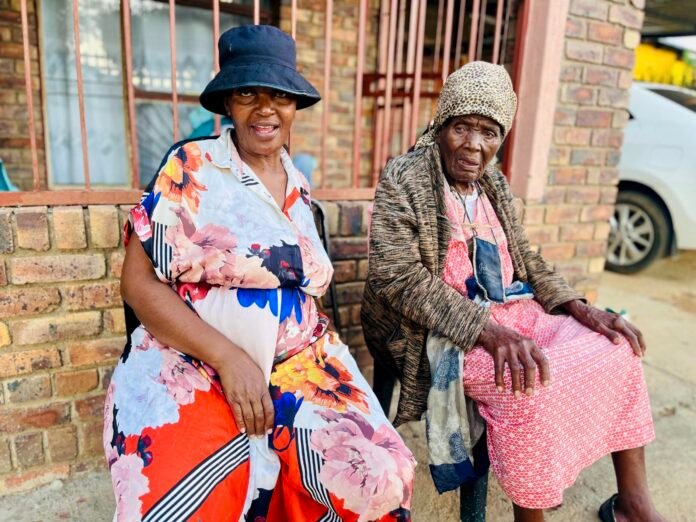
Violet Ramadimetsa recently reached an important milestone. She marked her 110th birthday on Sunday, 12 April 2026. But for her daughter, Elsie Maluleka (60), the celebration comes with a heartfelt plea: help her mother live with dignity.
Maluleka is more than a daughter. She is a caregiver, interpreter, and constant companion, assisting her mother with everything from meals to handing her a walking stick and chair.
A life well lived
Ramadimetsa has lived an extraordinary life.
She recalls serving as a messenger during World War II. “I was a foot soldier, running between command posts under heavy fire to deliver handwritten messages,” she tells Health-e News. “I hid them under my clothes. It was dangerous, but we had to do it.”
She also remembers surviving a devastating locust invasion that destroyed crops and led to widespread hunger. “We lived off trees and ate anything that was not poisonous,” she says.
Born in Bohom village in Limpopo in 1916, Ramadimetsa later moved to Polokwane, where she met her husband. The couple eventually settled in Pretoria before his death in 1975 forced her to return to Limpopo, where she lived independently for decades.
“I’ve always done things for myself; cooking, cleaning, washing. I don’t like people interfering,” she says.
But today her life looks very different. She moved in with her daughter in Hammanskraal, north of Pretoria, earlier this year. Over the past two years, her mobility has become severely impaired; she uses a chair or broomstick for support and balance. Her hearing has deteriorated, making it difficult for her to communicate effectively.
Despite these challenges, Ramadimetsa is determined to maintain her independence, especially when it comes to her personal hygiene, which is her primary priority.
Secret to a long life
According to Statistics South Africa (Stats SA), the average life expectancy for women in the country is 69 years. Ramadimetsa has far surpassed this age.
So what’s the secret to her longevity?
“My secret to long life is staying pure,” she says. “After my husband died, I remained celibate. I don’t share my personal plate, bathing tub, and cutlery with anyone; I use my own things.”
She is also particular about her diet, avoiding salt, oil, spices, and tea. “My body reacts. I struggle to breathe if I eat certain foods. I prefer simple meals and warm water with a bit of sugar,” she explained.
“I exercise by going to the toilet by myself, I don’t like a wheelchair, I prefer walking sticks, so that I can stretch my back.”
Ramadimetsa believes her longevity is rooted in the natural diet of her youth.
“We ate raw food fresh from the ground, raw tomatoes, potatoes, carrots, beetroot, and lots of greens. Sorghum, fresh milk from livestock. Meat was for special occasions.”
Life changes
Maluleka says her mother lived alone in Limpopo for years, with family visiting periodically. But safety concerns earlier this year forced a change.
“After hearing about a break-in nearby, I insisted she move here,” she says. “It wasn’t easy because she’s very independent. But she eventually agreed.”
For Maluleka, one of the most painful challenges is her mother’s hearing loss.
“She used to be very talkative, always sharing stories,” Maluleka says. “Now people get frustrated and raise their voices when she can’t hear. It’s heartbreaking because they don’t understand.”
Maluleka bought her a birthday cake weeks in advance, something she had never had before.
“My mother never celebrated her birthday,” Maluleka says. “I want the community to celebrate her while she’s still alive.”
She is appealing to local businesses and community members to help provide basic assistive devices, including crutches and hearing aids, to improve her mother’s quality of life.
“I know she is old, but I am not ready to lose her.”
Limited support for elderly care
According to the City of Tshwane, the Community and Social Development Services Department has a “Healthy Lifestyle Programme” that’s implemented through non-profit organisations (NPOs) that work with the elderly.
The initiative focuses on promoting physical activity, proper nutrition, disease prevention, and awareness of age-related conditions.
“The city does not have assistive devices to support Violet’s care and mobility needs,” spokesperson Lindela Mashigo says. “However, her case can be better handled by the Health Department, which has clinics that render rehabilitation services and offer assistive devices.”
The Department of Health did not respond to our query.
“The city does not offer home-based care services but is working hand in hand with NPO’s that render these services,” Mashigo adds
The family is encouraged to seek assistance from NPO’s that provide home-based care services in the community.”
Mashigo said the city would arrange a visit by the city’s Social Worker for a possible intervention. This visit has not taken place yet. – Health-e News