



Central Asian leaders gather at first ever regional ecological summit to discuss water crisis

ASTANA
–
Copyright
Copyright 2008 AP. All rights reserved.
22/04/2026 – 9:47 GMT+2
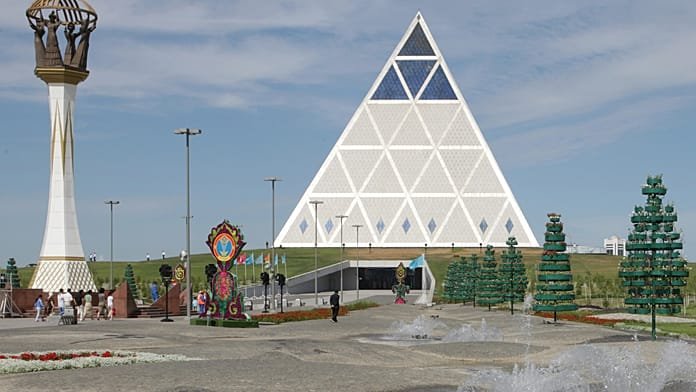
The Regional Ecological Summit kicks off today in Astana.
With rising temperatures threatening the population’s health and degraded land putting millions at risk of food shortages, Central Asia has more than enough reasons to prioritise the environment.

ADVERTISEMENT
ADVERTISEMENT
The first ever Regional Ecological Summit (RES) will bring the region’s governments together, with the aim of establishing a roadmap that turns commitments into concrete climate action while fostering deeper regional cooperation.
RES kicks off today in Astana, Kazakhstan’s capital, and runs until Friday.
“At present, Central Asian countries often operate in isolation, even as these challenges call for a coordinated approach,” says Yerlik Karazhan, CEO of the Central Asia Climate Foundation.
The summit was first proposed by Kazakhstan President Kassym-Jomart Tokayev at the UN General Assembly three years ago. He extended the invitation during his speech at the Third UN Conference on Landlocked Developing Countries, in Avaza, Turkmenistan last year.
“I believe that climate action should remain balanced and inclusive matching the legitimate development needs of nations. To strengthen our joint climate efforts, I invite all of you to take part at the regional ecological summit to be held in Astana in partnership with the United Nations in April next year”.
The summit is expected to bring policymakers together at more than 60 thematic sessions and events.
Water will be top of the agenda at Kazakhstan’s Regional Ecological Summit
Finding ways to ensure water security will be top of the agenda.
The dried out Aral Sea, located between Uzbekistan and Kazakhstan, has been called “the poster child for environmental catastrophe.”
Once the fourth-largest inland body of water in the world, the sea has lost more than 90 per cent of its volume since the 1960s after river diversion projects redirected the Amu Darya and Syr Darya for large-scale irrigation. What was once a vast fishing economy has largely become a desert.
But thanks to restoration efforts which started with a dam built by Kazakhstan in 2005, the situation in the North Aral Sea is looking more hopeful.
According to a report from February this year, the volume of water in the Northern Aral Sea has increased to 24.1 billion cubic metres from 2023 to the present.
Data from the World Bank shows that the water level in Northern Aral Sea is now 50 per cent higher than at its lowest point some years ago.
The region is also grappling with the rapid decline of the Caspian Sea, where water levels are falling by around ten centimetres per year, posing risks to biodiversity and international shipping routes.
A new UN water agency could be established at the Regional Ecological Summit
President Tokayev will hold talks on the sidelines of the summit in the hope of establishing an international water organisation.
He proposed the idea at a forum marking the International Year of Peace and Trust and the 30th anniversary of Turkmenistan’s permanent neutrality in December last year. Speaking in Ashgabat, Tokayev noted that “there is currently no specialised UN agency focused exclusively on water.”
Ahead of the summit, Tokayev also met with the UN Secretary-General’s Special Envoy on Water, Retno Marsudi, at the Akorda, stressing the need to “build a more effective system of international cooperation in the water sector.”
He added that water resources are of strategic importance for Kazakhstan, directly linked to sustainable development, environmental security and regional stability, according to the presidential press office.
The climate crisis is a serious risk to Central Asia
Since its inception, the summit’s agenda has expanded beyond climate change to address a broader range of environmental challenges facing the region.
Central Asia is experiencing some of the world’s most acute climate risks, with average annual temperatures rising faster than the global average — from an increase of around +2.1C in Kyrgyzstan to as much as +1.5C in Turkmenistan over the past 115 years.
The consequences are already visible. According to UNESCO, glacier coverage in Kyrgyzstan has shrunk by 16 per cent over the past 70 years, while in Tajikistan more than a thousand glaciers have disappeared over the last three decades.
More than 20 per cent of the region’s land — roughly 80 million hectares — is degraded, affecting around 30 per cent of the population.
Green financing will also be on the agenda
Leaders from across Central Asia are expected to adopt a joint declaration at the Regional Ecological Summit, which will serve as its key outcome document.
“The upcoming summit will be a key platform for the region to assert its voice and demonstrate its readiness to tackle environmental challenges,” said Mansur Oshurbaev, Kazakhstan’s Vice-Minister of Ecology and Natural Resources.
Alongside the political agenda, the summit is also expected to outline green financing needs for each country, support adaptation efforts, and accelerate the deployment of low-carbon technologies.
In Kazakhstan’s case, signed agreements are expected to channel more than €1.5 billion in investment, according to Oshurbaev.
By linking shared challenges with collective action, organisers say the summit could strengthen both environmental cooperation and economic resilience across Central Asia.