


US Treasury Secretary Bessent says Gulf, Asian allies request swap lines
Bessent has pushed back on allegations that the Trump family’s financial ties with UAE are driving the decision to offer a swap line.
Save


Published On 22 Apr 202622 Apr 2026
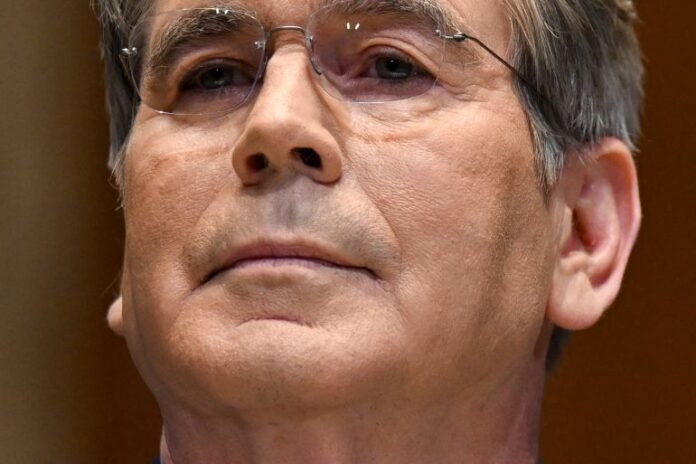
United States Secretary of the Treasury Scott Bessent has said that several allies in the Gulf region and Asia have requested currency swap lines from the US to help them with the energy shocks and other fallout from the US-Israel war on Iran.
Bessent told US senators on Wednesday that both the US and the United Arab Emirates would benefit from a proposed swap line – the act of central banks exchanging currency to provide liquidity that can stabilise markets in times of economic uncertainty – that US President Donald Trump said he was considering on Tuesday.
Recommended Stories
list of 4 itemsend of list
Bessent did not name the countries making such requests, but told a US Senate Appropriations Committee budget hearing that such facilities would help stabilise financial markets amid turmoil from the war.
“And swap lines, whether it’s from the Federal Reserve or the Treasury, are to maintain order in the dollar funding markets and to prevent the sale of the US assets in a disorderly way,” Bessent said. “So, the swap line would benefit both the UAE and the US, and, as I said, numerous other countries, including some of our Asian allies, have also requested them.”
The US Treasury last October provided Argentina with a $20bn currency swap to help stabilise the country’s peso during a tumultuous election period, which helped strengthen the position of President Javier Milei’s party.
The swap line, backed by the Treasury’s $219bn Exchange Stabilization Fund, provided Argentina with a safety net of dollars that the central bank could use to help prop up the value of the peso and prevent a devaluation ahead of the vote. It has since been repaid.
Advertisement
Trump ties
Democrats on the committee pushed back on Bessent’s claims. Senator Chris Van Hollen of Maryland argued that such a move would put pressure on US consumers.
“In addition to lives lost, we’re talking about over a billion dollars a day in taxpayer money, we’re talking about higher gas prices, higher prices overall, and now we understand that the UAE is asking you to provide them a swap line through the Exchange Stabilization Fund,” Hollen said.
“It is more likely that the ask is symbolic and one of the many ways that the UAE government has been trying to signal their commitment to the US, at least in national security sensitive areas like AI development, defense and more,” Rachel Ziemba, adjunct senior fellow at the Center for a New American Security, said in a post about the currency swap idea in her Substack, Weaponized Economy.
“Moreover, the UAE would like to be at the nexus of global financial hubs, making a swap line that is a US seal of approval particularly attractive,” Ziemba wrote.
In the hearing, Van Hollen raised concerns that the Trump family’s close ties with the UAE could be driving the decision.
“President Trump and his family have done a very brisk business with the UAE over the last few years,” Van Hollen said.
Among those include a top UAE government official’s $500m investment in World Liberty Financial, the Trump family’s crypto venture, and the use of $2bn worth of its stablecoin to invest in Binance, whose founder, Changpeng Zhao, Trump pardoned in October, all while the US government relaxed export controls on UAE companies, Hollen pointed out.
Bessent denied the “linkage” between those claims and this swap line.
Swap lines are usually approved by the Federal Reserve, but such a proposal is unlikely to pass its Board of Governors, according to media reports.
However, the Treasury has issued a currency swap without Federal Reserve oversight before, including the $20bn arrangement with Argentina in October.
During the onset of the COVID-19 pandemic, the Fed issued swap lines to Brazil, Mexico, South Korea, and Singapore as economic uncertainty weighed on emerging markets.