


Who are the US CEOs in China with Trump, and what’s in it for them?
Top executives hope to expand their businesses in China as Trump aims for win ahead of midterm vote.
Save

Published On 14 May 202614 May 2026
More than a dozen United States business leaders have joined President Donald Trump on his state visit to China, where he is discussing issues including trade, technology and artificial intelligence (AI) with Chinese President Xi Jinping.
Upon arrival in Beijing on Wednesday, Trump introduced the group by telling Xi that they were all “distinguished representatives from the American business community” who “all respect and value China”, according to China’s Xinhua news agency.
Recommended Stories
list of 3 itemsend of list
The group told Xi that they “highly value the Chinese market” and hope to do more business in the country. The Chinese president responded by welcoming more “mutually beneficial cooperation” and assured them that American companies “will have broader prospects in China”.
The visit comes amid a long-simmering trade war between the two countries, after Trump’s sweeping tariffs last year triggered tit-for-tat levies that exceeded 100 percent. The two leaders are set to discuss extending a one-year truce on tariffs and the export of Chinese rare earth metals, agreements reached during their last meeting in South Korea in October last year.
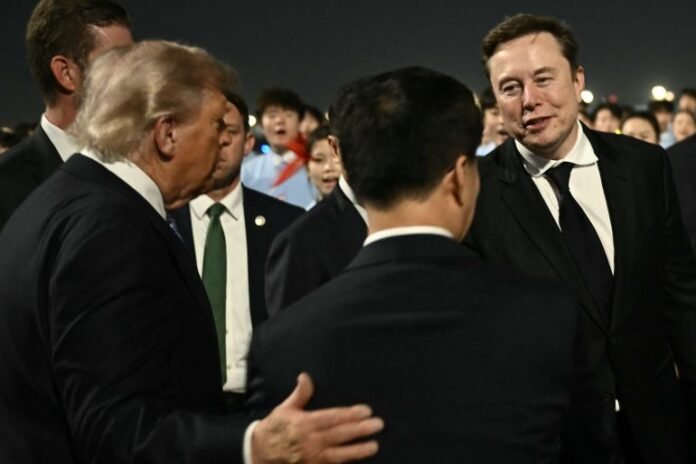
As the US president was greeted with flowers and flags on a red carpet, the CEOs walked behind him as potent reminders of the business deals he hopes to sign between the world’s biggest economies.
Who is in Trump’s delegation?
The delegation largely consists of US executives seeking to resolve issues with Beijing.
SpaceX and Tesla’s Elon Musk, Apple’s Tim Cook and Goldman Sachs’s David Solomon are among the top business executives accompanying Trump on his visit.
Advertisement
Musk, who also owns the social media platform X, travelled to China on Air Force One with Trump despite having feuded with the president last year in a war of words that included claims by Musk that Trump closely associated with infamous sex offender Jeffrey Epstein.
The billionaire led Trump’s Department of Government Efficiency (DOGE) until his departure in early 2025 before the controversial pop-up agency was shuttered in November.
Other big names include BlackRock Chairman and CEO Larry Fink, Citi Chairman and CEO Jane Fraser, Blackstone CEO and cofounder Stephen Schwarzman, and Boeing CEO and President Kelly Ortberg.
Nvidia’s Jensen Huang was a surprise late addition to the trip, joining the plane at a stopover in Alaska.
Other businesses represented on the state visit to Beijing are Meta, Cargill, Visa, Cisco, Qualcomm, Coherent, Micron, GE Aerospace, Illumina and Mastercard.
Why are CEOs taking part in Trump’s visit to China?
CEOs on tour with Trump briefly spoke to the media following the US president’s official welcoming ceremony at the Great Hall of the People in Beijing. Musk, Tesla’s CEO, told reporters that he wants to accomplish “many good things” while in China, while Huang, Nvidia’s CEO, said a meeting with Chinese officials had gone “excellently”.
Many have strong interests in better relations with China.
Top US tech companies are heavily dependent on China for imports and exports, as well as a manufacturing base. China, the world’s second-largest economy, also controls the majority of global mining and processing of critical rare earth metals, which are key for the manufacture of technology from smartphones to fighter jets.
In April last year, China restricted exports of seven of 12 specific rare earths and, later in the year, said it was planning to restrict exports of five more. The restrictions on the second tranche of five have been paused as part of the truce agreed with Trump in October.
Musk is in China hoping to buy $2.9bn-worth of equipment for manufacturing solar panels from Chinese suppliers, Reuters reported in March. This will be tricky if China also decides to limit exports of its most advanced technologies to the US.
China is also a critical market for Musk’s electric vehicle group, Tesla, and he is currently seeking clearance from Chinese regulators to expand adoption of Tesla’s Full Self-Driving assistance system. In 2018, Tesla became the first foreign car company allowed to set up an automaking operation in China without a local partner.
Advertisement
Tesla produces a large number of cars every year from its Shanghai Gigafactory, the group’s largest global export hub. In the first four months of 2026, Tesla’s Shanghai factory reported total sales of 292,876 vehicles, up 26.7 percent compared with the same period the year before, financial reporting shows.
Apple, headed up by outgoing CEO Cook, who announced he would end his 15-year tenure in September, is also heavily dependent on overseas manufacturing for the production of iPhones.
Apple sells more than 60 million iPhones in the US each year, with roughly 80 percent of them made in China, according to Reuters. Last year, Trump imposed some tariffs on the device, and pressured Apple to shift its production to the US instead, but Cook managed to minimise the fees by shifting production of iPhones destined for the US market to India and promising $100bn of other investments in the US.
Nvidia’s Huang is in Beijing, hoping to unlock stalled efforts to sell the company’s H200 chips in China.
Before export curbs were put in place by the US citing security concerns early this year, Nvidia controlled about 95 percent of China’s advanced chip market. Huang previously estimated the country’s AI market would be worth $50bn this year.
In January, the Trump administration greenlit the export of its H200 artificial intelligence chips to China but placed new security requirements on Nvidia’s sales to the country.
New rules set by the Commerce Department’s Bureau of Industry and Security dictate that Nvidia must ensure that there is an adequate supply in the US and undergo a third-party review before exporting components to China.
Planemaker Boeing is also looking to do business with China, amid ongoing talks about a possible large aircraft sale. Bloomberg reported that China was considering buying about 500 of Boeing’s 737 Max jetliners, as well as about 100 Boeing 787 Dreamliner and 777X wide-body jetliners.
The planemaker’s CEO, Ortberg, expressed confidence that a deal between Trump and Xi would “include some aircraft orders”.

What is Trump hoping to achieve by bringing CEOs to China?
The US president is pushing for a commitment from China to open its economy to American firms, as he attempts to score some points with Silicon Valley amid widespread criticism over the US-Israeli war in Iran, which worsened economic conditions and raised prices across the US.
He is also hoping to firm up popularity ahead of crucial midterm elections in the US in November.
Independent China strategist Andrew Leung said the presence of top US CEOs “signals what [Trump] needs to take home: market access and investment commitments that he can present to his political base, with midterm elections approaching and his popularity under pressure”.
“In return, China will press for relaxation or removal of tariffs, the lifting of sanctions on Chinese entities, greater access to advanced semiconductors, and the opening of markets for Chinese investment in the United States,” Leung told Al Jazeera.
Advertisement
“If [this requires] moving some electric vehicle production to American soil, [it] could generate jobs and economic activity there, too.”