


18/04/2026 – 16:48 GMT+2
There are about 2,200 farms within the city limits of Italy’s capital alone, making it the largest agricultural municipality in Europe.
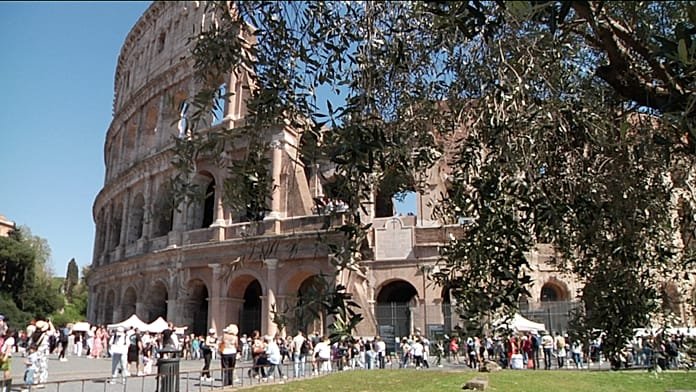
In the heart of the Colosseum Archaeological Park, amidst columns, ruins and the constant coming and going of tourists from all over the world, The olive harvest has become an increasingly familiar and symbolic scene.

ADVERTISEMENT
ADVERTISEMENT
Under the olive trees, green nets stretched out on the ground collect the fruit as it falls after being picked, while the crates are filled one after another and the work blends into the site’s unique archaeological landscape.
The Colosseum site is the starting point of the Olio di Roma IGP (Protected Geographical Indication) project, which aims to bring agriculture back into the urban fabric of the capital by rediscovering its productive dimension alongside its historical and monumental one.
Olive trees in Rome’s iconic locations
The approach is one of broad recovery—not only of large peri-urban agricultural areas, but also parks, historic villas, and urban spaces where olive trees had remained silent for years.
The work launched by the Campidoglio involves a systematic census of trees across the city, with projects already underway in places such as Villa Glori and Villa Chigi, as well as areas within the Colosseum park and many neighborhood gardens.
As Sabrina Alfonsi, Rome’s Councillor for the Environment, explains, the idea stems from the need to interpret the city through its agricultural traces—often hidden, yet still alive.
“The olive harvest in the Colosseum park was one of the first strong signals. From there, mapping the city’s olive groves began: a project involving Villa Glori, Villa Chigi, and many other green spaces where olive trees were present but often forgotten. We restored around 400 olive trees in Villa Glori and are also working in other areas because these trees tell the story of the city’s widespread agricultural past,” she said.
Rome, between fields and urbanisation
This initiative is also part of a broader vision of the city. Rome is described as a system where nature, agriculture, and urban development coexist in balance, even if this is not always obvious.
The figures are striking: about one-third of the municipal territory is green, one-third agricultural, and one-third urbanised. There are also around 2,200 farms within the city limits alone, making Rome the largest agricultural municipality in Europe.
In this context, olive oil becomes one of the clearest symbols of this “mixed” identity, between urban and rural, archaeology and countryside.
The IGP label and strict standards
In terms of production, Olio di Roma IGP is supported by a regional supply chain of around 120 farms in Lazio. The label is governed by strict specifications with very precise quality requirements.
Tiziana Tornelli, Vice President of the Olio di Roma IGP Consortium, emphasises this technical aspect, which underpins the product’s distinctiveness:“The Olio di Roma IGP specifications set very precise parameters to guarantee quality: an oil with low acidity and high polyphenol content. These natural antioxidants, like vitamin E, play an important role both in taste and health, particularly for the cardiovascular system and the product’s preservation.”
Olio di Roma IGP
In ancient Rome, olive oil was central to daily life: food, fuel for lighting through oil lamps, and a base for cosmetics and body care. This widespread use made it one of the most important products in Roman economy and culture.
“For the Romans, oil was a complete product: it was used for food, lighting, cosmetics, and body care. It was central to daily life and accompanied the development of Roman civilisation throughout the Empire,” explains Tiziana Tornelli.
Where to find Olio di Roma IGP
Alongside production, a new distribution network is also developing that takes Olio di Roma PGI outside the traditional channels.
The product is already available in museum bookshops across Rome and is being expanded to major cultural sites such as the Ara Pacis and Palazzo Braschi, with the aim of strengthening the link between the city’s identity and cultural consumption.
At the same time, the consortium’s website is becoming a direct gateway to the supply chain: producers can be browsed and contacted through the official platform www.olioromaigp.it, allowing direct purchases from producers.
The idea is to build a dual network: on one hand, direct and transparent sales; on the other, a presence in symbolic cultural locations, where the product becomes a storytelling object as well as a food item.
This same approach underlies the project for a unified Olio di Roma IGP container, designed to bring together different products in a recognisable and easy-to-distribute format.
It is also aimed at the international market, where the name “Rome” carries strong evocative value and helps make the product immediately identifiable.
From museums to olive trees
Finally, the project is expanding into tourism. The “Via dell’Olio di Roma IGP” are routes currently under development, linking the city with farms across Lazio and creating an olive oil tourism system that allows visitors to follow the entire production cycle—from grove to tasting.
This idea goes beyond countryside visits, integrating restaurants, museums, historic workshops, and schools, with the goal of turning olive oil into a broad and continuous cultural experience.
From the Colosseum to historic villas, from museums to regional countryside, Olio di Roma IGP becomes the common thread connecting a landscape that is often fragmented. It is a project that goes beyond producing an agricultural excellence, aiming instead to restore one of Rome’s oldest identities: that of a deeply agricultural and monumental city.