


Kalshi, a U.S.-based prediction market platform, has raised $1B in a Series F round, bringing the company’s valuation to $22B. According to Kalshi’s official announcement, the round was led by Coatue, with participation from Sequoia Capital, Andreessen Horowitz, IVP, Paradigm, Morgan Stanley, and ARK Invest.
This is one of the largest funding rounds in the prediction market sector. It also shows that investors are viewing Kalshi not only as an event trading app, but as part of a new fintech infrastructure layer for probability data, risk management, and outcome-based trading.
ARK Invest’s participation is also notable. Previously, Cathie Wood’s ARK announced a partnership with Kalshi to use prediction market data for investment strategy, risk management, and real-time market insights. This strengthens the thesis that prediction markets are being viewed as financial analysis tools, not just betting products.
What Is Kalshi?
Kalshi is a platform that allows users to trade contracts based on the outcomes of future events. Instead of buying stocks, crypto, or commodities, users can trade questions such as where interest rates will go, whether economic data will meet expectations, who will win an election, or how a sports event will end.
Put simply, Kalshi turns the question “what will happen?” into a tradable market. If users believe an event is more likely to happen than the market is pricing in, they can buy the corresponding contract. If their prediction is correct, they make a profit.
That is why Kalshi is often called a prediction market platform. But this model is also what puts Kalshi in a controversial area: is this a new financial market, or just a form of betting repackaged in fintech language?
Why Is Kalshi Valued So High?
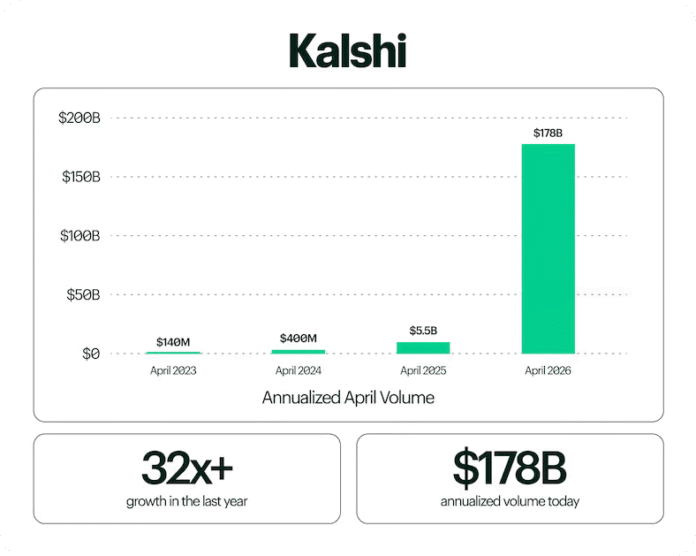
The biggest reason is growth. According to Kalshi, institutional trading volume on the platform increased 800% in six months. Annualized trading volume also more than tripled, rising from $52B to $178B over the same period.
The important point is that $178B is not actual monthly trading volume. It is annualized trading volume, meaning the trading volume is annualized based on the current pace. If converted simply, the corresponding actual monthly volume would be much lower, at around nearly $14.8B.

Kalshi also said the platform now accounts for more than 90% of prediction market activity in the United States and most global volume. Bloomberg/Yahoo Finance also reported that Kalshi has around 2M monthly active users, but this figure was not included in Kalshi’s official funding announcement.
This is why investors may accept such a high valuation. If Kalshi were only an app for users to bet on events, a $22B valuation would be hard to justify.
But if prediction markets become an infrastructure layer for:
- Hedge funds
- Asset managers
- Proprietary trading firms
- Insurance companies
The story becomes different.
What Will Kalshi Use the $1B For?
Kalshi said the new capital will be used to expand adoption among institutions, including hedge funds, asset managers, proprietary trading firms, and insurance companies. The company will also continue developing block trading, risk management products, and deeper integrations with brokers.
This is an important detail because it shows Kalshi does not want to be seen simply as a betting platform. The company is trying to position event contracts as financial tools: helping institutions hedge real-world risks, track market expectations, and trade outcomes that do not yet have corresponding traditional financial products.
For example, an investment fund may care about election results, inflation data, interest rate decisions, or regulatory risk in a specific industry. If those events can be traded through regulated contracts, prediction markets could become an additional tool for risk management.

Prediction Markets Are Entering a New Fintech Phase
Prediction markets used to be a fairly niche idea. But in recent years, they have started gaining attention because of their ability to reflect collective expectations faster than traditional surveys.
When thousands or millions of people put real money behind predictions, market prices can become a signal of the probability that the crowd assigns to an event. This is what makes prediction markets attractive to both individual users and institutions.
For regular users, Kalshi looks like a way to trade news. For financial institutions, it can become a tool for pricing political, economic, legal, sports, weather, or industry risk. The second part is the real reason Kalshi is being valued like an infrastructure fintech company, not just a consumer app.
But Legal Risk Remains Very Large
Despite the large funding round, Kalshi still faces legal pressure in the United States. Reuters reported that the Massachusetts Supreme Judicial Court appeared to open the door for the state to ban Kalshi from offering sports-related contracts if the platform does not have a gaming license. The justices also questioned how Kalshi’s products differ from traditional betting.
This is the most tense part of the Kalshi story. The company argues that its event contracts fall under financial regulation and are supervised at the federal level. Meanwhile, some states view sports contracts as gambling products that require separate licenses.
Massachusetts is especially important because it could become a precedent for other states. If the court in Massachusetts sides with the state regulator, other states could easily use a similar argument to pressure Kalshi. That would threaten the national prediction market model built on a federal regulatory framework.
Why Is Kalshi Valued So High?
To understand why Kalshi is valued so high, it needs to be placed next to Polymarket. Both are part of the prediction market wave, but their approaches are very different.
- Kalshi is choosing the regulated fintech path in the United States. The company wants to build prediction markets as a regulated event exchange that can serve both individual users and financial institutions. This is why Kalshi emphasizes institutional volume, broker integration, block trading, and risk management products.
- Polymarket has a more crypto-native image, tied more closely to stablecoins, crypto users, and internet-native prediction markets. According to Reuters, Polymarket has also been mentioned as a major competitor in the prediction market industry, especially after the sector surged around political events.
This difference is very important. If Polymarket represents the crypto/open internet path, Kalshi represents the regulated Wall Street path.
Kalshi’s $1B funding round shows that investors are betting prediction markets are not just a viral product after an election cycle, but could become a financial infrastructure layer used by institutions.

What Are Investors Saying About Kalshi’s $22B Valuation?
After the funding news, the community on X reacted actively, and most reactions leaned positive. Many people saw this as a sign that prediction markets are moving from a niche product into real financial infrastructure.
@arceyul said Kalshi is gradually becoming “real financial infrastructure,” while @0xbeehive highlighted 32x growth in one year and argued that this is only the early stage.
https://x.com/arceyul/status/2052429467159515544
https://x.com/0xbeehive/status/2052446274394169481
One notable view came from @MacroAlphaHQ, who pointed out that Wall Street does not pour money into a “$22B casino” unless it sees much larger potential. The implication is that the participation of Morgan Stanley and major funds is a signal of the model’s legitimacy, not just speculation.
https://x.com/MacroAlphaHQ/status/2052407305031827781
However, it is important to note that most of the prominent opinions on X came from people who were already bullish on prediction markets. Skeptical views, especially around legal risk and the gambling nature of the product, went less viral, but that does not make them less important.
The post Kalshi Reaches $22B Valuation After $1B Funding Round appeared first on Memeburn.