


Democratic Republic Of Congo
At the edge of Kinshasa’s forest, a quiet rescue mission unfolds every day: human caregivers stepping in as mothers for orphaned bonobos, the world’s most endangered great ape found only in the Democratic Republic of Congo.
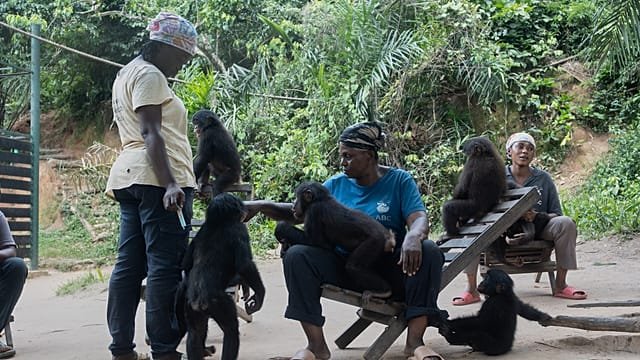
Micheline Nzonzi rocks a drowsy bonobo against her chest, the way one might soothe a toddler.
At Lola ya Bonobo, the only sanctuary on Earth dedicated exclusively to bonobos, this tenderness is not optional — it is survival.
Many of the infants arrive traumatized, their mothers killed by poachers supplying the illegal bushmeat trade.
Nzonzi, who has spent more than 20 years raising these orphans, says the first days are the most fragile.
Without constant touch and reassurance, the babies can shut down emotionally and physically.
“They need to be in our arms to feel safe,” she says. “Without affection, they can die or wither away.”
A species found nowhere else
Bonobos share nearly 99% of their DNA with humans, yet their future is far from secure.
Their population has plunged from around 100,000 in the 1980s to roughly 20,000 today.
Educator Arsène Madimba explains why their situation is uniquely precarious: bonobos live only in the DRC.
If they disappear here, they disappear everywhere.
“It is not only the bonobo that is a victim of poaching,” he says. “But the problem with bonobos is that they’re just not anywhere else.”
Their slow reproductive cycle — one baby every four to five years — makes recovery painfully slow.
Bushmeat markets go underground
In Kinshasa, primate meat is illegal, partly due to the risk of zoonotic diseases like Ebola.
But the broader wildlife trade persists.
At one city market, vendors sell giant rodents, snakes, and pythons.
Guyva Mputu, who has sold bushmeat for a decade, says customers come from “all walks of life, rich and poor alike.”
The demand keeps hunters in business — and keeps sanctuaries like Lola ya Bonobo full.
Raising, rehabilitating, and sometimes releasing
At the sanctuary, young bonobos begin life in a nursery with their human foster parents.
As they grow, they join larger social groups in forested enclosures.
A few, after years of preparation, are eventually reintroduced into the wild — a rare but hopeful outcome.
The sanctuary also invests heavily in education, teaching communities that bonobos should not be hunted, eaten, or kept as pets.
Rethinking conservation models
Francois Sandrin of the Wildlife Conservation Society says the bushmeat crisis extends far beyond bonobos.
Across the DRC, wildlife populations are under pressure.
He believes solutions must be adapted to local realities, drawing inspiration from regulated hunting systems in Europe and North America.
“There are heavily regulated systems with licenses, quotas, seasons,” he says. “The challenge is to adapt these models to Central African realities.”
That includes promoting traditional Congolese dishes without wild meat and developing sustainable protein alternatives — without shaming communities that rely on bushmeat for cultural or economic reasons.
A fragile future, held in human arms
Back at Lola ya Bonobo, Nzonzi continues her quiet work — bottle-feeding, comforting, and playing with the orphans who cling to her for safety.
Each one represents both a tragedy and a possibility: a life saved, and a species still fighting for survival.
You may also like
From the same country