



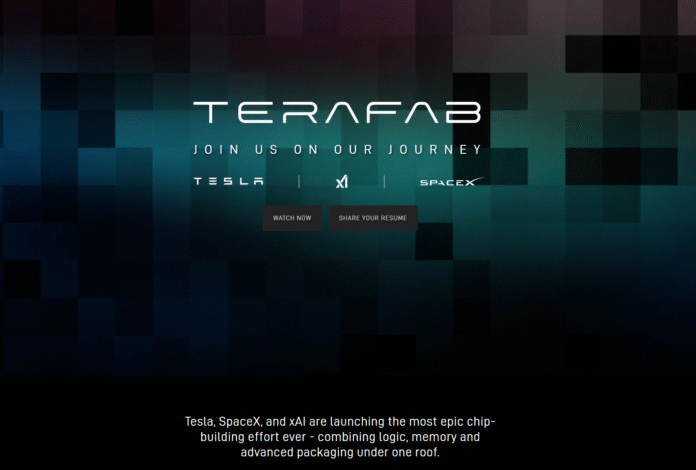
Elon Musk just made one of the boldest infrastructure bets we’ve ever seen in tech. SpaceX filed plans this week for a $55 billion semiconductor factory in Texas, with potential to scale up to $119 billion. The project, called Terafab, ties Tesla, xAI, and SpaceX together with one shared goal to build the AI chips they can’t get fast enough from anyone else. Here’s what the plan actually involves, why it matters, and what it tells you about where Musk is taking AI next.
What Is Terafab?
Terafab is a planned chip manufacturing facility in Grimes County, Texas. It’s a joint project between SpaceX, Tesla, and xAI.

Think of it as Musk’s answer to a problem every AI company has right now: there aren’t enough chips. Companies like Nvidia design the chips, but real production happens at a few foundries — mainly TSMC in Taiwan. Demand is so high that even Apple and Google can’t always get the volume they need.
Terafab is Musk’s plan to build his own foundry. Instead of waiting in line, his company makes the chips itself.
How Big Is the Project?
The numbers are massive — even by tech industry standards. Here’s the breakdown from the public filing:
- Phase 1 investment: $55 billion
- Total buildout potential: up to $119 billion
- Facility size: roughly 100 million square feet at full scale
- Power needs: over 10 gigawatts at full operation
- Process node: 2-nanometer (one of the most advanced in the world)
- Output target: 1 terawatt of compute per year
For context, that’s bigger than TSMC’s entire Arizona project. Ben Bajarin, a chip analyst at Creative Strategies, told CNBC Musk is embarking on a “15-year strategy” — meaning this isn’t a quick win. It’s a multi-decade play to control compute infrastructure.
Why Musk Wants His Own Chips
You might be wondering: why bother building chips when you can just buy them? The answer comes down to supply, control, and cost.
Right now, Musk’s businesses depend on outside foundries for almost everything:
- Tesla needs chips for Full Self-Driving and the Optimus humanoid robot.
- SpaceX needs chips for Starlink satellites and Falcon avionics.
- xAI needs chips for training Grok and the company’s AI compute clusters.
All of that demand competes for the same limited foundry capacity. Building Terafab gives Musk’s ecosystem direct control over chip design, fabrication, and packaging under one roof.
The downstream impact is real. Tesla’s FSD hardware, the Dojo supercomputer, and Optimus all need custom silicon at huge volumes. A vertically integrated fab could speed up hardware updates and reduce supply bottlenecks that have delayed Tesla features for years.
The xAI Merger and “SpaceXAI”
Here’s where things get interesting. Earlier this year, SpaceX acquired xAI, and the combined entity is now valued at $1.25 trillion. On X, Musk wrote: “xAI will be dissolved as a separate company” — and the merged entity will be called SpaceXAI.

That’s a major restructuring. It means xAI’s compute needs, including training Grok, are now SpaceX’s problem to solve. Terafab is the answer.
The merger also explains why Musk has pushed the idea of AI data centers in space. SpaceX has the launch capacity. xAI brings the AI workloads. Terafab supplies the chips. It’s a vertically integrated AI stack — from silicon to satellite to model.
Intel’s Surprise Role
One of the biggest surprises in the Terafab story is Intel. The American chipmaker joined the project in April 2026 as a strategic manufacturing partner. Musk confirmed during Tesla’s Q1 earnings call that Terafab will use Intel’s upcoming 14A process to produce chips.

That’s a big deal for Intel. The company has struggled to compete with TSMC for years, and its foundry business has barely won outside customers. Terafab is the first major external commitment for Intel’s foundry. The market reacted fast — Intel stock had its best month ever in April, more than doubling in value.
For you as a reader, the takeaway is simple. Musk isn’t trying to build a fab from scratch alone. He’s plugging into Intel’s existing manufacturing expertise while bringing his own scale and capital.
What This Means for AI Infrastructure
The bigger story here is what Terafab signals about the AI race. Compute is the new oil, and the companies that control it will dominate the next decade.
But chips are only part of the picture. Even with the best hardware, AI systems still face security and trust problems. We saw this firsthand in the recent Grok wallet exploit that drained 3 billion DRB tokens through a Morse code prompt injection. Building powerful AI chips is one thing. Building AI agents that can’t be tricked is a separate, equally hard problem.
The Terafab plan also puts pressure on other big players like Google, Amazon, and Microsoft, are all racing to design their own AI chips. NVIDIA is now the most valuable company in the world precisely because chips are the bottleneck. If Musk pulls Terafab off, his companies will become less dependent on NVIDIA, which would shift the whole power balance in AI hardware.
What Could Go Wrong
Before you treat Terafab as a done deal, a few realities to keep in mind.
A filing is not groundbreaking. Semiconductor fabs of this complexity take years to permit, build, and qualify. The first phase alone is $55 billion — that’s more than most companies’ entire valuations. Sustained funding will be a challenge, even with SpaceX’s planned June 2026 IPO at a $1.75 trillion valuation.

Other open questions:
- What chips get made first? Tesla, SpaceX, or xAI workloads have very different requirements.
- How does the Intel partnership scale? 14A is unproven at this volume.
- Will Musk’s other ventures distract focus? He recently agreed to spend $60 billion acquiring AI startup Cursor.
- What happens if AI demand cools? Building $119B of capacity that customers don’t need would be catastrophic.
The June 3 public hearing in Grimes County is the next checkpoint. If approved, Terafab gets the tax incentives needed to start construction. If not, the timeline slips and skeptics will gain ammunition.
What Holders and Watchers Should Track
Here’s the short watchlist for what to follow next:
- June 3 hearing. Grimes County tax abatement vote determines if Terafab moves forward on timeline.
- SpaceX IPO. A June listing at $1.75T valuation gives Musk capital to fund Phase 1.
- Intel 14A milestones. Pilot production at Terafab targets late 2026.
- xAI integration. Watch how SpaceXAI restructures Grok and compute infrastructure.
- Competitor responses. Look for similar moves from Google, Amazon, or Apple to bring chip production in-house.
For now, Terafab is the clearest signal yet that the AI race is becoming a manufacturing race. And Musk is betting $119 billion to win it on his own terms.
The post SpaceX’s $55B Terafab Bet: Inside Musk’s Plan to Build His Own AI Chips appeared first on Memeburn.