



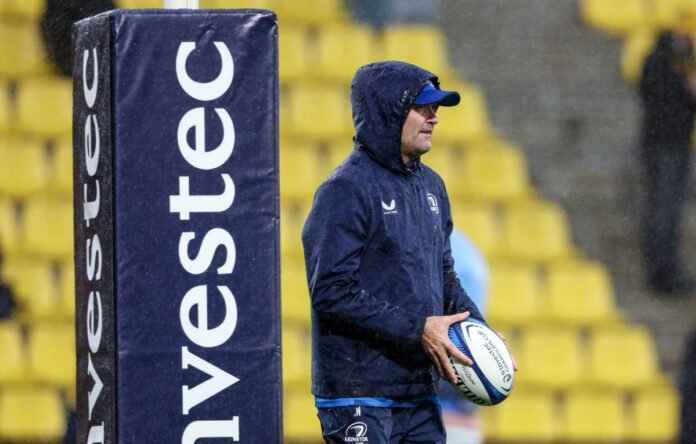
There is no entitlement in Investec Champions Cup rugby. Not for clubs with four stars and not for coaches with two World Cup titles. That is where Jacques Nienaber starts.
“The fact that you have an international squad doesn’t give you the right to a star,” he says. “Otherwise, they would have given that to us when we put our team sheet out at the start of the season.”
Nienaber, throughout his coaching career, has never dealt in media soundbites.
There is an articulation that is by design and not default. His brain has always worked before his mouth, which makes him rather unique among the very best coaches.
Nienaber is about process, which means understanding something and appreciating the need for repetition to bring that something to fruition.
Read more: best bets for the Champions Cup semi-finals
He operates in the now, which means each day is a new opportunity to improve on what may have been a missed opportunity.
Leinster lost in the Champions Cup semi-final at the Aviva Stadium to Northampton Saints a year ago. It was a result few expected, with the bookmakers giving Leinster a 17-point pre-match advantage.
Leinster had not conceded a point in the two play-off matches before the semi-final, but Nienaber doesn’t question the mentality of those match-day players. He also doesn’t soften the reality of the result.
If anything, he says a result like last year’s reinforces the reality that a player and, by extension the team as a collective, has to earn everything.
“It is simple. You earn the right to a result through performance on the day, not because of what you did the match beforehand.”
Nienaber arrived at Leinster having led the Springboks to a second successive World Cup title, but he quickly strips away comparisons of coaching at Test and club level.
“If you go from an international point of view into a World Cup, you’re managing one competition. There’s pure focus and a definite route forward over a block period in which you can build momentum.”
ALSO: Leinster lose star, Keenan slots back in
Nienaber references the playing period of a World Cup tournament, in which the four pool matches occur over three weeks, followed immediately by three successive play-off weeks.
Finding the balance between two intense club competitions that run parallel is a challenge of a very different kind.
“What makes this competition different is that you’re fighting on two fronts. The Champions Cup does not exist in isolation. It sits inside a season that demands constant compromise.
“In a World Cup, you know your pool games, your knockout path. Here, you’re balancing everything all the time. It is not a complaint. I would say it is more an explanation of why this competition is so tough. It is relentless.”
At Leinster, player depth is a strength and a complication. The squad is stacked with internationals, and the challenge is managing the players’ game minutes while also merging the talents of the seasoned Test players with the best graduating from the Academy.
“There’s a sweet spot,” Nienaber says. “On one side, players go in well-rested but underprepared. On the other, they’re exhausted but rugby-ready.”
That balance is never fixed.
MORE: Leinster excited for ‘another crack’
“Do you let players go five weeks in a row? Or do you rest them and risk losing cohesion? That’s the challenge. And the margins are unforgiving. You want players cohesive and playing together, but you don’t want to overplay them. That’s the reality of operating in two competitions.”
Leinster have adjusted this season and there has been a conscious reset. A year ago, they fell one match short of winning both the Champions Cup and the United Rugby Championship.
“We tried something last year. We felt it didn’t work. So we’re trying something different now.”
For Nienaber, the Champions Cup owns a unique space in world rugby because it is not domestic and it is not international, but something that bridges both.
“From a club perspective, fans can see their club heroes perform against internationals,” he says. “That’s the beauty. You see the best versus the best at club level.
“It is not just about the names on the team sheet. It is about exposure for players, for supporters, for the game itself. A player who hasn’t played international rugby can now test himself against a top international. He can measure himself.”
And the intensity in performance reflects that.
RINGROSE: Leinster driven by heartbreak
“It’s the bridge between domestic and international rugby. The level and intensity are as close to Test matches as you’ll find.”
Add the movement of supporters, the collision of cultures and the weight of history and it becomes something so much bigger.
“You see the travelling support and the different cultures coming together. That’s what makes it special.”
The narrative around Leinster centers on expectation, history and, most recently, the pursuit of the fifth star after winning the title four times.
But Nienaber keeps it grounded and he says he has never experienced a sense of entitlement from the playing group or management that the success of the past was a guarantee for more success.
“I didn’t get the sense when I arrived that we just pitch up and things go our way,” he says. “Since I’ve been here, it’s been semi-finals and finals that were decided by the smallest margins.”
He references moments like missed drop goals, inches that separate victory from defeat.
“It’s literally a foot, two feet. That’s how close it is.” And it is that closeness defines the competition. “No one has the right to win the Champions Cup. You have to earn it.”
For all his success in Test rugby, Nienaber speaks most passionately about what he has had to relearn.
“At club level, you work with completely different players,” he says. “You have internationals, experienced club players, and 20-year-olds all in the same environment.”
Each demands something different.
PLUS: Leinster get triple boost for Toulon duel
“You can’t coach them the same way. The messaging, the detail and the expectations. I felt, in the beginning, I wasn’t good enough to move between those levels. It was frustrating but it was the challenge I wanted, and when I reflect on my Leinster journey I take pride in this area of personal growth.”
Nienaber’s thirst is for knowledge, but he operates with realism and not romance, which is why his coaching pedigree was founded on the brutal principles of defence and why those teams he has coached are so difficult to beat.
But he is as big on cultural respect within teams and knows it is a strength that he can acknowledge players from different countries are culturally unique.
“There’s a cultural difference,” Nienaber says. “As a South African coaching Irish players, there are parts of their history I don’t understand and I won’t pretend otherwise.
“You come in with perceptions, and then you realise those perceptions aren’t necessarily reality.
“You have to put effort into learning the reality. It’s easier to connect with players when you understand where they come from. But that connection is earned, and that is the only way I would want it to be.
“Coming to Leinster, I had no history with the club and the players had no history with me. There was no credit on either side. So, from both sides, it is about earning trust and earning respect. And that is a constant.”
This interview first appeared in the official Investec Champions Cup semi-final match programme for Leinster v Toulon, courtesy of EPCR.
Photo: ©INPHO/Dan Sheridan
The post Stars are aligned for five-star Nienaber appeared first on SA Rugby magazine.