


Kenya
Waste pickers in the Kenyan capital are learning about the circular economy, sustainable practices and how to advocate for their own needs – by playing a board game.
Nairobi’s giant Dandora dump.
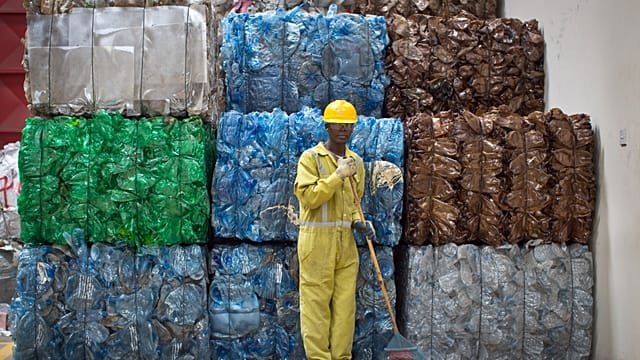
Amid marabou storks, waste pickers work, often with no education or recognition.
They make a living by pulling anything of value from the giant piles of rubbish.
Although they may be doing it just to get by, these frontline recyclers keep large volumes of material out of landfills.
The Circularity Gap Report 2025 found that, although less than 10 percent of the over 100 billion tonnes of materials used each year globally are circular, waste pickers recover a substantial share of recyclables that would otherwise go to landfills.
Now, the Mazingira Yetu Organization is hoping to arm these overlooked recyclers with the knowledge to make them more efficient.
They’ve come up with an innovative board game that they say trains the recyclers on circular economy principles, sustainable livelihoods and self-advocacy.
Divided into teams, players roll dice to advance across a numbered board, landing on spaces that trigger discussions via matching question cards.
Topics span reducing waste, recycling techniques, health insurance benefits, protective gear needs and collective bargaining power.
Teams debate answers, crosscheck against a reference booklet, and tally points, reinforcing knowledge that could translate into higher value income streams.
“So people are not understanding, for example, the principle of circular economy, the reduce, recycle, restore. It was a difficult concept,” says Sam Ndindi, director of the Mazingira Yetu Organization.
“We thought of why can’t we use a Sheng (Kenya slang) language as a way of just telling them, these are things that you know but in a very fun way.”
Raphael Kung’u has worked as a waste picker at Dandora dumpsite for three years.
He scavenges plastics, which he recycles for own use and sells most to recyclers.
Through the board game, Kung’u says he has learned that he can recycle plastics for multiple purposes and that these materials have far higher potential value than many realise.
“I have learnt that when we collect waste, we can use it in many ways that can benefit us and give us more profits. For example, I collect plastic, I have learnt that I can use the plastic bottles in many ways. I can use it as a water container, to plant tree seedlings or flowers. All those alternative uses I have learnt through this game,” Kung’u says.
Circular economy
The Circularity Gap Report 2023 found that the circular economy could cut global material use by about 30 percent while still meeting consumption needs, which means every tonne of waste safely sorted and reused by pickers like Kung’u brings the city closer to a circular model.
Stanley Kiai, a waste picker most of his life, collects waste batteries, which he sees as ‘money’.
“I have learnt that the batteries are discarded because they have already been used. Some are broken and others are usable but have been discarded and regarded as waste. But to me, it’s a source of money. So I collect it from waste and take it to recyclers,” he says.
Experts say that game-based learning can meaningfully improve understanding of sorting, reuse, refill and which materials are organic or recyclable, making it a powerful tool for informal workers who learn by doing.
“Board games have been proven to teach children and even adults about circularity and also sustainable practices,” says Hellen Dela, Project Lead for the Pan African Plastic Project at Greenpeace Africa.
“In the sense that some of these games would look at things like sorting, type of waste, which waste can be recycled, which waste can be organic. So I think just learning about sustainable practices about the three Rs we use, reuse, refill and recycle.”
For the Nairobi waste pickers taking part in the training programme, the game is more than play.
Organisers believe it’s a practical gateway into a circular economy that could stabilise incomes, reduce environmental harm and shift their status from invisible scavengers to recognised stewards of urban resources.
Humanity generates roughly 2.3 billion tonnes of municipal solid waste per year, and this is projected to rise to about 3.8 billion tonnes by 2050 if current trends continue, according to UNEP.
Kenya produces about 22,000 tonnes of municipal solid waste per day, with cities like Nairobi generating roughly 2,400 tonnes daily, according to the National Environment Management Authority (NEMA).
Related articles
From the same country