



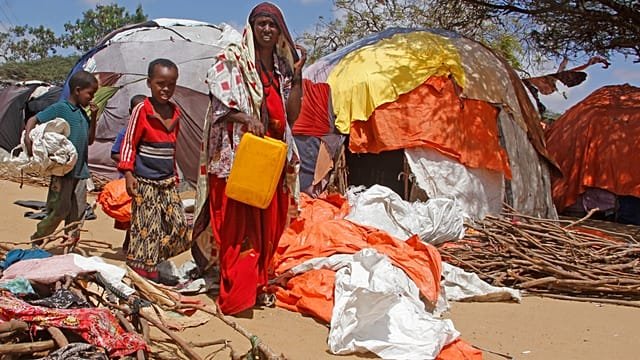
In the largely arid Puntland region in north-eastern Somalia, where the past three rainy seasons have failed, there is nothing to see but dry water ponds, destroyed crops, and animal carcasses.
As the drought intensifies, and the malnutrition rate soars, the race is on to stop another hunger catastrophe.
But several international organisations have had to stop operations in the Kismayo camp and elsewhere, in large part due to aid cuts made last year by United States President Donald Trump.
World Food Programme Assistant Executive Director for Programme Operations, Matthew Hollingworth, said there is a malnutrition crisis across the country.
“We simply don’t have the resources to respond as we should do,” he said.
“This is made absolutely worse because of the Middle East crisis which is raising prices across the whole country; fuel by 150%, even food commodities by at least 20 or 30%.”
Experts say even if the forthcoming rainy season is normal, it will take months for affected populations to recover.
Displaced community member, Mahad Farah Muse, said the little bit of rain that fell recently did not last.
“And if rain does not come soon, people may start dying just like the livestock. People depend on livestock, and now the livestock are gone. Everything has been lost,” she said.
‘Toxic cocktail’
Somalia is facing one of the most complex hunger crises in recent years, driven by drought, conflict, large-scale displacement, and severely limited humanitarian assistance.
Famine has claimed hundreds of thousands of lives.
As aid funding dries up, the WFP says it can only reach 1 in 10 people in urgent need and it risks having to halt emergency assistance by July.
Save the Children Somalia director, Mohamud Mohamed Hassan, says the recent foreign aid cuts have had “a huge impact” on its work.
More than 200 health centres and 400 schools have closed since last year.
Farmers, whose herds and crops have been decimated, describe one of the worst droughts ever recorded in a country where a third of people already lacked regular meals.
The United Nations’ humanitarian arm has had to steadily reduce its Somalia programme from $2.6 billion in 2023 to $852 million this year, especially since Washington slashed its donations.
So far, only 13% of this year’s target has been raised.
“It’s a toxic cocktail of factors … Things are really, really desperate,” said Tom Fletcher, head of the UN Office for the Coordination of Humanitarian Affairs.
“Often we’re having to choose which lives to save and which lives not to save.”