


If you’ve been following AI news, you’ve seen agents leaving the lab. They’re running supply chain audits, hunting cyber exploits, and even being kicked out of the Pentagon. The latest example is Exiger. The company uses agentic AI to expose how deeply the US military depends on Chinese suppliers. Here’s what the platform does, what it found, and why this is one of 2026’s most important AI use cases.
What Is Exiger?
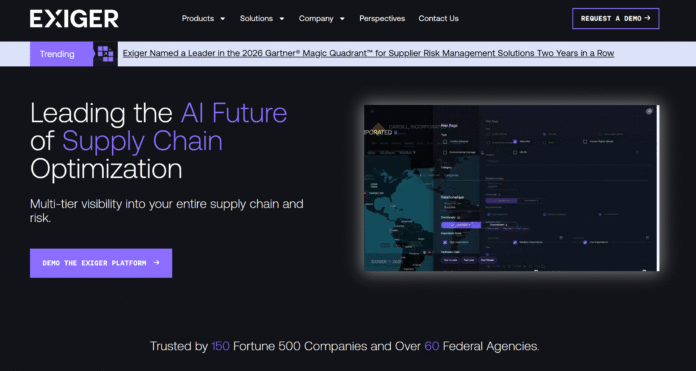
If you’re new to this name, here’s the quick version. Exiger is a US software company. It builds AI tools for supply chain risk management. Its main product is a platform called 1Exiger, which uses AI to scan vast supplier networks and surface hidden risks.

Think of it like a search engine for supply chains. Instead of finding web pages, it finds suppliers and sub-suppliers — going down many layers deep. The result: it can tell you exactly who makes what for whom.
That’s a big deal for the US government. Exiger is the largest provider of supply chain technology to the US Federal Government. It has over 60 government and defense contracts. When the Pentagon wants to know what’s actually inside its weapons, it asks Exiger.
What Did Exiger Find?
CEO Brandon Daniels went on FOX Business this week to share what the platform has uncovered. The short version: the US has quietly lost much of its industrial base. China filled the gap.

According to Daniels, the US once had more than 360 domestic manufacturers for parts like iron castings, magnesium castings, and forgings. These components go into tanks, ships, missiles, and ammunition. That number has dropped below 120 in the past decade.
So when the Pentagon needs those parts now, the supply often traces back to Chinese-controlled suppliers. Sometimes the trail goes through several layers of subcontractors. Exiger’s AI maps all of those layers in real time. That way, defense procurement officials actually know what they’re buying.
Why This Matters: 78% of Pentagon Weapons Affected
Exiger isn’t the only firm doing this work. Research from defense analytics firm Govini put hard numbers on the problem. According to their 2024 National Security Scorecard:
- 80,000 weapons parts rely on antimony, gallium, germanium, tungsten, or tellurium — critical minerals dominated by Chinese supply.
- That means nearly 78% of all Pentagon weapon systems are potentially affected.
- Chinese firms make up 9.3% of Tier 1 defense subcontractors across nine major mission areas.
- The dependence is even worse in some sectors: over 11% of missile defense subcontractors and nearly 8% of nuclear arsenal subcontractors are Chinese.
These aren’t theoretical risks. China has already used export bans on critical minerals to apply pressure on US defense manufacturers. If a real conflict broke out, those choke points would matter immediately.
How the Agentic AI Actually Works
Here’s what makes this different from just “AI for analytics.” Exiger’s 1Exiger platform uses agentic AI. That means AI that doesn’t just answer questions. It actually takes actions on its own.
For supply chain work, that looks like:
- Mapping suppliers automatically. The AI scans contracts, customs data, corporate filings, and shipping records. It builds a live map of who supplies whom.
- Flagging risks proactively. Instead of waiting for someone to ask, it alerts officials when a Chinese-linked supplier appears in a new contract chain.
- Tracing components back to source. When a weapons part includes a critical mineral, the AI works backward. It finds where the mineral was mined and processed.
- Automating compliance. Federal contractors must follow rules like Section 889, which bans certain Chinese tech firms. The AI handles that paperwork in the background.
This used to require teams of analysts working for months. Exiger’s AI does it continuously.
The Bigger Picture: AI Agents Are Going Mainstream
You’ve probably noticed AI moving fast across national security stories this year. The Pentagon designated Anthropic a “supply chain risk” in March. The same month, it signed major deals with OpenAI, Google, Microsoft, Nvidia, AWS, and SpaceX for classified work. Now Exiger applies the same agentic AI approach to a different problem. Not generating answers — mapping supply chains.
This pattern is what we’d call the emerging use case for AI agents. These are autonomous systems that handle complex, multi-step tasks across messy real-world data. But giving AI agents real decision-making power also creates new attack surfaces, and we’ve seen what that looks like already.
In the recent Grok hack that drained nearly $200K from a crypto wallet, attackers used a hidden Morse code prompt injection to fool xAI’s chatbot into approving a transaction it shouldn’t have. That’s the dark side of agentic AI: the same autonomy that lets Exiger map suppliers also lets bad actors manipulate AI agents into acting on their behalf.

The supply chain angle isn’t new either. Apple’s exploration of Intel and Samsung to reduce TSMC dependence shows the same concentration-risk problem the Pentagon is wrestling with — except in chips instead of weapons parts. When too much of an industry funnels through one country or supplier, AI is now the tool we use to surface those vulnerabilities and find alternatives.
For you as a reader, the takeaway is simple. Wondering “where are AI agents actually being used in the real world?” — Exiger, Grok, Apple, and the Pentagon are all examples. They’re being used to find weaknesses humans can’t see. Sometimes those agents help. Sometimes they get exploited. Either way, AI agents are here.
What’s Next for Exiger and the Defense Industry
Daniels told FOX Business that AI offers “a way out” of the supply chain mess. His prescription: combine autonomous workflows, automation, robotics, and artificial intelligence. The goal: rebuild domestic capacity faster than the US could on its own.
The Trump administration has been pushing in the same direction. That includes strengthening “Buy American” rules, reshoring manufacturing, and using AI agents to track every weakness. But rebuilding 240 lost manufacturers takes years, even with AI help.
For now, Exiger’s AI is doing the most useful thing it can: making the problem visible. You can’t fix what you can’t see. For the first time, the Pentagon can see all the way down.
The post How Exiger’s AI Is Exposing China’s Grip on the US Military Supply Chain appeared first on Memeburn.