



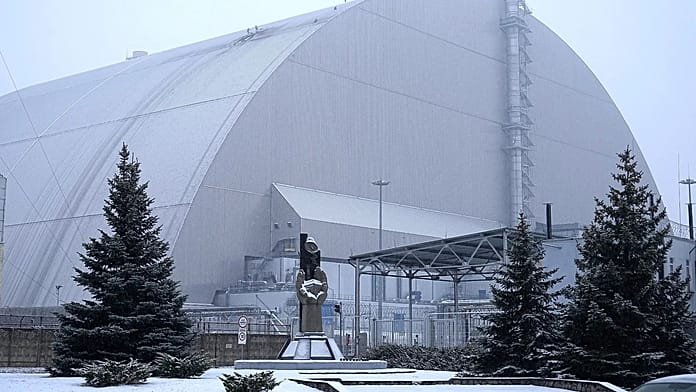
Chernobyl could face ‘catastrophic’ collapse as repairs stall following Russian drone strike

The protective shell surrounding the remains of a damaged reactor at the defunct Chernobyl nuclear power plant. Ukraine, Friday, Feb. 14, 2025.
–
Copyright
AP Photo/Efrem Lukatsky
14/04/2026 – 12:40 GMT+2
Failure to repair the protective structure around the nuclear site could unleash ‘highly radioactive dust’ that ‘does not recognise borders’, experts warn.
A potential collapse of the internal radiation shelter at the defunct Chernobyl nuclear power plant in Ukraine could risk a release of radioactivity into the environment, Greenpeace warned on Tuesday (14 April).

ADVERTISEMENT
ADVERTISEMENT
It comes just days before the 40th anniversary of the Chernobyl disaster, which remains the world’s worst nuclear disaster. On 26 April 1986, while Ukraine was part of the Soviet Union, a reactor at the plant exploded, contaminating a vast area spanning Ukraine, Belarus and Russia.
Following the disaster, an inner steel-and-concrete structure, known as the sarcophagus, was hastily built around the destroyed reactor to prevent further radiation leaks.
Years later in November 2016, a high-tech metal dome called the New Safe Confinement (NSC) structure was built, at a cost of €1.5 billion, to reinforce the inner shell.
Why are experts concerned about Chernobyl?
Kyiv has repeatedly accused Russia of targeting the power plant since Moscow launched its full-scale invasion of Ukraine in 2022, including last year, when a Russian drone struck the outer shell in February.
While the International Atomic Energy Agency (IAEA) initially had not reported any radiation leaks, in December it confirmed that the drone impact had degraded the steel structure and that it no longer blocked radiation.
IAEA Director General Rafael Grossi said that an inspection “confirmed that the [protective structure] had lost its primary safety functions, including the confinement capability, but also found that there was no permanent damage to its load-bearing structures or monitoring systems.”
Grossi added that while some repairs had taken place, “comprehensive restoration remains essential to prevent further degradation and ensure long-term nuclear safety”.
Chernobyl requires an estimated €500 million in repairs
Last month, French Foreign Minister Jean-Noel Barrot estimated the dome required almost €500 million in repairs.
“We presented this evening the first financial estimate of the damage caused by this drone which amounts to around €500 million,” said Barrot after chairing a meeting of G7 foreign ministers in March.
Greenpeace reported that despite some repair efforts, the protective shield has not yet been fully restored. The organisation warned that this increases the risk of radioactivity release, especially in the case of a collapse of the internal structure.
“That would be catastrophic because there’s four tonnes of dust, highly radioactive dust, fuel pellets, enormous amounts of radioactivity inside the sarcophagus,” senior nuclear specialist for Greenpeace Ukraine, Shaun Burnie, told media agency AFP earlier this month.
“And because the New Safe Confinement cannot be repaired at the moment, it cannot function as it was designed, there’s a possibility of radioactive releases,” Burnie added.
‘Radioactive particles do not recognise borders’
The deconstruction of unstable elements of the inner shell is crucial to prevent an uncontrolled collapse, Greenpeace said, but further works to the site have been impeded by Russia’s ongoing attacks.
In addition to Greenpeace’s warning, the power plant‘s director Sergiy Tarakanov has also warned that if a rocket were to land near the facility, the structure could be at risk of collapsing due to the impact.
“And from what the 1986 accident showed us… the radioactive particles do not recognise borders,” Tarakanov added.