


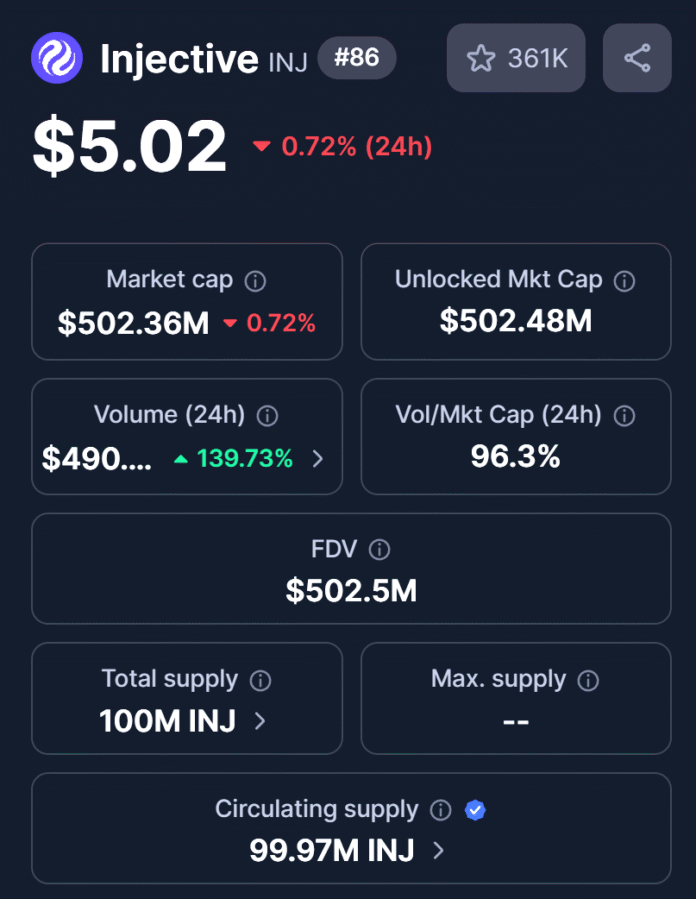
Injective (INJ) just ripped nearly 90% in a month, climbing from around $3.05 in mid-April to above $5.80 by May 13, 2026 — one of the strongest moves any large-cap altcoin has put together this year. The rally landed as Circle’s USDC went live natively on Injective, the first CFTC-regulated INJ futures opened in the U.S., and a community burn round filled in under ten minutes. Here’s what’s driving the surge, what the chart is saying, and what we’d actually consider doing about it.
INJ’s price action: from $3 to nearly $6 in a month
In mid-April 2026, INJ was around $3.05 and looking flat — one of many large-cap altcoins stuck below $4. Then the chart flipped. By May 13, INJ was near $5.80, up 48% on the week and 90% on the month, outpacing every other top-100 coin on the day. For a token that lost over 90% from its 2024 high of $52.94, this is the first real reversal in over a year.

Volume tells the same story. Daily spot volume jumped 86% to over $283 million in 24 hours, while futures volume hit $612 million. Open interest — the total value of all open futures contracts, which shows how much fresh money is in the market — climbed 60% in a single day. That’s the kind of participation that turns a quick bounce into a real trend.
One more number worth knowing: INJ funding rates were negative when the rally began. In plain English, a big slice of the market was still betting price would fall. When it climbed instead, those short sellers had to buy INJ back to close their bets — fuel that traders call a “short squeeze.” That’s how a normal breakout turned into a 22% single-day candle on May 13.
What’s driving the Injective INJ rally in May 2026
We’d be lying if we said this is purely a chart story. The breakout lined up with a stack of real-world catalysts, all hitting inside about four weeks. Let’s find out about each one.
U.S.-regulated INJ futures went live
On April 15, 2026, Bitnomial — a CFTC-regulated derivatives exchange — launched the first U.S.-regulated INJ futures. INJ now sits in a tiny club next to BTC, ETH, SOL, and XRP with regulated futures in the U.S. That matters because regulated futures usually come before a spot ETF approval, and Canary Capital has already filed with the SEC for a staked INJ ETF.

An ETF (exchange-traded fund) is a regulated fund that holds the asset for you, so getting closer to one means institutional money can buy in without ever touching a crypto wallet.
Kraken closed its $550M Bitnomial deal
The futures launch got a second boost in early May, when Kraken’s parent Payward closed its $550 million acquisition of Bitnomial. The deal plugs INJ futures into Kraken’s customer base, and into the same pipes big banks and brokerages already use.

At Consensus 2026, Bitnomial’s president called Injective one of the few digital assets with both active regulated futures and live ETF filings.
Native USDC and CCTP went live on Injective
On May 7, 2026, Circle launched native USDC and its Cross-Chain Transfer Protocol (CCTP) on Injective. Circle confirmed it on X:
Before this, USDC on Injective had to come from a “wrapped” version — basically a copy minted by a third party. Wrapped tokens carry bridge risk, where a hack can wipe out the funds parked there. Native USDC removes that layer.
You get the real Circle-issued stablecoin, backed by audited cash and short-term Treasuries, transferable across 23+ chains with near-zero gas fees.

Four days later, Injective went further — announcing that Injective USDC will be the canonical USDC standard for Cosmos Hub and dYdX, one of the largest perpetual DEXs (decentralized exchanges, where trades clear on-chain instead of through a company). The deal is locked in for four years.
A record-fast community token burn
On May 6, 2026, Injective’s monthly Community BuyBack filled in under 10 minutes. Participants committed INJ to a pool worth over $196,000 in ecosystem revenue, and those tokens were permanently burned. It’s a simple loop: more network activity means more revenue, more revenue feeds the buyback, and more INJ gets removed each month.
This sits on top of the broader Supply Squeeze Upgrade (IIP-617), passed with 99.89% support in January 2026. Combined with the existing burn, over 6.87 million INJ have been permanently removed. When supply shrinks, and demand picks up, price usually has only one direction to go.
Pre-IPO tokenized stocks on the chain
One more thread worth watching. Injective is one of the only chains where you can trade price exposure to private companies like OpenAI, SpaceX, and Anthropic — assets normally locked behind venture capital. Through a partnership with investment platform Republic, retail traders can now access these pre-IPO markets on Injective.

There’s regulatory noise (Anthropic has pushed back against unauthorized stock transfers), but the idea of bringing the $13 trillion private equity market on-chain is genuinely new.
INJ technical analysis: what the chart is saying
The news flow explains why money is moving in. The chart tells us where the price might go. Here’s what each major indicator is showing as of May 13, 2026.

Chart pattern: Falling wedge breakout
INJ spent most of 2026 stuck in a falling wedge — a pattern where lower highs and lower lows squeeze into a tighter range. Wedges act like coiled springs: when price breaks out, the move is usually sharp. INJ broke above its wedge in early April and confirmed with a clean retest on April 8. That’s the structural reason a $3 token is suddenly trading near $6.
Key support and resistance levels
These are the levels traders are watching:
- Immediate support: $5.15 (the breakout level). If this holds on any dip, the bullish case stays intact.
- Deeper support: $4.60, then $4.00 and $3.50. A close below $4.60 would suggest the breakout was a fake-out.
- Next resistance: $6.20 (January 2026 high), then $6.90 (the wedge’s measured-move target), with $8 and $10 as stretch targets.
RSI: Hot and getting hotter
The RSI (Relative Strength Index) is a momentum gauge that runs from 0 to 100, where anything above 70 is “overbought.” INJ’s daily RSI sits at 86–87 right now — deep into the zone where pullbacks tend to happen. It doesn’t mean a crash is coming, but it does mean this pace isn’t sustainable. INJ has historically cooled off within three sessions of hitting these levels.
MACD: Bullish, but starting to diverge
The MACD (a trend indicator that compares short and long moving averages) flipped positive in late April and stayed there. But on May 13, the MACD’s histogram flattened to near zero while price kept climbing. That gap between momentum and price is called bearish divergence — a warning sign that the engine is starting to cough even though the car still looks fast.
Bollinger Bands: Outside the band
Bollinger Bands measure how far a price has stretched from its average. INJ is currently punching through the upper band, with a %B reading above 1.2. Outside-the-band readings rarely last more than a few sessions before either a hard pullback or a sideways pause to let the bands catch up.
So what’s next? The $6 to $10 question
We’ve seen this pattern before. A coin breaks out, the news flow gets loud, RSI runs hot, and then one of two things happens: either price holds above support and pushes higher, or profit-taking kicks in, and the move retraces hard. Right now, INJ is balanced on exactly that edge.
- The bullish path is clean. If INJ holds above $5.15 on any pullback and closes a week above $6.20, the wedge’s target points to $6.90 first, then the psychological $10 level. The short-squeeze fuel is real, the burn keeps tightening supply, and ETF expectations build as the Bitnomial futures rack up trading history.
- The bearish path is just as plausible in the short term. RSI at 86 is the kind of reading that often fades within 48–72 hours. If Bitcoin loses its grip above $81,000, alt momentum trades usually unwind first — and INJ is the most crowded long in the top 100 right now. A drop below $5.00, especially on rising volume, puts $4.60 in play fast.

If you’re tracking similar setups, SUI’s recent monthly run shows how fast these moves can flip from euphoria back into chop.
The next big check-in for INJ is the Injective Summit in Washington, D.C, on July 16, where ETF progress and adoption updates are on the agenda.
What you can actually do during this rally
This isn’t financial advice. But here’s how informed traders typically think about a setup like this, so you can apply the same logic to your own decisions.
If you’re already holding INJ
Holders who bought below $4 are sitting on big paper gains. A common playbook here is to take partial profits — for example, selling enough to cover your original investment and letting the rest run. That removes downside risk on your starting capital while keeping exposure to a possible push toward $8–$10. Setting a <u>stop-loss</u> below $5.00 or $4.60 is another common move — that’s where the breakout structure would technically break.
If you’re thinking about buying in now
Chasing a 90% move with RSI above 85 is historically how people lose money fast. Traders who still want exposure usually scale in — a small position now, then adding more on a pullback toward $5.00 or $4.60 if those levels hold. Waiting for a clean retest of the breakout zone is generally a better risk-reward setup than buying the green candle.
If you’re brand new to crypto
A few things to know before you do anything. First, INJ is volatile — it can move 20% in a day either way, as this week showed. Second, never invest more than you can afford to lose. Third, big narratives like ETFs and stablecoin launches sound bullish, but they often get priced in fast — by the time it’s on the front page, the easy move is usually done.
What we’re watching from here
A few signals we’re keeping an eye on: a weekly close above $6.20 (confirms the next leg), funding rates flipping deeply positive (over-leveraged longs, possible reversal), Bitcoin holding or losing $81,000, and any official update on the Canary Capital staked INJ ETF filing. Any one of those can swing the next move sharply.
The post Why is Injective (INJ) Up 90% in the last 30 days? Inside the May 2026 Rally appeared first on Memeburn.