


15/05/2026 – 12:50 GMT+2
After raising high expectations ahead of his trip to Beijing, the U.S. president leaves with little to show for it, disappointing investors. On key flashpoints such as Iran and Taiwan, China didn’t give any ground.
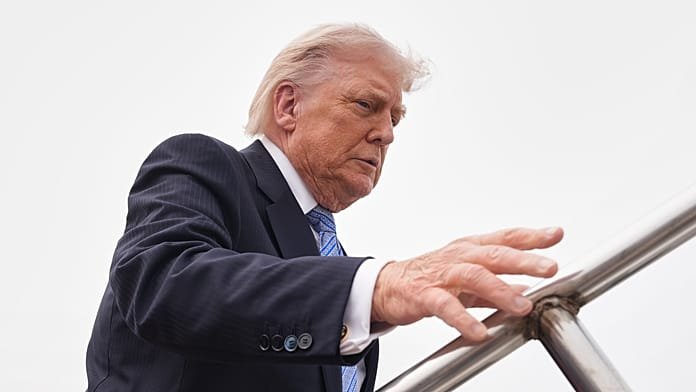
Before his trip to China, Donald Trump faced outsized expectations – largely nurtured by himself.

ADVERTISEMENT
ADVERTISEMENT
But the reality of a complex and challenging relationship caught up with him.
And that includes the fact that China has the upper hand right now.
From a US perspective, the immediate outcome of his summit with Chinese President Xi Jinping was meagre: no grand breakthrough, but a mere stabilization of relations and a broad effort to prevent the superpower rivalry from spiralling further out of control.
“You don’t get the sense that much has been accomplished,” said Helmut Brandstätter, a liberal Member of the European Parliament from Austria who is well connected with Chinese diplomats.
“Trump hasn’t achieved anything economically for himself, nor has he done anything for the rest of the world,” he added.
In the run-up to the summit, Trump gave the impression that, with his large entourage of top American CEOs, he would bring home major contracts for the American economy. But that wasn’t the case.
Although Xi agreed to purchase 200 Boeing jets, that number was much lower than the 500 that Trump had floated before.
Consequently, investors in the US were disappointed, with Boeing shares falling 4% on Wall Street.
The US president’s comment was vintage Trump: Xi “is going to order 200 jets…200 big ones.”
A large Boeing order was one of many business deals expected to come out of the closely watched talks. Yet by the time Trump left China on Friday, it was the only major deal that was announced.
The country’s last big order with Boeing was during Trump’s November 2017 trip to Beijing, when China agreed to buy 300 Boeing planes.
Relations between the two countries soured after that, and Boeing orders from China dried up.
According to US officials, both sides had agreed to sell farm goods, but only scant details were available, and no signs of a breakthrough on selling Nvidia chips to China, despite CEO Jensen Huang’s dramatic last-minute addition to the trip.
On a positive note, both sides agreed to work to preserve and extend the fragile “trade truce” reached after the tariff war of last year.
They discussed mechanisms to manage future tariff disputes and export controls rather than allowing tensions to escalate immediately.
For European leaders nervously watching the summit, the underwhelming outcome should be a reason for relief, as nothing was said that would sideline the EU economically, according to Ling Chen, an associate professor at the Johns Hopkins University School of Advanced International Studies (SAIS).
“The EU is not economically marginalized because it is an important economic partner to both the U.S. and China, especially as the two great powers compete strategically,” she added. “The EU is also an essential market for China’s green energy products.”
While Trump and Xi may have stabilized their economic and trade relations, geopolitical security differences were barely papered over, at least in public.
At a banquet filed with pageantry, both leaders praised the other lavishly.
Xi described the get-together as a “milestone visit”, while Trump spoke of a “great couple of days” during which “fantastic trade deals” were made.
Yet, the commonality seemed to end there.
Just before the final Trump-Xi meeting on Friday, China’s foreign minister issued a blunt statement outlining its frustration with the US and Israel’s war with Iran.
“This conflict, which should never have happened, has no reason to continue,” the ministry said, adding that China was supporting efforts to reach a peace deal in a war that had severely affected energy supplies and the global economy.
On Thursday, Trump said in an interview with Fox News that Xi offered “to be of help” to re-open the Strait of Hormuz and pledged not to send military equipment to Iran, yet the Chinese side did not comment.
Before the summit, Trump was hoping for Chinese pressure on its Iranian ally to find a solution to end the conflict, but that did not materialize – maybe not yet.
“It is quite possible that the Chinese will exercise subtle influence on the Iranians in the weeks to come, but little of it will likely be visible,” said Ian Lesser, distinguished fellow at The German Marshall Fund.
The other big geopolitical issue, central to Chinese politics, is Taiwan – a topic that the American readout of the talks didn’t mention at all.
Yet, the Chinese issued a statement saying that Xi “stressed to President Trump that the Taiwan question is the most important issue in China-US relations” and could lead to clashes and even conflict if not handled properly.
A stark, if not unprecedented warning.
Taiwan, just 80 kilometres off China’s coast, has long been a flashpoint in Sino-American ties, with Beijing refusing to rule out use of military force to gain control of the island and the US bound by law to provide it the means of self-defence.
US Secretary of State Marco Rubio who was part of the delegation later tried to downplay the significance of the Chinese warning on Taiwan.
“US policy on the issue of Taiwan is unchanged as of today,” he told NBC News. The Chinese “always raise it…we always make clear our position and we move on,” he added.
A remark Rubio was thanked for on Friday by Taiwan Foreign Minister Lin Chia-lung.
Others compared Beijing’s posturing on Taiwan to some sort of shadow-boxing.
“When it comes to Taiwan, the big question is: will Xi take the plunge, or won’t he?”, Brandstätter said.
“As long as the Chinese continue to buy chips manufactured in Taiwan, they won’t attack,” he added. “Moreover, the Taiwanese are very well-equipped militarily and would be anything but easy prey for Beijing.”