



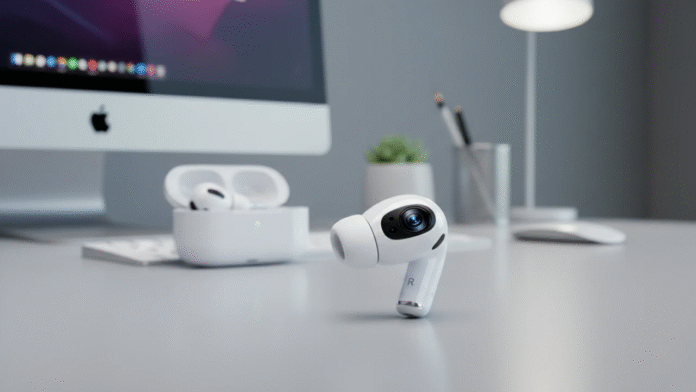
Apple is reportedly moving closer to a version of AirPods with built-in cameras, marking a new step in its strategy to bring AI into wearable devices. The Verge, citing Bloomberg’s Mark Gurman, reported that the project has reached an advanced testing stage, with the design and feature set nearly finalized. The current prototypes are reportedly in design validation testing, a stage that often comes before mass production testing.
The key point is that the cameras on these AirPods are not designed to turn the earbuds into tiny cameras. Instead, they are expected to act as “eyes” for Siri, giving Apple’s voice assistant more visual information about the user’s surroundings. MacRumors also cited Gurman as saying that Apple is developing AirPods with cameras “for Siri,” rather than for traditional photo-taking purposes.
If this information is accurate, this would no longer be a traditional AirPods upgrade focused on better sound, stronger noise cancellation, or longer battery life. Apple may be trying to turn AirPods into an AI device that can understand real-world context.

What Would Cameras on AirPods Be Used For?
The core idea is not to let users take photos with earbuds, but to give Siri more “visual input.” With low-resolution cameras, AirPods could:
- Collect visual data so users can ask Siri about what is in front of them, such as what meal they can cook with the ingredients they have.
- In other scenarios, the cameras could support navigation, object recognition, or context-aware responses.
This is what makes camera-equipped AirPods notable: users would still interact through voice, but AI would no longer only hear audio. It could also understand part of the world around the user.
In other words, Apple may be testing a new AI interface layer. Instead of forcing users to open an iPhone, type a question, or look at a screen, AirPods could become an intermediary device that lets users ask AI questions in everyday life.

Privacy Could Become a Major Issue
However, cameras on AirPods also raise a sensitive question: will other people know when the device is “looking”?
Even if the cameras are low-resolution and are not used for taking photos or recording videos, a wearable device that can analyze the surrounding environment could still make users and people nearby uncomfortable. This is especially important because AirPods are often used in public places, offices, cafés, public transportation, and more private spaces.
Apple also appears to be aware of this issue. The Verge reported that camera-equipped AirPods could include an LED indicator to show when visual data is being processed. If implemented, this detail would not just be a small hardware feature. It would be a way for Apple to reassure users that they can know when the camera is active.
But an LED indicator may not be enough. With an AI wearable device, the bigger questions are:
- Where is the visual data processed?
- Is the data stored?
- How clearly will Apple explain that mechanism?
This could become one of the biggest barriers if Apple wants to bring cameras to a product as popular as AirPods.
Why Does Apple Need an AI Wearable Device?
Apple is under major pressure in the AI race. While OpenAI, Google, Anthropic, and Meta continue to push chatbots, AI models, and new AI devices, Apple is still seen as slower in AI software, especially Siri.
But Apple has an advantage that many rivals do not: a massive hardware ecosystem. The iPhone, Apple Watch, AirPods, Mac, and Vision Pro can all become touchpoints for bringing AI into users’ daily lives.
This is why camera-equipped AirPods matter more than a normal product rumor. Apple may not need to win the chatbot race with a ChatGPT-like product. It could instead bring AI into devices that users already wear, carry, and use every day.
AirPods may also be a more practical choice than smart glasses in the early stage. Smart glasses are still a new category, while AirPods are already popular and require less behavioral change from users. If Apple wants to test always-available AI, AirPods could be a lower-risk starting point.
Ray-Ban Meta Shows Why Apple Cannot Stay Out
The AI wearable market is no longer just an idea. Meta has moved ahead of Apple with Ray-Ban Meta, a line of smart glasses with cameras, microphones, open-ear speakers, photo capture, video recording, livestreaming, and voice interaction with Meta AI. On newer models, Meta has also added display-based experiences, messaging, navigation, translation, and context-aware AI responses.
The important point is that the product has already shown clear market traction. The Verge reported that Mark Zuckerberg said Ray-Ban Meta sold more than 1M units in 2024. Reuters later reported that Meta and EssilorLuxottica had considered increasing annual production capacity for Ray-Ban AI glasses to 20M units by the end of 2026 if demand continues to grow.

That creates direct pressure on Apple. If users start getting used to asking AI questions by voice, receiving directions, translating speech, or interacting with their surroundings without opening a phone, the smartphone may no longer be the only interface for personal AI.
Camera-equipped AirPods could be Apple’s way of responding without directly competing with Ray-Ban Meta right away. Instead of asking users to wear glasses, Apple could use a product that is already popular and tightly connected to the iPhone.
But Meta also shows the difficult trade-off with this type of device: the more convenient it becomes, the more privacy concerns it can create. Meta says Ray-Ban glasses have an indicator light when users take photos, record videos, or livestream, and if the light is covered, the device will ask the user to clear it.
If Apple brings cameras to AirPods, it will almost certainly have to solve a similar problem.
Siri Remains the Biggest Barrier
The hardware may have progressed, but the final experience will depend on Siri. A pair of AirPods with cameras will only be truly valuable if Siri is smart enough to understand visual data, respond quickly, and provide useful answers.
This is something Apple cannot ignore. The Verge reported that the product was previously expected to arrive earlier, but was affected by setbacks in the development of a more advanced Siri. Times of India also cited information suggesting that the launch timing could depend on the new version of Siri, not just the hardware.
That makes camera-equipped AirPods a major test for Apple AI. If the new Siri is good enough, Apple could create a different kind of AI experience where users ask a voice assistant about the world around them without opening a phone. But if Siri remains slow, inaccurate, or unnatural, cameras on AirPods may become more of a curiosity than a real reason to upgrade.
Apple has not officially announced this product, so the launch timing remains uncertain. However, the fact that the device has reportedly reached an advanced testing stage suggests Apple is serious about turning AirPods into part of a broader AI wearable strategy.
The post Apple AI AirPods With Cameras Could Be Its First Real AI Wearable appeared first on Memeburn.