



Michael Saylor recently drew attention from the Bitcoin community after saying that Strategy could sell part of its Bitcoin holdings to pay dividends.
During Strategy’s Q1 2026 earnings call, Saylor said the company could “probably sell some Bitcoin to fund a dividend” to show the market that Strategy remains stable, Bitcoin remains stable, and selling a small amount of BTC does not mean the collapse of its Bitcoin treasury model.
By the end of the quarter, Strategy held 818,334 BTC, or about 3.9% of Bitcoin’s total supply. In Q1, the company bought another 89,599 BTC worth about $7.3B, despite Bitcoin falling during the quarter. Strategy also reported a net loss of about $12.8B, mainly due to a non-cash impact from the decline in the fair value of its Bitcoin holdings.
For years, Saylor has been one of the most visible supporters of the “Never Sell Bitcoin” thesis. So when he mentioned the possibility of selling BTC, the story immediately became bigger: is Strategy changing its Bitcoin strategy?
https://x.com/WatcherGuru/status/2051802384943194431
How STRC Works?
To understand why Saylor mentioned selling Bitcoin, it is important to understand how Strategy is operating its financial model.
Strategy does not only buy Bitcoin with operating cash flow. The company raises capital through common stock, convertible debt, and preferred shares, with STRC, or Stretch Preferred Shares, currently playing a key role.
- In Q1 2026, Strategy raised $11.7B, split almost evenly between common stock and preferred stock, with a large portion linked to STRC.
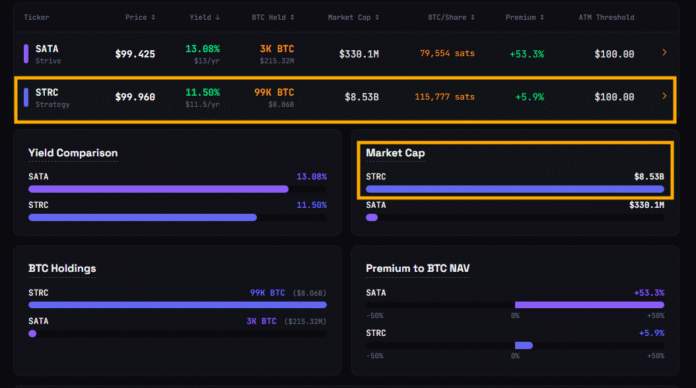
- STRC is perpetual preferred stock with a yield of about 11.5% per year.

The core mechanism is relatively simple:
- New investors buy STRC.
- Strategy uses that money to help pay dividends to earlier holders and buy more Bitcoin.
When Bitcoin rises, Strategy’s balance sheet looks stronger, new investors gain more confidence, and the cycle continues.
In other words, this model depends on new capital continuing to flow in. Bitcoin does not generate cash flow the same way POS blockchains can through staking. A typical example is Tom Lee’s Bitmine, which holds ETH, stakes it, and earns yield.
With BTC, the asset simply sits on the balance sheet and creates value when the BTC price rises. Meanwhile, Strategy’s traditional software business is too small to carry hundreds of millions of dollars in annual dividend obligations by itself.
The actual source of dividend payments comes from issuing more STRC, managing the balance sheet, and relying on expectations that Bitcoin will rise. This creates a model where new capital helps support payments to existing holders.
This model could enter a negative loop if:
- STRC selling slows and fewer new investors buy in.
- Or capital markets tighten, causing the source of funds for dividends to dry up.
- At that point, selling part of the BTC holdings becomes the plan B for maintaining dividend obligations.
CEO Phong Le also said Strategy would consider selling Bitcoin if doing so helped repurchase debt or optimize the Bitcoin-per-share metric. The company did not say it would sell because it had lost faith in Bitcoin. Instead, it said selling BTC could make sense if it increased shareholder value based on how much Bitcoin corresponds to each share.

What Happens If Strategy Really Has to Sell BTC?
Saylor described selling BTC as a controlled and proactive option. But the more concerning scenario is when selling is no longer optional and becomes necessary.
The issue lies in the domino effect. STRC dividend obligations are around $800M per year, and that number only increases as Strategy issues more shares. If new STRC capital slows and Bitcoin does not rise enough, Strategy may have to sell BTC to pay dividends. Once the first sale happens, the issue may not stop there.
The reason is simple:
- The entire STRC model relies on confidence that Strategy will not sell Bitcoin.
- Once that confidence is broken, who will continue buying STRC?
- Investors buy STRC because of its 11.5% yield, but that yield is only sustainable if new buyers continue to come in.
If Strategy sells BTC to pay dividends, sentiment could weaken sharply. The market would start asking:
- How much will be sold next time?
- How long will the selling continue?
- Does this model really work?
If Strategy can no longer issue more STRC, it loses its main source of funds for dividend payments, which means it may need to sell more BTC. More selling could pressure the BTC price, weaken Strategy’s balance sheet, and damage investor confidence further, creating a downward spiral.
For the broader Bitcoin market, Strategy holds nearly 4% of Bitcoin’s total supply. If the company has to sell continuously during a weak market, the pressure on BTC would not be small.
Not because one sale of a few thousand BTC would break the market, but because the signal could trigger panic. If the world’s largest corporate Bitcoin holder is selling, why should others keep holding?
This is the worst-case scenario, not a guaranteed outcome. Strategy still has about $2.25B in cash, enough for around 30 months of dividend payments without selling BTC. But if Bitcoin trades sideways or falls for a long period, that runway could shrink quickly.
Looking at the Bigger Picture
Strategy has not abandoned Bitcoin. But the company is entering a new phase, where “buy and hold” is being combined with a much more complex financial system.
MSTR is no longer just a software company holding Bitcoin. It has become a complex financial product, where investors are exposed not only to Bitcoin but also to the way Strategy raises capital, issues preferred stock, and manages debt.
If the model succeeds, Bitcoin could be used not only as a reserve asset but also as a foundation for credit instruments and corporate capital strategies. If the model comes under pressure, it will raise new questions about leverage risk, dividend obligations, and liquidity, not only for Strategy but for the broader “Bitcoin as corporate treasury” narrative.
The post Michael Saylor Explains How MSTR Could Sell Bitcoin to Pay Dividends appeared first on Memeburn.