


What was the Iran nuclear deal Trump dumped in search of ‘better’ terms?
The US president withdrew the US from the JCPOA in 2018, previously branding it ‘the worst deal ever’ and seeking stronger terms.
Save

Published On 21 Apr 202621 Apr 2026
United States President Donald Trump has said a nuclear agreement currently being negotiated with Iran will be “far better” than the 2015 Joint Comprehensive Plan of Action (JCPOA), which he withdrew from in 2018 during his first term in office.
The original 2015 accord took roughly two years of negotiations to reach and involved hundreds of specialists across technical and legal fields, including multiple US experts. Under it, Iran agreed to restrict the enrichment of uranium and to subject itself to inspections in exchange for the relaxation of sanctions.
Recommended Stories
list of 3 itemsend of list
But Trump took the US out of that pact, calling it the “worst deal ever”. Before the initial US-Israeli strikes on Iran at the end of February, the US had made new demands – including additional restrictions on Tehran’s nuclear programme, the restriction of its ballistic missiles programme and an end to its support for regional armed groups, primarily in Lebanon, Yemen and Iraq.
Trump’s latest remarks come amid growing uncertainty about whether a second round of talks will proceed in the Pakistani capital Islamabad, as a two-week ceasefire between the US-Israel and Iran approaches the end in just a day.
So, what was the JCPOA, and how did it compare to Trump’s new demands?
What was the JCPOA?
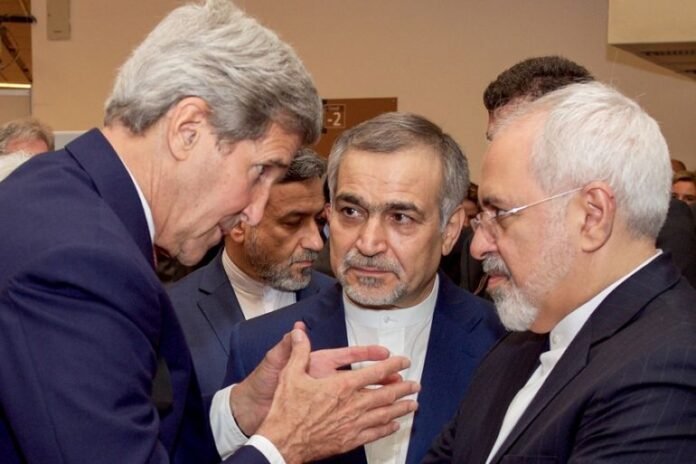
On July 14, 2015, Iran reached an agreement with the European Union and six major powers – China, France, Russia, the United Kingdom, the US, and Germany – under which these states would roll back international economic sanctions and allow Iran greater participation in the global economy.
Advertisement
In return, Tehran committed to limiting activities that could be used to produce a nuclear weapon.
These included reducing its stockpile of enriched uranium by about 98 percent, to less than 300kg (660lb), and capping uranium enrichment at 3.67 percent – far below weapons-grade of 90 percent, but high enough for civilian purposes such as power generation.
Before the JCPOA, Iran operated roughly 20,000 uranium-enriching centrifuges. Under the deal, that number was cut to a maximum of 6,104, and only older-generation machines confined to two facilities, which were subject to international monitoring.
Centrifuges are machines which spin to increase the concentration of the uranium-235 isotope – enrichment – in uranium, a key step towards potential bomb-making.
The deal also redesigned Iran’s Arak heavy water reactor to prevent plutonium production and introduced one of the most intrusive inspection regimes ever implemented by the global nuclear watchdog, the International Atomic Energy Agency (IAEA).
In exchange, Iran received relief from international sanctions which had severely damaged its economy. Billions of dollars in frozen assets were released, and restrictions on oil exports and banking were eased.
The deal came to halt when Trump formally withdrew Washington from the nuclear deal in 2018, a move widely criticised domestically and by foreign allies, and despite the IAEA saying Iran had complied with the agreement up to that point.
“The Iranian regime supports terrorism and exports violence, bloodshed and chaos across the Middle East. That is why we must put an end to Iran’s continued aggression and nuclear ambitions. They have not lived up to the spirit of their agreement,” he said in October 2017.
He reimposed crippling economic sanctions on Tehran as part of his “maximum pressure” tactic. These targeted Iran’s oil exports, as well as its shipping sector, banking system and other key industries.
The goal was to force Iran back to the negotiating table to agree to a new deal, which also included a discussion about Tehran’s missile capabilities, further curbs on enrichment and more scrutiny of its nuclear programme.
What has happened to Iran’s nuclear programme since the JCPOA?
During the JCPOA period, Iran’s nuclear programme was tightly constrained and heavily monitored. The IAEA repeatedly verified that Iran was complying with the deal’s terms, including one year after Trump announced the US’s withdrawal from the agreement.
Starting in mid-2019, however, Iran began incrementally breaching the deal’s limits, exceeding caps on uranium stockpiles and enrichment levels.
Advertisement
In November 2024, Iran said it would activate “new and advanced” centrifuges. The IAEA confirmed that Tehran had informed the nuclear watchdog that it planned to install more than 6,000 new centrifuges to enrich uranium.
In December 2024, the IAEA said Iran was rapidly enriching uranium to 60 percent purity, moving closer to the 90 percent threshold needed for weapons-grade material. Most recently, in 2025, the IAEA estimated that Iran had 440kg (970lb) of 60-percent enriched uranium.
What are Trump’s latest demands for Iran’s nuclear programme?
The US and its ally, Israel, are pushing Iran to agree to zero uranium enrichment and have accused Iran of working towards building a nuclear weapon, while providing no evidence for their claims.
They also want Iran’s estimated 440kg stock of 60pc enriched uranium to be removed from Iran. While that is below weapons-grade, it is the point at which it becomes much faster to achieve the 90 percent enrichment needed for atomic weapons production.
Iran has insisted its enrichment effort is for civilian purposes only. It is a signatory to the 1970 Treaty on the Non-Proliferation of Nuclear Weapons (NPT).
In March 2025, Tulsi Gabbard, the US director of national intelligence, testified to Congress that the US “continues to assess that Iran is not building a nuclear weapon”.
On Sunday, Iranian President Masoud Pezeshkian, in a strongly worded statement, said Trump had no right to ”deprive” Iran of its nuclear rights.

What else is Trump asking for?
Restrictions on ballistic missiles
Before the US-Israel war on Iran began, Tehran had always insisted negotiations should be exclusively focused on Iran’s nuclear programme.
US and Israeli demands, however, extended beyond that. Just before the war began, Washington and Israel demanded severe restrictions on Iran’s ballistic missile programme.
Analysts say this demand was at least partly triggered by the fact that several Iranian missiles had breached Israel’s much-vaunted “Iron Dome” defence system during the 12-day war between the two countries in June last year. While Israel suffered only a handful of casualties, it is understood to have been alarmed.
For his part, Trump has repeatedly warned, without evidence, about the dangers of Iran’s long-range missiles, claiming Iran is producing them “in very high numbers” and they could “overwhelm the Iron Dome”.
Iran has said its right to maintain missile capabilities is non-negotiable. The JCPOA did not put any limits on the development of ballistic missiles.
However, a United Nations resolution made when adopting the nuclear agreement in July 2015 did stipulate that Iran could not “undertake any activity related to ballistic missiles designed to be capable of delivering nuclear weapons”.
Ending support for proxy groups
The US and Israel have also demanded that Iran stop supporting its non-state allies across the Middle East, including Hezbollah in Lebanon, the Houthis in Yemen and a number of groups in Iraq. Together, these groups are referred to as Iran’s “axis of resistance”.
Advertisement
In May last year, Trump said Tehran “must stop sponsoring terror, halt its bloody proxy wars, and permanently and verifiably cease pursuit of nuclear weapons”, during a GCC meeting in Riyadh.
Three days before the war on Iran began in February, during his State of the Union address to Congress, Trump accused Iran and “its murderous proxies” of spreading “nothing but terrorism and death and hate”.
Iran has refused to enter a dialogue about limiting its support for these armed groups.
Can Trump really get a new deal that is ‘much better’ than the JCPOA?
According to Andreas Kreig, associate professor of Security Studies at King’s College, London, Trump is more likely to secure a new deal that closely resembles the JCPOA, with “some form of restrictions on enrichment, possibly with a sunset clause, and international supervision”.
“Iran might get access to frozen assets and lifted sanctions much quicker than under the JCPOA, as it will not agree to a long drawn-out, gradual lifting of sanctions,” Krieg pointed out.
However, he warned that the political landscape in Tehran has hardened. “Iran now is a far more hardline and less pragmatic player that will play hardball at every junction. Trump cannot count on any goodwill in Tehran,” he said.
“The IRGC is now firmly in charge… with likely new powerful and tested levers such as the Strait of Hormuz,” he said, referring to the Islamic Revolutionary Guard Corps, which operates as a parallel elite military force to the army and has a great deal of political and economic power in Iran. It is a constitutionally recognised part of the Iranian military and answers directly to the supreme leader.
Overall, Krieg stressed, the US-Israel war on Iran “leaves the world worse off than had Trump stuck to the JCPOA”, even if a new compromise is eventually reached.
Moreover, since the revocation of the JCPOA, the US and Israel have waged two wars on Iran, including the current one. The 12-day war in June last year included attacks on Iran’s nuclear sites and killed more than 1,000 people.
Attacks on Iran’s nuclear infrastructure have continued since the latest war began on February 28, including on the Natanz enrichment facility, Isfahan nuclear complex, Arak heavy water reactor, and the Bushehr nuclear power plant.

Nevertheless, King’s College’s Krieg said there is still room for a negotiated outcome if Tehran and Washington scale back their demands.
“Both sides can compromise on enrichment thresholds, and on temporary moratoriums on enrichments. But Iran will not surrender its sovereignty to enrich altogether, and the Trump administration will have to meet them halfway,” he said.
“While the Iranians will commit on paper not to develop a nuclear weapon, they will want to keep R&D [research and development] in this space alive.”
Economic incentives will be central, he added. “Equally, Iran would want to get immediate access to capital and liquidity. Here, the Trump administration is already willing to compromise.”