


18/03/2026 – 15:00 GMT+1
Attacks on ships in Hormuz and strikes across the region expose Tehran’s strategy of gradual escalation and long war, testing US, Israeli and Gulf resolve.
If you ask Iran, the Strait of Hormuz has not been closed. You just have to do it Tehran’s way.

ADVERTISEMENT
ADVERTISEMENT
“Iran now channels ‘verified’ shipping through a path well inside Iranian territorial waters north of Larak island and away from the international corridors in Omani waters,” Farzin Nadimi, a senior fellow at the Washington Institute for Near East Policy, described the arrangement to Euronews.
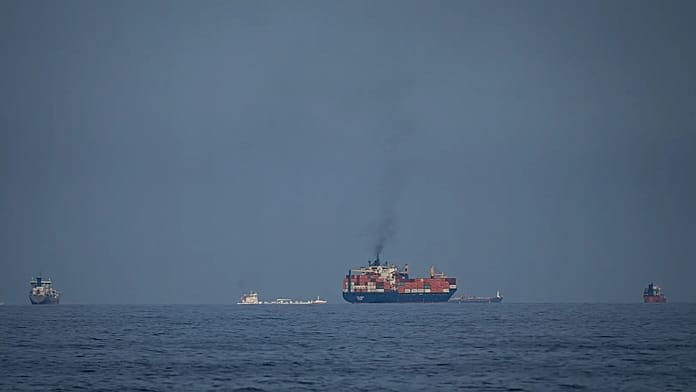
Since the outbreak of the Iran war, Tehran has used coercion — be it threats or outright force — to redirect cargo ships attempting to pass through the bottleneck passage connecting the Persian Gulf to the Arabian Sea into Iranian territorial waters, where Iran can impose its own rules.
If you want to pass through the narrow waterway, there are three options.
Some tankers are still coming through with their tracking transponders switched off, navigating dark. Tehran has allowed a few others to pass, including Chinese-, Turkish-, Indian- and Pakistani-flagged vessels.
Most captains — and companies — are not willing to try their luck, as Iran has attacked at least 17 ships in Hormuz since the outbreak of the war on 28 February, according to shipping security monitors, with some reports counting as many as 21.
On Wednesday, maritime data firm Lloyd’s List Intelligence said that only some 89 ships crossed the Strait of Hormuz between 1 March and 15 March – including 16 oil tankers — down from roughly 100 to 135 vessel passages per day before the war.
Over the years, the Iranian Revolutionary Guard Corps (IRGC) — the elite military unit meant to answer directly to the ayatollah — has built up multiple means of intimidation to be deployed in the strait if something goes awry.
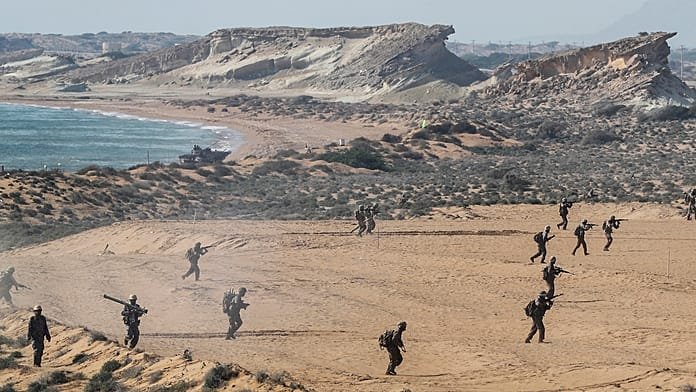
As part of its arsenal, the IRGC Navy maintains Basij militia craft and civilian fishing vessels as cover for surveillance, keeping a line of sight from the fortified island clusters it controls.
Abu Musa, the most strategically significant of the islands Iran controls at the mouth of the Gulf, looks in Nadimi’s description like “a mini version of an IRGC missile city — it has elaborate underground fortifications,” drone bases, landing strips, missile and rocket batteries. Farur island houses an IRGC special operations unit.
“They are trained to launch clandestine operations — among them sneaking into marinas and blowing up multi-million dollar yachts,” Nadimi said. “These are the kinds of things they might do further up the escalation ladder.”
While Iran’s conventional navy has been badly damaged, the IRGC’s naval asymmetric capabilities — the small boat swarms and submersibles in particular — have barely been touched, and they might be the preferred next move instead of a sudden intensification of hostilities.
“If they lay contact mines in the shipping lanes, that will mark the top level of escalation, because when you lay those mines, you just cannot backtrack,” Nadimi explained.
“You make those shipping lanes and anchorages inoperable for a considerable period of time — months. It would take weeks if not months to sweep those waters.”
Instead, to spike insurance premiums or freeze shipping decisions without crossing a red line a full mining campaign would, the IRGC could opt for something much simpler.
“They can use localised attacks — small boats, or submersibles with mines, by sneaking into anchorages and lay a limited number of contact mines to create chaos,” Nadimi said.
According to Nadimi, considering Iran’s stated objective of oil reaching $200 a barrel, “we can assume they will cautiously escalate.”
No quick and decisive war
The caution does not equal weakness, experts say. According to Mehran Kamrava, professor of government at Georgetown University in Qatar, Iran and the US are not fighting the same war.
“The United States and Israel want a quick and decisive victory,” he told Euronews. “Iran has a very different assumption. Simply resisting and surviving is tantamount to victory.”
“Iran doesn’t see the war in quick and decisive terms, it sees it in terms of a very prolonged conflict, one in which over time Iran would grind down American and Israeli resolve and steadily increase the pain inflicted on them.”
Kamrava has studied the region for long enough to find the current situation grimly familiar. “Whenever a more powerful state attacks a less powerful state,” he explained, “in none of those cases has the superior power been able to declare victory,” he said.
“They’ve inflicted a lot of damage, but they have not been able to declare victory. And apparently that historic lesson is lost on Donald Trump and company.”
Nadimi said Tehran is adhering to “a measured, phased escalation,” with Iranian forces using Russian and Chinese satellite imagery — and, he believes, direct intelligence — to assess damage and adjust their daily barrages of missiles and drones targeting neighbouring countries.
The Pentagon has been trying to reduce Iranian launches to what it calls “persistent low rates of firing.” It has largely achieved that. “However,” Nadimi added, “even those few projectiles that manage to pass through defences seem to be very effective.”
Believing in regime’s zero-sum game
The basic principle behind the IRGC’s game of patience has nothing to do with orders — instead, it is driven by belief.
”The IRGC is a highly ideologically indoctrinated military force,” Nadimi said, “and many of them still believe the regime can lead them in a zero-sum game toward a perfect Islamic civilisation in a region where Israel and the United States have no place.”
At the same time, Tehran’s command and control remains questionable, if not outright non-existent. Ayatollah Ali Khamenei was killed in the US-Israeli strikes in the opening salvo of the war on 28 February.
His son Mojtaba Khamenei, installed as supreme leader following his father’s death, has been seen nowhere since he was appointed, while his first public statement was read by an anchor on state-run TV just last week.
“We don’t even have a recording of his voice,” Kamrava said. “Does that mean he is on his deathbed, he’s been injured, he has been disfigured? We don’t know.”
Ali Larijani, Tehran’s top powerbroker and secretary of Iran’s Supreme National Security Council — the man widely seen as pulling the strings for the past weeks instead of Mojtaba Khamenei — was killed in an Israeli strike overnight on Tuesday.
Kamrava believes that none of it may matter much, as the Iranian regime engineered a system over the past decades to keep functioning even if decapitated.
“The Iranians had based their military and political structure in a way so as to be able to continue to function and make decisions somewhat autonomously without the top leadership being there,” he said.
In the context of Hormuz, to Nadimi the crucial figure is not the ayatollah but the commander of the IRGC Navy, Rear Admiral Alireza Tangsiri. “As long as he is still alive, I believe they will be able to maintain some cohesion of command,” he said.
“I do not believe they have started a wholehearted fight yet — they are probably preserving capabilities for a perceived next phase, which could be some kind of an attempt to seize islands, or a major landing operation.”
‘Trapped in this conflict’
Meanwhile, the war has caught the Gulf states in a position they spent years trying to avoid.
Iran has struck targets in Abu Dhabi, Dubai and Manama — acting on the assumption, Kamrava said, that the Gulf countries’ integrated radar systems make them silent partners in the US-Israeli campaign, and that inflicting further pain on others will kill Washington’s appetite for a prolonged intervention.
“In international relations we refer to this as entrapment,” he said. “These states are literally trapped in this conflict. Regardless of how much they might try to distance themselves, in the eyes of the Islamic Republic they are active partners in attacks on Iran.”
Both Qatar and the UAE have publicly credited European defence cooperation in intercepting Iranian strikes — an acknowledgement that has not gone unnoticed in Brussels and European capitals.
“What we saw was a realisation across the GCC that the United States is not always a reliable partner,” Kamrava said. “For the time being the safest bet, apart from the United States, is the European Union.” The partnership is likely to deepen once the shooting stops, whenever that is.
Meanwhile, according to Kamrava, Turkey and Oman are trying to broker an off-ramp, and Qatar and Saudi Arabia are engaged in the process. However, the fundamental question of how the war will unfold and ultimately end remains unanswered.
“Tomorrow Trump could declare victory and say: we’ve achieved our political and military objectives, and the war is over,” Kamrava said. “The question is who’s going to blink first.”
On whether the war ends with the Islamic Republic still standing, both experts are careful.
“The United States and Israel can inflict major damage and can destroy infrastructure and missile batteries — but they cannot win this war against Iran in the same way that so many others tried in the past,” Kamrava said.
“One preferred objective of this extensive air campaign is obviously regime change,” Nadimi said, “but that is ultimately the job of the Iranian people to secure that goal.”
“I do not have a definitive answer to whether an air campaign alone can convince those people to give up. You can’t ignore the fact that most of those people who have guns are still alive.”
Aadel Haleem contributed reporting.