


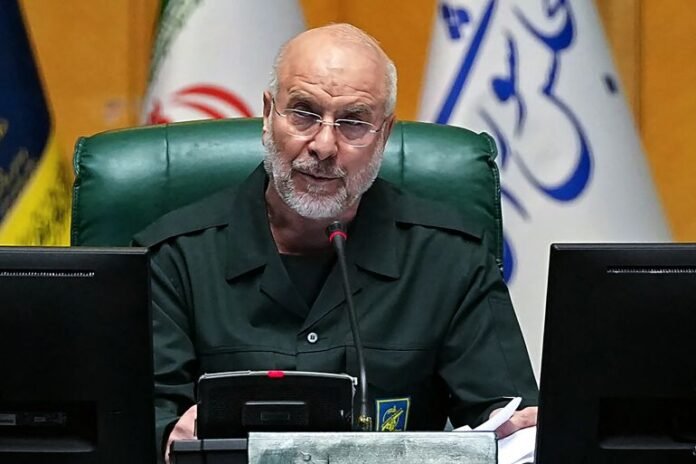
Where to invest during Iran war? Ask – or don’t – Mohammad Bagher Ghalibaf
Iran’s parliamentary speaker has been using social media to shape market sentiment, blending war messaging with financial signalling.
Save

 By Nils AdlerPublished On 31 Mar 202631 Mar 2026
Iran’s parliamentary speaker, Mohammad Bagher Ghalibaf, has positioned himself as an unlikely financial adviser during the United States-Israel war on Iran.
In a series of posts on X, Ghalibaf has urged investors to treat US-driven, market-moving headlines with scepticism, arguing that “fake news” is often used to manipulate financial and oil markets.
Recommended Stories
list of 4 itemsend of list
In a recent post, he wrote: “Heads-up: Pre-market so-called ‘news’ or ‘Truth’ is often just a setup for profit-taking. Basically, it’s a reverse indicator.
“Do the opposite: If they pump it, short it. If they dump it, go long.
“See something tomorrow? You know the drill.”
Ghalibaf’s posts should be viewed within the context of general online sparring between Tehran and Washington since the war began, analysts said, and reflect a new reality in which social media and conflict increasingly overlap.
They have also been laced with wry humour.
In another post, Ghalibaf wrote: “We are aware of what is happening in the paper oil market, including the firms hired to influence oil futures. We also see the broader jawboning campaign.
“But let’s see if they can turn that into ‘actual fuel’ at the pump – or maybe even print gas molecules!”
But behind the bluster, analysts said, there are more serious calculations at play.
Here’s what we know:
Why the financial ‘advice’ from Ghalibaf?
This reflects Iran’s use of asymmetric warfare, through which it seeks to show it can influence US markets by exploiting key economic pressure points, analysts said. This was one of the main reasons for closing the Strait of Hormuz, which links the Gulf to the open ocean and through which 20 percent of the world’s oil and liquefied natural gas (LNG) supplies are shipped. As expected, the strait’s closure sent oil prices soaring and placed mounting economic pressure on the rest of the world.
Advertisement
As part of this approach, Ghalibaf took to X on March 22 to threaten financial institutions that have any role in financing US military assets in the Middle East. “US treasury bonds are soaked in Iranians’ blood,” he wrote. “We monitor your portfolios. This is your final notice.”
“It is widely believed that falling stock markets, rising energy prices and higher interest rates will eventually force [US President Donald] Trump to retreat from military action and look for a diplomatic solution,” Jo Michell, a professor of economics at the University of the West of England in Bristol, told Al Jazeera.
By doing all this, Ghalibaf is also leveraging Trump’s own behaviour on social media.
“It has also been noted that the US president makes some of his most aggressive statements at the weekend when markets are closed, only to back off in time for markets to open,” Michell said, referring to Trump’s at times inconsistent messaging.
One example of this was at the start of the trading week on March 23 when fewer than 12 hours remained on Trump’s original 48-hour deadline for Iran to reopen the Strait of Hormuz. If it did not, he had threatened to “obliterate” Iran’s energy infrastructure.
Just before that deadline expired, Trump extended it by five days and later promised to hold off from attacks on Iran’s energy facilities for an additional 10 days to allow for further “constructive conversations”.
Observers said this pattern of behaviour has given rise to the acronym TACO – “Trump always chickens out” – a phrase used by traders willing to bet that the US president will back down.
Iran appears to have understood how to push the businessman-president’s “pressure points”, Zeidon Alkinani, a Middle East analyst at the Arab Perspectives Institute, told Al Jazeera.
A prolonged and unpredictable conflict can rattle global markets, and even brief shifts in tempo, such as signs of de-escalation, may be interpreted as attempts to stabilise investor confidence and limit economic fallout, Alkinani said, adding that speculation, particularly about sensitive sectors, such as oil, has itself become part of the conflict.
This is something that Tehran and Ghalibaf have capitalised on by becoming more active in the information space and framing the conflict as both a military and propaganda struggle, Alkinani explained.
Michell described Ghalibaf’s social media posts as a form of “taunting” the billionaire US president by exposing “his primary weakness while also emphasising that markets are increasingly ignoring Trump’s attempts to influence them”.
Advertisement
Why words matter
When it comes to financial markets, uncertainty over what will happen can be as powerful a driver of instability as direct action, which analysts said Ghalibaf encapsulates in his posts.
Alkinani explained that the issue is “less about Iran moving prices in a mechanical sense” and more about how the conflict itself creates new leverage points.
In a market in which investors are looking for any small signal about how the war could develop and are growing wary of Trump’s unreliable messaging, even seemingly playful rhetoric from Iranian officials, such as Ghalibaf’s, can add to market volatility, analysts said.

Furthermore, Alkinani said, the importance of the Strait of Hormuz has expanded Iran’s influence beyond actual petroleum supply disruptions and reshapes expectations and market behaviour.
The “high visibility of Donald Trump online”, he said, simply amplifies this dynamic, making him a frequent and accessible target in the digital arena.