



The Western Cape Department of Health and Wellness says it has no plans to comply with a 2025 Labour Court ruling that community health workers (CHWs) must be absorbed into the formal health workforce.
For decades, CHWs have been functioning as part-time workers, employed on a contractual basis, earning stipends, with no pension benefits. Most of these workers were hired by non-profit organisations, and contracted by various provincial health departments. The court ruled that CHWs must be absorbed into the health departments’ formal labour force, where they’d earn salaries and qualify for a pension.
But the Western Cape is not planning on changing its relationship with CHWs.
“Over the years, we have built strong partnerships with non‑profit organisations that recruit and employ the community health workers, ensuring services are tailored to the needs of the neighbourhoods they know best,” Maret Lesch, a spokesperson for the provincial health department, tells Health-e News.
According to Lesch this model has been effective and sustainable, and the province will continue to partner with NPOs.
“We appreciate the vital contributions of every community health worker and will continue working with our partners to ensure they perform their roles with the respect and support they deserve,” Lesch says.
Partnering Organisations
Nobuntu Mfengwana (53) is a CHW in Cape Town working for Philani Nutrition Centre, one of the NPOs contracted by the department.
“Being regarded as an essential worker feels like an insult to me. I see myself as a vulnerable worker,” says Mfengwana.
She’s been working as a CHW for different organisations since 2012, gaining extensive experience over the years. She earns R4900 monthly – an amount she says is not enough to meet the basic needs of her family of nine.
Like many CHWs, Mfengwana is hopeful that the Western Cape health department will eventually follow the lead of other provinces and integrate them into the formal health system. But this seems unlikely.
“In the Western Cape, we are kept in the dark. The DoH remains silent on this issue. We see other provinces making progress in employing CHWs within their health systems. Knowing if the Western Cape will not pursue that route would be preferable to being left uninformed,” she explains.
Provinces such as the Free State, Northern Cape, Limpopo and Gauteng have started absorbing CHW into the permanent health workforce.
Working under extreme conditions
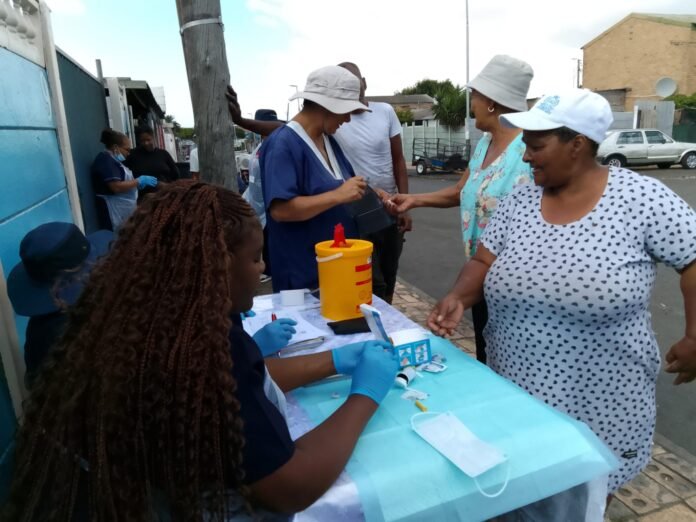
Community health workers often spend their days conducting home visits, walking in neighbourhoods that ambulances sometimes don’t reach.
“Crime is rampant in the communities we serve, and we risk losing our cell phones and devices, or even our lives, when doing fieldwork,” Mfengwana says.
The work they do includes tending to severely ill patients. The COVID-19 pandemic highlighted the essential function of personal protective equipment (PPE). But her superiors appear indifferent. “Gloves, aprons, and masks are always in short supply. If you don’t get any, you’re on your own,” she says.
Mfengwana recounts walking long distances between home visits, sometimes with several visits that required walking 30 minutes apart. She believes transport should be provided to reach daily targets. “During Cape Town’s rainy winters, we are provided with light jackets, and on hot summer days, we walk kilometres without sun protection,” she says.
Poorly paid stipends
According to Mfengwana, their workload often exceeds their official duties, yet the Western Cape Department of Health does not seem to value their efforts. Mfengwana notes that over the past 14 years of service, she has had to reapply for her job every year.
Philani Nutrition Centre did not respond to our queries.
Cynthia Tikwayo began her community healthcare service in 2011, and has always been vocal about the unpleasant conditions in which they work. She currently serves as a CHW at Michael Mapongwana clinic in Khayelitsha, working for TB HIV Care. Her monthly stipend is R3700 a month.
“The stipends are determined by the Western Cape Department of Health and Wellness, and are in line with the national minimum wage stipulations”, says TB HIV Care spokesperson Aziel Gangerdine.
He adds that they haven’t received any complaints from employees regarding unpleasant working conditions and PPE issues.
“Internal processes are in place for all staff to raise concerns related to workplace challenges,” Gangerdine says.
TB/HIV Care is expected to sign an agreement with the provincial health department to continue rendering health services.
Mobilisation of CHWs
Tikwayo is calling on workers in the Western Cape to unite and organise, instead of boycotting strikes organised by competing unions. “Unions representing the CHWs are politically competing, and I wish this could come to an end. The workers are divided because of the politics within the unions,” she says.
She believes that the WC health department will, at some point, permanently employ the CHWs.
“I do have hope that one day, we will be absorbed by the Department of Health and be entitled to the benefits of permanent employment. We call on the government to stop outsourcing this service.”
In his 2025/26 budget speech, Health Minister, Dr Aaron Motsoaledi said R1.4 billion had been set aside for the permanent employment of 27 000 community health workers. The national health department didn’t respond to queries about the approach being adopted by the Western Cape. – Health-e News