


Sharon Mbonani grew up frequenting clinics in eMbalenhle, a township in Mpumalanga, seeking treatment for chronic sinus infection.
In 2015, she attended a training workshop organised by the environmental advocacy group, Greenpeace, and learned how pollution affected her sinuses.
“I thought it was something that comes with the seasons,” says the 30-year-old mother of one. “It affected me my entire life. I took a lot of pills for sinus disease and medication for allergies.”
Sinusitis, which causes the spaces inside the nose and head known as sinuses to become inflamed and swollen, is a respiratory infection that can be caused by air pollution. Respiratory and cardiovascular diseases are some of the illnesses suffered by communities in Mpumalanga due to severe air pollution.
Benefits of coal come at a high price to health
Mpumalanga is home to coal mines, which supply more than 80% of the country’s coal. About 11 of Eskom’s 14 coal-fired power plants were in Mpumalanga, as of April 2024.
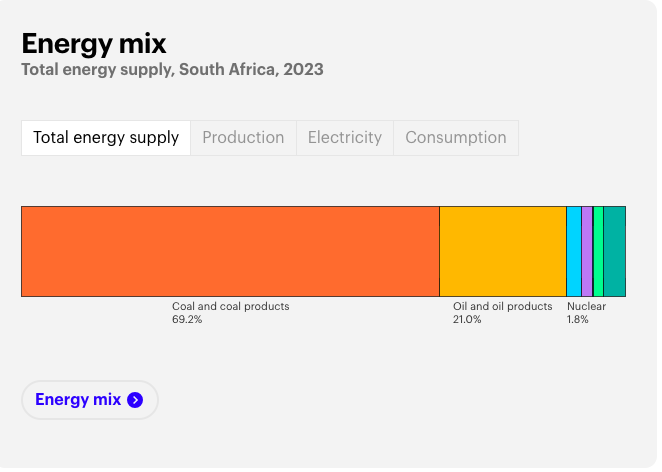
The coal-rich province is key to South Africa’s economy, contributing 6.1% of South Africa’s R4.6 trillion Gross Domestic Product in 2024, and employing tens of thousands of people from the local communities. Areport by the International Energy Agency (IEA) shows that 69.2% of South Africa’s energy supply is from coal.
But the benefits of coal mining have come at a high price for South Africa. Large volumes of sulphur dioxide and fine particulate pollution released from these coal-fired power stations, mines and fossil fuel industries have claimed the lives of many while costing the country’s health system billions of rands in medical care.
According to the 2025 Lancet Countdown Report, South Africa had the highest mortality rate from coal-related air pollution in Africa, at 16 deaths per 100,000 people. More than 21,000 deaths were recorded in 2022.
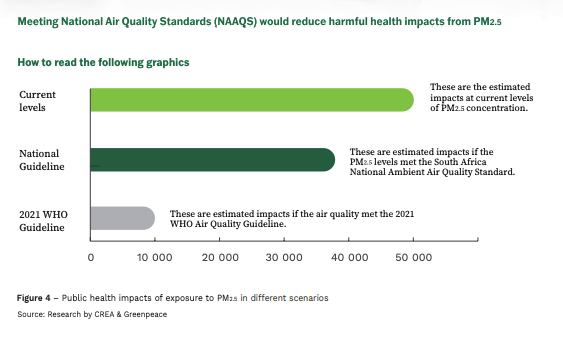
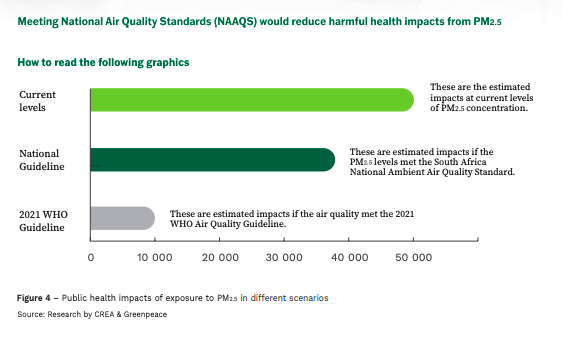
Air pollution health costs total approximately $52bn (R832bn) per year, according to a report by Greenpeace Africa & Centre for Research on Energy and Clean Air. The majority of this cost is due to the loss of life, followed by preterm births. The $52bn is enough to fund the country’s health budget for more than two years.
Coal and air pollution
Tafadzwanashe Mabhaudhi, a professor of climate change, food systems, and health at the London School of Hygiene & Tropical Medicine, says continued use of fossil fuels and biomass contributes to high levels of air pollution in South Africa.
“This is increasing the risk of respiratory and cardiovascular diseases, and leading to premature death,” says Mabhaudhi, who is also a director of the Lancet Countdown in Africa.
“Most air pollution-related deaths in South Africa are linked to coal-related air pollution, household energy use, and industrial use. This disproportionately affects poor communities living adjacent to coal-fired power plants, who may also use coal for domestic energy.”
Women, children, and the elderly are especially vulnerable to respiratory diseases.
Mbonani lost her one-month-old baby in 2017. She suspects the baby died from pollution-related illnesses. Her other son suffered respiratory problems, including an infection in the throat, for years until she moved him out of eMbalenhle.
“It was a terrible experience where you have just lost your child, and you are on the verge of losing another. I had to sacrifice raising him in a healthy environment,” she says.
Air pollution was responsible for more than 8 million deaths globally in 2021, including over 709,000 in children under the age of five, representing almost 9% of global air pollution deaths,according to the Global Burden of Disease study.
Mbonani’s mother also had to relocate to Johannesburg after suffering from skin infections for decades in Mpumalanga.
“Whenever my mom would be away, she would get better. But it gets worse when she is here in Mpumalanga. So she had to leave,” she says.
Khehla Mahlangu has suffered from respiratory diseases for decades in his home township of eMbalenhle in Mpumalanga.
“My community is highly affected by air pollution as we live next to a coal mining company whose activities cause toxic dust in the air,” says the 55-year-old man who lost his eyesight from air pollution.
Pollution hotspot
Annual concentrations of fine particulate matter in parts of Mpumalanga regularly exceed the World Health Organisation’s guideline by about 4 times. Fine particulate matter consists of microscopic solid or liquid particles suspended in the air that can easily penetrate human lungs, posing serious health risks.
Cynthia Moyo, a climate and energy campaign lead at Greenpeace Africa, says Mpumalanga is a pollution hotspot. But millions of people outside the province in areas like Gauteng are also affected.
In addition to the public health impact, South Africa’s reliance on fossil fuels is contributing to global warming, causing disasters like the droughts and floods southern Africa is experiencing. The country is experiencing more frequent and more severe weather events.
In January 2026, South Africa declared a national state of disaster over deadly floods in several provinces across the country. At the same time, South Africa has seen an increase in heat-related deaths. From 2012 to 2021, an estimated 4,500 heat-related deaths were recorded annually, three times as many as those recorded annually in 1990-1999.
Moyo says air pollution and climate change are two outcomes of fossil fuel dependence. Reducing their use would immediately improve public health in South Africa while also cutting carbon emissions.
Just Transition
In recent years, there have been growing calls to shut down coal power stations and transition to renewable energy, which is cleaner and more sustainable; a phrase coined as “just transition”.
“A just transition to clean, renewable energy is not only a climate necessity, but it is a public-health and environmental justice imperative,” she says.
In 2021, South Africa launched the Just Energy Transition Partnership to move away from fossil fuels to renewable energy. Germany, the UK, France, the US and the European Union committed to providing South Africa with $8.5bn.
But in March 2025, United States President Donald Trump pulled out of the agreement with about $1.5bn of funding after relations between Pretoria and Washington deteriorated.
About $583m (R9.3bn) has been allocated under the Just Energy Transition Partnership in areas like the electricity sector, green hydrogen, new energy vehicles, skills development and a transition away from coal in Mpumalanga.
South Africa has also introduced reforms in the energy sector to attract investments into renewables. For instance, the private sector is now allowed to generate renewable electricity without a licence for projects up to 100MW.
But there has been pushback against the planned just energy transition from labour unions and politicians who argue that the shutdown of coal mines will result in job losses.
Experts say the growth brought about by fossil fuels is a double-edged sword. While it seems to be benefiting the country, the reality is that it is causing immense harm.
Melanie Jean Murcott, an adjunct associate professor of law at the University of Cape Town, says the Constitution mandates that economic development must be ‘justifiable’ when weighed against the need to secure ecologically sustainable development. Everyone in the country has the right to an environment that is not harmful to their health and well-being.
“Growth that is not aligned with this constitutional mandate is unlawful,” she says.
Murcott says the Climate Change Act enacted by the South African parliament in 2024 requires that climate-resilient development pathways be pursued through the decarbonization of the economy.
“This necessitates rapidly phasing out fossil fuel exploitation and pursuing less harmful alternatives in a manner that is just and equitable,” she says.
Back in Mpumalanga, Mbonani says they want accountability and to replace coal-fired power plants with renewable energy projects, creating employment for locals who are in the coal industry.
“There is a lot of injustice in our community. We are sick, and we want investments in our community,” she says.
_______