


US readying another aircraft carrier for Middle East deployment: Trump
Despite nuclear diplomacy with Iran, US president suggests Washington will send more military assets to the region.

 By Al Jazeera StaffPublished On 12 Feb 202612 Feb 2026
Save
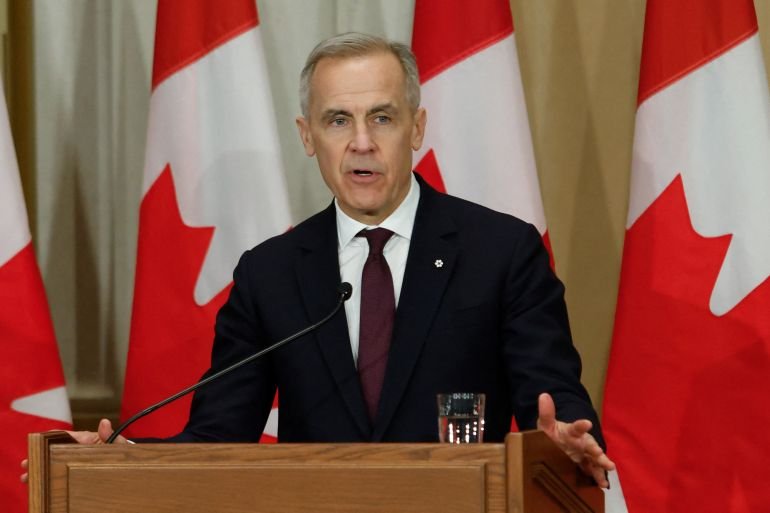
Donald Trump has appeared to confirm that the United States is looking to further shore up military assets in the Middle East despite ongoing diplomacy to ease tensions with Iran.
The US president shared on his Truth Social platform on Thursday, without comment, a Wall Street Journal article titled “Pentagon Prepares Second Aircraft Carrier to Deploy to the Middle East”.
Recommended Stories
list of 3 itemsend of list
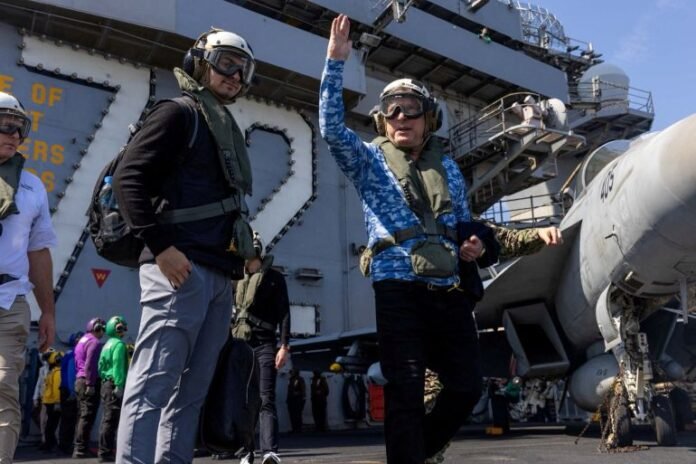
The story cited US officials as saying that the Pentagon ordered the military to prepare an aircraft carrier strike group for deployment to the region to join the USS Abraham Lincoln, which is already there.
The reporting came hours after Trump hosted Israeli Prime Minister Benjamin Netanyahu, who has been pushing for hawkish policies against Tehran, at the White House and reaffirmed his preference for a diplomatic deal with Iran.
“There was nothing definitive reached other than I insisted that negotiations with Iran continue to see whether or not a Deal can be consummated,” Trump wrote after the meeting with Netanyahu.
“If it can, I let the Prime Minister know that will be a preference. If it cannot, we will just have to see what the outcome will be.”
Last week, the US and Iran held their first round of indirect talks since last year in Oman. Both Washington and Tehran have said they would continue on the diplomatic path, but no further talks have been scheduled publicly yet.
Tehran has warned Washington against allowing Netanyahu to spoil the ongoing diplomatic push.
“Our negotiations are exclusively with the United States – we are not engaged in any talks with Israel,” Iran’s security chief Ali Larijani told Al Jazeera on Wednesday.
Advertisement
“However, Israel has inserted itself into this process, with their intent on undermining and sabotaging these negotiations.”
Later on Thursday, Trump denied that Netanyahu was lobbying him against talks with Iran.
“I’ll talk to them as long as I like, and we’ll see if we can get a deal with them,” he told reporters.
Trump has said that he is seeking an agreement that would ensure that Iran has “no nuclear weapons” and “no missiles”.
But Iran, which denies seeking nuclear weapons, has ruled out any concessions over its missile arsenal. Foreign Minister Abbas Araghchi told Al Jazeera last week that the missile programme is a defence issue that is “never negotiable”.
Trump has repeatedly warned of renewed strikes against Iran should the negotiations fail.
Israel launched a military offensive against Iran in June of last year, killing the country’s top military officials, several nuclear scientists and hundreds of civilians.
Tehran responded by firing hundreds of missiles at Israel, dozens of which penetrated the country’s air defences.
The US joined the Israeli campaign and bombed three of Iran’s nuclear facilities before a ceasefire was reached.
Trump has said that the US attack “obliterated” the Iranian nuclear programme.
But it is not clear what happened to Iran’s stockpiles of highly enriched uranium.
Tehran has been coy about the effects of the US strikes, but it has insisted on its right to enrich uranium, which it says does not violate its commitments under the Treaty on the Non-Proliferation of Nuclear Weapons (NPT).
During Netanyahu’s previous visit to the US, in December, Trump warned Iran against rebuilding its nuclear or missile programmes.
“Now I hear that Iran is trying to build up again, and if they are, we’re going to have to knock them down,” Trump told reporters at that time. “We’ll knock them down. We’ll knock the hell out of them. But, hopefully, that’s not happening.”
Days later, antigovernment protests broke out in Iran. The US president backed the demonstrators and urged them to take over government institutions, telling them that “help is on the way”.
But the Iranian government managed to quickly subdue the protest movement, which it said included a US-backed plot to violently attack civil institutions and government agents, with an intense security crackdown.
The Wall Street Journal reported on Thursday that the US smuggled approximately 6,000 Starlink satellite-internet kits into Iran after the Iranian government cut off the internet to help stem the protests last month.
Advertisement