



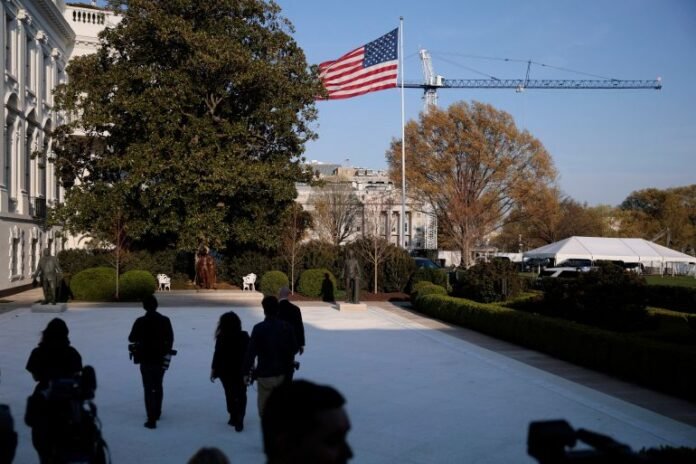
US appeals court extends deadline to halt White House ballroom construction
The judges, however, raised questions about Trump’s arguments that completing the ballroom is necessary for national security.
Save

 By Al Jazeera StaffPublished On 11 Apr 202611 Apr 2026
The United States appeals court has allowed construction on the White House ballroom to continue at least until April 17, extending a pause on a lower court’s order that barred further building.
On Saturday, a three-judge appeals panel for the District of Columbia explained that the new deadline would allow the administration of President Donald Trump “to seek Supreme Court review” of the lower court’s order.
Recommended Stories
list of 3 itemsend of list
The ruling was the result of a March 31 order from the court of Judge Richard Leon, an appointee of former Republican President George W Bush.
Leon ordered construction on the ballroom to be paused, citing the need for congressional authorisation for a project so transformative to the US capital.
But in his decision, Leon added exceptions and loopholes to that order. His injunction, for example, excluded “construction necessary to ensure the safety and security of the White House”.
He also issued a temporary 14-day stay on the injunction — meaning it would not go into effect immediately — to give the Trump administration time to appeal his order. That stay was set to expire this upcoming week.
But the appeals court on Saturday granted the Trump administration a few more days to mount its appeal.
Questions about Trump’s arguments
Saturday’s decision, however, split the appeals court: Judges Patricia Millett and Bradley Garcia formed the majority opinion, while Neomi Rao issued a dissent.
Millett and Garcia were appointed by Democratic presidents, Barack Obama and Joe Biden, respectively. Rao, meanwhile, is a Trump appointee.
Advertisement
Even as it extended the deadline for halting construction, the majority raised questions about the Trump administration’s arguments.
The Trump administration has repeatedly argued that pausing the erection of the ballroom would create a security risk, and on April 4, it filed an emergency motion to lift any barriers to construction.
But the appeals court ruled on Saturday that the Trump administration had yet to show how any national security concerns were not covered by the original order’s exemptions.
“Defendants have not, on this record, explained how, if at all, the injunction interferes with their existing plans for safety and security at the remaining portions of the White House during the construction project,” the majority wrote.
It also noted that the Trump administration “repeatedly represented to the district court that any below-ground work was distinct from construction of the ballroom”.
That, in turn, raised questions for the judges about why the ballroom’s construction “is necessary to ensure the safety and security” of “below-ground national security upgrades”, as the Trump team argued.
The appeals court also used Saturday’s ruling to push back against arguments about the timeline.
The Trump administration had maintained that the delay to the ballroom’s construction, while court proceedings unfolded, would also present a national security risk.
But the appeals court pointed out that the Trump administration itself acknowledged that the ballroom was anticipated to be a years-long project.
“Planning documents in the record estimate that the ballroom was never expected to be completed for almost three years from when ground was broken,” the court explained.
“So it is unclear on this record how a potential delay to the construction imposes additional harm beyond the expected and consciously undertaken risks of a lengthy and major construction project of the White House.”
Need for Congress’s approval?
The appeals court’s majority ultimately remanded the issue back to the lower court for clarity on the “unresolved factual questions” presented by the Trump administration, as well as for further details about the scope of the national-security exception.
In her dissent, however, Rao argued that the majority’s request for “further fact-finding” impedes the Trump administration from continuing its work.
She also argued that the “irreparable injury” caused by halting the ballroom’s construction “is clearly a weightier interest than the generalized aesthetic harms” that critics of the project have raised.
Advertisement
The construction of the White House ballroom has been a flashpoint for the Trump administration, particularly since it broke ground last October.
To make room for the massive, 90,000-square-foot (8,360 square-metre) structure, the Trump administration abruptly tore down the White House’s East Wing, which had existed since 1902.
Trump had previously told reporters that his ballroom would be near the East Wing “but not touching it” and that it wouldn’t “interfere” with the older structure.
Critics have argued that they were blindsided by the East Wing’s destruction, which took place within roughly three days and was conducted without prior notice.
In December, the National Trust for Historic Preservation filed a lawsuit seeking an injunction against the ballroom project.
It argued that the president had exceeded his authority in unilaterally choosing to build a ballroom on the White House grounds, a project more transformative to the capital than any in recent history, without first seeking Congress’s approval.
Trump has countered that he has the right to make changes to the structure, as past presidents have done before him.
But in his March decision, Judge Leon sided with the National Trust in saying that Trump had overstepped his bounds.
“Defendants’ reading of the statutes assumes that Congress has granted nearly unlimited power to the President to construct anything, anywhere on federal land in the District of Columbia, regardless of the source of funds,” Leon wrote.
This clearly is not how Congress and former Presidents have managed the White House for centuries, and this Court will not be the first to hold that Congress has ceded its powers in such a significant fashion!”