


15/03/2026 – 8:21 GMT+1
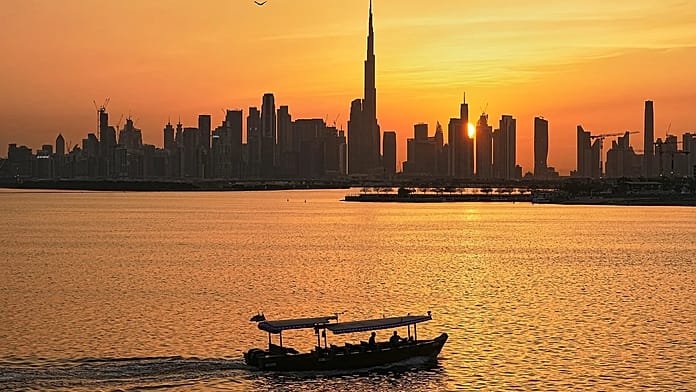
For policymakers in Abu Dhabi, the ongoing crisis is viewed as another test of a development model that has enabled the UAE’s rapid expansion over the past five decades.
The United Arab Emirates’ Minister of State Lana Nusseibeh vows that the UAE can withstand the shock of the attacks that the Iranian regime unleashed on the Emirates which has absorbed more missiles and drones strikes than Israel since the war started.

ADVERTISEMENT
ADVERTISEMENT
The Minister of State at the UAE Foreign Ministry told Euronews in Abu Dhabi that the Emirates are defending more than a country and its residents, it is defending what Nusseibeh calls “a model of coexistence, of tolerance, of peace for the wider region, a model that also wants to export stabilization in commodities, in energy, and in security and peace.”
“If you are against those things, then you are in the camp of Iran and these rogue state actors that are trying to export nihilism to the whole international system. I don’t think we can allow that to happen on our watch,” the UAE minister of State told Euronews.
With over 1,800 missile and drone that Iran launched at the UAE over the last two weeks, Nusseibeh says “the UAE is not a steady state or a state that we accept for our country, what needs to happen is that Iran needs to desist from its attacks, needs to understand that it cannot behave as a regional bully.”
The UAE minister, the country’s former ambassador to the UN, says Iran “needs to know that it is isolated on the international stage, that the model here is resilient, that it is tough, that it is adaptable and that we will overcome this.”
“But they may not if they don’t choose to go to the negotiating table at some point with the United States and find a compromise out of this. We are always for diplomatic solutions to conflicts. We don’t believe in military escalation, but we are tough when what we have fought so hard to build is challenged, and we will be tough through this,” the UAE minister added.
The UAE minister vowed that the UAE continues its sustained efforts to respond to the developing global energy crisis generated by Iran’s blockade of the Strait of Hormuz, which, the minister said, “has an impact on not only global energy prices but global food security and food supplies and that will also impact bills in grocery stores, bills in petrol stations, and the price of food,” the UAE minister told Euronews.
In the Euronews interview, Nusseibeh sough to reassure the UAE’s global suppliers emphasising the country’s commitment to the world’s energy markets by underlining that as “a responsible and committed supplier to the global energy market, we will continue to do what we can.”
Addressing Euronews’ European audiences amid the ongoing concerns related to Iran’s relentless attacks, Nusseibeh vowed that the UAE will ensure “the safety and security of the 500,000 European residents” adding that “we will allow them not only to prosper, but to thrive here in this country.”
Moving on, the UAE minister emphasised in the Euronews interview that as the Iran keeps expanding, the UAE’s focus is on maintaining stability at home while advancing its long-term economic development plans and that the country’s economy and transport networks remain resilient.
The UAE plays a central role in global aviation and logistics. Dubai and Abu Dhabi act as key gateways linking Europe, Asia and Africa.
According to Nusseibeh, the country’s economic resilience stems from decades of investment and diversification.
“Our economy is structurally sound and honed over decades,” she said, adding that “I think you will see this economy and this country come through this stronger. Because we adapt, we are not only resilient, we adapt to crisis, and we adapt to change.”
One of the indicators of that resilience has been the return of aviation operations, with Nusseibeh saying that national airlines Emirates and Etihad have achieved up to 50% return to normalcy amid the ongoing Iranian attacks.
She said that the majority of travellers who wished to leave during the early phase of the crisis have already departed, but that “many have chosen to stay.”
Public confidence, she said, has played a key role in maintaining stability, saying that “the residents of the UAE have really rallied around the idea that this is their home.”
For global markets, maintaining stability in the UAE carries broader implications. The country serves as one of the region’s primary logistics hubs, connecting supply chains spanning multiple continents.
As the Gulf faces one of its most serious security crises in recent years, the UAE’s government says the country’s long-term strategy remains focused on economic transformation and future industries and that the country’s development model is built to withstand such geopolitical shocks.
According to Nusseibeh, the UAE’s development over the past half-century has fundamentally reshaped its economic structure.
In the Euronews interview, minister Nusseibeh said that “we have had, since our founding, a number of shocks. Even as we were formed as a federation, there were a lot of naysayers who said the federation would last. We didn’t just last. We grew from a pearl-diving economy into a global exporter, not only of hydrocarbons, but of commodity, of foreign direct investment, of clean energy, of AI.”
That transformation forms the foundation of the UAE’s long-term strategy. Instead of depending solely on oil revenues, the country has spent decades diversifying into sectors such as finance, logistics, and advanced technology.
“We are an economy of the future, we always adapt in crisis, we respond, we are flexible, we don’t promise that the regional environment can be entirely controlled, it cannot. I think that’s a false promise, but we do promise that we will keep our country safe, we will our residents safe. (…) In the longer term, that is our commitment, because what we are fighting for is something far more compelling than what the Iranians have been putting on the table, not only for their own population, but to the international system about how they conduct international relations.”, Nusseibeh told Euronews.
She pointed to major technology investments aimed at positioning the UAE as a global hub for artificial intelligence infrastructure, with a 1.5 trillion-dollar investment with the United States in AI data centres and “similar investments in Europe, in Italy, in France, in AI data centres that we are building here.”
According to Nusseibeh, the focus on emerging industries is intended to ensure that the UAE remains competitive in a rapidly changing global economy.
But she acknowledged that no government can fully control the geopolitical environment surrounding it. “We don’t promise that the regional environment can be entirely controlled,” she said. “I think that’s a false promise,” she admitted.