


20/02/2026 – 20:24 GMT+1
Trump vowed to press on with tariffs — including a new 10% global levy — after the Supreme Court ruled his sweeping duties exceeded presidential authority.
US President Donald Trump said he would immediately impose a new 10% global tariff and press ahead with alternative trade measures after the Supreme Court ruled his sweeping tariffs exceeded executive authority on Friday.

ADVERTISEMENT
ADVERTISEMENT
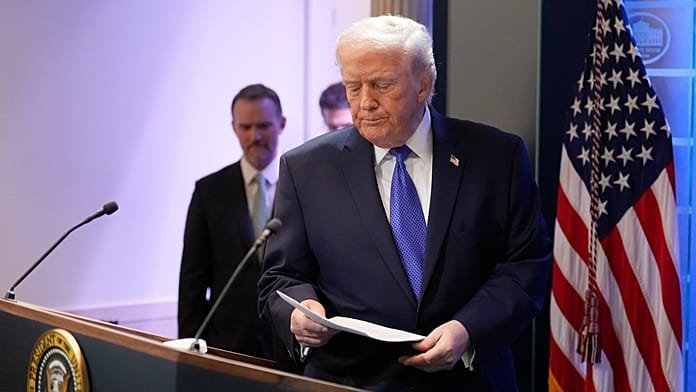
“Today I will sign an order to impose a 10% global tariff under Section 122 over and above our normal tariffs already being charged,” Trump said in a press conference.
The court, in a 6–3 ruling on Friday, struck down the far-reaching tariffs Trump imposed under an emergency powers law, handing him a major setback on a signature economic policy.
“In order to protect our country, a president can actually charge more tariffs than I was charging… under the various tariff authorities,” he continued.
The ruling centres on tariffs imposed using the International Emergency Economic Powers Act (IEEPA), a 1977 law typically used for sanctions and other economic tools, which Trump had invoked to justify broad import taxes.
Other presidents have used the statute many times, but Trump was the first to deploy it for tariffs.
Trump said he was not worried by the decision, saying the SCOTUS decision “merely overruled a particular use of IEEPA”.
“So we can use the other statutes, other tariff authorities, which have also been confirmed and are fully allowed.”
Trump has repeatedly framed the dispute as existential for his economic agenda, even as polling has shown tariffs are not broadly popular amid wider voter anxiety about affordability.
Congress versus the executive branch
In its majority opinion, the court said the US constitution “very clearly” gives Congress the power to impose taxes — including tariffs — and not the president.
Chief Justice John Roberts wrote that the framers of the constitution did not place taxing power in the executive branch.
The decision does not prevent the White House from pursuing duties under other laws, though those routes generally come with tighter procedural limits and constraints on speed and scope than the emergency-powers approach Trump originally attempted.
Administration officials have said they expect to keep the broader tariff framework in place using other authorities.
“Therefore, effective immediately, all national security tariffs under section 232 and existing 301 tariffs … remain in place, fully in place and in full force and effect,” he said.
“And we’re also initiating several section 301 and other investigations to protect our country from unfair trading practices,” Trump added.
What ‘other’ legal means are still available?
Among the alternative legal means available to the president, Section 301 and Section 122 of the Trade Act of 1974 are crucial to any future tariff plans.
Both provisions carry considerably tighter constraints than IEEPA, with the Trump administration facing a genuinely narrower toolkit.
Section 301, formally part of Title III of the Trade Act of 1974 and titled “Relief from Unfair Trade Practices” grants the Office of the United States Trade Representative (USTR) authority to “investigate and act against foreign trade practices that violate US trade agreements or burden American commerce”.
Where the USTR concludes that a foreign government’s conduct is unjustifiable or discriminatory, it may impose retaliatory tariffs or withdraw trade concessions.
Crucially, investigations in cases not involving trade agreements must generally reach a determination within 12 months — meaning tariffs cannot be introduced rapidly.
Section 301 would not, for example, allow a 50% tax on imports from Brazil.
On the other hand, Section 122 can be imposed faster but is time-limited.
The provision authorises the President to impose temporary import surcharges of up to 15%, or quotas, for no more than 150 days, when the United States faces fundamental international payments problems — such as a serious balance-of-payments deficit or rapid depreciation of the dollar.
It was enacted after President Nixon used the Trading with the Enemy Act to impose a temporary 10% import surcharge in 1971 and represents Congress’s effort to codify a narrower version of that emergency tariff authority.
No prior investigation is required, allowing for rapid executive action — but the tariffs expire automatically after 150 days unless Congress votes to extend them.
The constraints of both provisions matter enormously for the administration’s ambitions.
Despite President Trump’s seemingly strong posturing this Friday, Treasury Secretary Scott Bessent had already acknowledged before that these alternative methods are “not as efficient and not as powerful” as IEEPA.
Lawsuits under way by tariff-affected companies
The case drew challenges from a group of largely Democratic-leaning states and from businesses ranging from small importers to major retailers, arguing the emergency law does not authorise tariffs and that Trump’s move failed established legal tests.
“I know the people who brought the lawsuit, and you know they’re sleazebags, major sleazebags,” Trump said.
“I don’t think we’ll ever give up on MAGA, MAGA is always going to be with us.”
Trump has repeatedly framed the dispute as existential for his economic agenda, even as polling has shown tariffs are not broadly popular amid wider voter anxiety about affordability.
He plans to find new ways of keeping tariffs in force.
“Some of [the tariffs] stand. Many of them stand. Some of them won’t, and they’ll be replaced with other tariffs,” he concluded.