


17:10
Teachers in the eastern European nation of nearly 19 million have threatened to go on strike if the government implements the measures.
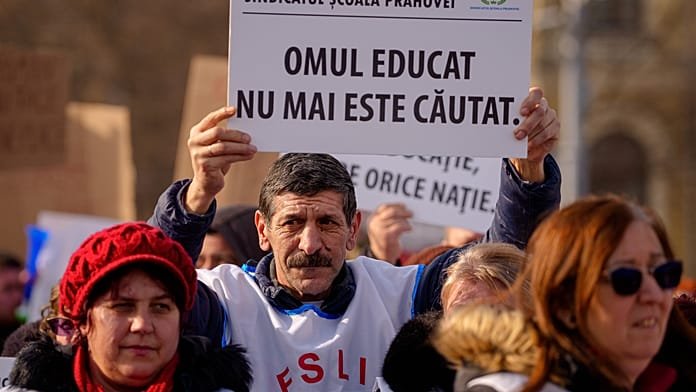
Dissatisfied with the government’s planned austerity measures in the education sector, thousands of Romanian teachers and education staff took to the streets this week in protest.
The demonstration in Bucharest on Wednesday came after the coalition government led by Prime Minister Ilie Bolojan approved two austerity packages to reduce the budget deficit as part of reforms.
The new austerity measures specifically place a 10% cut on the salary fund of public institutions. Teachers in the eastern European nation of nearly 19 million have threatened to go on strike if the government implements the measures.
“The funds allocated to the Ministry of Education have already been reduced by 600 million lei (€117.8m). They are already applied; that’s why we took to the streets so that the third austerity package could not be put into practice by the Bolojan government,” one of the protesters said.
“The lack of funding for education — the cuts to education continue, although to have a future, this country needs more money invested in education,” said another protester.
Several demonstrators argue that the new decisions will affect the working conditions in schools and universities.
“For higher education, along with pre-university, last year they increased the fees and applied some measures, and now they come and say that it is equal to zero and must be cut again by 10%,” a protesting university staff member said.
“What we are unhappy about is that they stopped the balances and blocked our revenues, which were a source of development for universities, especially those based on research,” he added.
The view was echoed by Liviu-George Maha, the rector of the Al I Cuza University of Iași.
“Universities generate their own revenues, beyond tuition fees,” Maha told Euronews.
“When even the university’s own revenues from various sources will be blocked from being used, including for salary expenses, then the pressure will subsequently fall exclusively on the state budget, and in the absence of financial resources, it will become increasingly difficult to finance education,” Maha explained.
Unions threaten to go on strike
The situation has also sparked conversations and comparisons with Ukraine, where education budgets have been increased.
“If a country at war increases the teachers’ salaries and student scholarships, what other explanation could any other country that is not at war have,” Mihnea Costoiu, rector of the Polytechnic University of Bucharest, said.
“A country that understands that at the most complicated moment of its existence, it needs to invest in those who can get the country out of the situation it finds itself in,” Costoiu told Euronews.
“What explanation can we have when we tell people that we cut from those who truly produce knowledge or do good to people?”
Three trade unions in the education sector are expected to announce this month whether they will strike in March or June. Additionally, education unions have launched a petition campaign in support of a citizens’ legislative initiative.
The action, they say, aims to repeal what the unions describe as anti-education measures adopted by the government. For the proposal to be submitted to the parliament, it requires at least 100,000 signatures.
The draft budget with the new measures will be submitted to parliament by 20 February.