



09/03/2026 – 11:52 GMT+1
The tourism industry in Mecklenburg-Vorpommern is looking nervously across the border. In Pobierowo, a “little Dubai” is growing on the Baltic Sea with the Gołębiewski mega hotel. There is great concern that guests and workers are moving away.
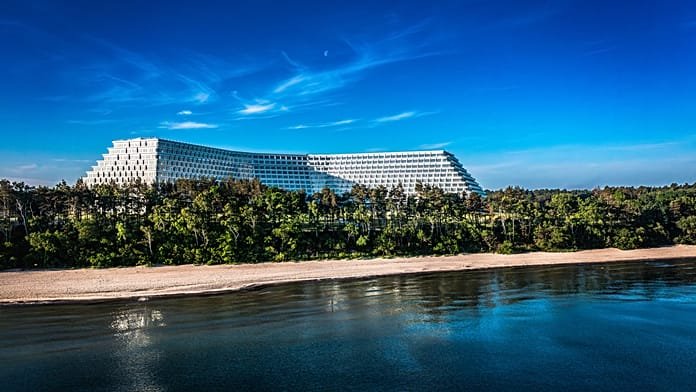
A stranded cruise ship on the Polish Baltic coast – only it won’t be moving again. The “Gołębiewski” hotel in Pobierowo, West Pomerania, should have opened in 2021, but it still hasn’t. In a Facebook post from 21 January, the company announced: “We will soon be opening a new hotel in Pobierów.” In the post, the hotel advertises for staff. They are looking for housekeepers, cooks, receptionists – there are quite a few positions that need to be filled.

ADVERTISEMENT
ADVERTISEMENT
Alarm bells are ringing in Mecklenburg-Vorpommern: Will guests and workers be poached on a grand scale in future? The project was soon nicknamed “little Dubai” in the German media. There are plans for 13 floors, 1,200 rooms and up to 3,000 guests. According to local statistics, Pobierowo itself only has around 1,000 inhabitants.
By comparison, the Morada Resort Kühlungsborn and the Hotel Neptun in Warnemünde are among the largest hotels on the German Baltic coast. The Neptun was opened in 1971 as a prestige project of the GDR and has been a landmark of German Baltic Sea holidays for more than 50 years. However, with less than 500 rooms, both are on a completely different scale to the building in Pobierowo.
Soon no more holidaymakers on the German side?
The mega hotel is around 60 kilometres from the German border near Ahlbeck. And because a wellness area has long been standard in a five-star hotel, the complex also boasts an aqua park, cinema and tennis court. The site is designed to offer so much that guests hardly have to leave it.
The Gołębiewski chain seems to follow a clear pattern: Every new hotel is bigger than the previous one. Mikołajki in Masuria, Karpacz in Lower Silesia or Wisła – each location was Poland’s largest hotel when it opened, until the next project raised the bar again. Pobierowo is the high point of this development for the time being.
‘Little Dubai’ with a long history of suffering
Founder Tadeusz Gołębiewski, a confectionery manufacturer who became rich with wafer rolls, entered the hotel business in 1991. In 2018, he laid the foundation stone for Pobierowo – his fifth and largest project, on a former military site with 34 buildings, which the municipality of Rewal sold in 2017 for 50.5 million złoty (the equivalent of around €11.8 million).
However, the construction came to a standstill: Coronavirus, delivery bottlenecks, construction disputes – and in June 2022, Tadeusz Gołębiewski died. District building inspector Janusz Zaryczański told the Polish news portal money.pl in September 2025 that they were still waiting for the environmental permit from the municipality of Rewal – the last hurdle before the final inspections by the fire brigade, health authority and building inspectorate. Łeba was originally planned as the location – but the environmental authority rejected the project as it is a European nature reserve. Pobierowo was plan B.
1,500 trees for 3,000 guests
When asked by Euronews about the opening date, the hotel remains tight-lipped: It is in the “final phase” and is preparing the property for the opening. More detailed information will be provided “in the near future”.
Around 1,500 trees in a coastal forest were cleared for the project. When asked by Euronews, the hotel rejected criticism of this: The site is not an untouched forest area, but a former military installation – “an area that has already been transformed and used by humans”. The clearing was limited to the necessary minimum. Around 4,000 new plantings are planned as compensation.
‘You have to like it’: Alarm in Mecklenburg-Vorpommern
While Poland is eagerly awaiting the opening, the tourism industry on the other side of the border is keeping a critical eye on developments. Lars Schwarz, President of the German Hotel and Restaurant Association (DEHOGA) Mecklenburg-Vorpommern – the state’s hotel and catering association – tells Euronews: “I would be worried if the state government of Mecklenburg-Vorpommern did not react to such things.”
On the Polish side, state subsidies are being used to invest in infrastructure and capacities, while companies in Mecklenburg-Vorpommern have to keep up with older structures.
He is particularly concerned about the issue of personnel: Many hotels in Mecklenburg-Vorpommern employ staff from the Polish border region. If the Gołębiewski Hotel were to offer these commuters local accommodation, “that could be problematic”, says Schwarz. He does not rule out this trend in the medium term.
Added to this is the structural price pressure. In an interview with Euronews, Schwarz calculates that in some cases only “a third of the German minimum wage” is paid on the Polish side. Price is therefore not the way to win this competition, he says – supply and quality are crucial.
He vividly describes what he thinks of the mass concept: “When two thousand people come here for breakfast” – in tight time corridors, with empty displays, noise and stress – “you have to like it.” The hotel tends to appeal to cruise tourists who are used to such dimensions.
‘The competition is tough’
The island of Usedom in Mecklenburg-Western Pomerania has deliberately positioned itself against mass tourism, emphasises Schwarz: “It’s difficult and is not accepted by the local population.” He sees this as the region’s strength: Individuality, tranquillity, solidity – qualities that a hotel with 3,000 beds can hardly provide structurally.
His demands to the state government are specific: Investment in sea bridges, public toilets, beach facilities and event areas. And a modernisation programme for the businesses, as was launched during the Corona period. “That actually has to happen. Competition is tough.”
The Ministry of Economic Affairs, Infrastructure, Tourism and Labour of Mecklenburg-Vorpommern did not respond to Euronews’ enquiry by the editorial deadline.
A German hotel chain as an important employer on Usedom
With around 450 employees, the SEETELHOTELS Group is one of the largest employers on the German side of Usedom. Rolf Seelige-Steinhoff, Managing Partner of SEETELHOTELS, is initially relaxed when asked by Euronews: “Competition is part of tourism and can also provide positive impetus for an entire destination.” At the same time, he states: “This property is clearly too big for this region and will lead to major distortions of competition.”
When it comes to staff, Seelige-Steinhoff is focusing on retention: “The competition for qualified specialists is noticeable throughout the industry – regardless of individual projects. Many of our employees come from the region or from Poland and have been part of our team for many years. We therefore focus strongly on long-term employee retention, fair working conditions, further training opportunities and a family-like corporate culture.”
Strategically, he formulates his approach clearly: “Our aim is not to compete on size, but on quality, personality and experience.” He would like to see reliable infrastructure and support in recruiting skilled labour from politicians.
The hotel itself: No competition problem?
The Polish hotel chain rejected the accusations from Germany when asked by Euronews. Differences in wage levels between countries are “due to different economic and systemic conditions and not to the actions of individual companies”. Employees from abroad are welcome, but the company also emphasises: “A strong and diverse offer on both sides of the border can complement each other and contribute to the further development of the entire region as an attractive tourist destination.”
Optimism despite headwinds
Despite all the concerns, Mecklenburg-Vorpommern’s DEHOGA boss Schwarz remains optimistic: He is convinced that Mecklenburg-Vorpommern will be able to set another record year in 2026. “We have nothing to hide by far,” he says, referring not only to the landscape, but also to the professionalism of his colleagues. “We take that as an incentive rather than being intimidated.”
In addition, one thing is crucial. “A guest who comes once brings nothing,” Schwarz realises matter-of-factly. This applies to both sides of the border. However, the hotel giant in Pobierowo still has to open its lobby doors.