


Mohamed Hamdan Daglo
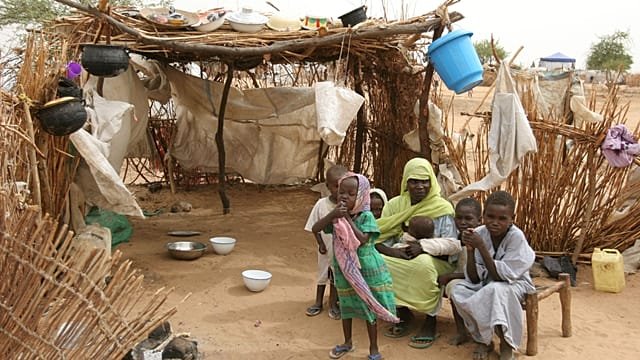
The big camp for internally displaced in Sudan’s war-torn Darfur region is home to more than half a million people who live in makeshift huts of sticks, hay and plastic sheeting. Some families have survived in those harsh conditions for months.
Among them, 17-year-old Doha and her brothers and sisters reached Tawila after a three-day long journey from El Fasher by foot and donkey cart, exhausted and frightened. Home in the key city of Darfur had become too dangerous. Food was scarce. Health facilities were destroyed. School — once the centre of Doha’s days — was no more.
“This girl caught our eye because she was smiling,” said Eva Hinds, spokesperson for UNICEF in Sudan to UN News. “And she so desperately wanted to speak English. I’m always so struck when I see someone who is beaming in the middle of such a hardship environment,” she continued.
The first name ‘Doha’, also pronounced as ‘Duha’, is a traditional Arabic name that means “morning.” It is often used colloquially to refer to the period from dawn to sunrise.
“The light in the eyes of this girl showed she lives to her name,” said Hinds.
Before the war broke out, Doha was studying English and she was keen to know if there were opportunities to continue learning English in Tawila. She told Eva Hinds she’d like to teach others at some point.
“I’m always struck by how people are resilient and they’re not giving up when the world is stuck against them,” said Hinds.
According to a recent report from the UN Human Rights Office based on victims and witnesses’ testimonies, more than 6,000 people were killed in three days when Sudan’s paramilitary Rapid Support Forces (RSF) captured the city of El Fasher last year. The key city of Darfur came under 18 months of sustained siege. This is where some of the most harrowing stories have emerged out of this brutal conflict.
“There are millions of children who’ve had to flee their homes several times, not only once or twice, but more than that,” underlined Hinds.
These children end up in camps for internally displaced which are very difficult places to grow up in. Children are in cramped spaces where there’s very limited access to safe water, food and opportunities to continue learning. “Their sense of safety has been shaken as they’ve been forced to flee, and they’ve seen things that many children have never seen and should never see,” she said.
Their routines, their friendships, their sense of security have been completely upended, and they struggle with the most basic things such as getting food and enough water to drink and wash.
On the ground, the UN Children’s Fund and its partners provide different types of support: healthcare and nutrition support, but also safe spaces where heavily traumatized children can start receiving psychosocial support, so they can start going through their traumatic experiences, they have a space where they can have a sense of normalcy for the first time. It’s a space where they can play, they can be with friends, and they can start learning.
But Sudan is an immense country with around 34 million people who need humanitarian assistance, and the needs keep growing. This is a challenge for humanitarians operating on the ground. The dramatic situation for children is worsening in conflict zones, where the risks of violence, including sexual violence, are escalating.
UNICEF works to identify and support children, looks for the adults in their families to reunite them and offers them refuge if needed. “With regard to sexual violence, it is essential to provide safe spaces, especially for women and girls.”
“Needs are skyrocketing and the funding is dwindling, it’s a very difficult equation to make, and unfortunately, it’s often the most vulnerable that pay the heaviest price, the children,” underlined UNICEF spokesperson.
Sudan is one of the countries that practices female genital mutilation. The UN Children’s Fund and the UN Population Fund, UNFPA, have a joint program on the elimination of female genital mutilation, which the agencies continue to implement despite the challenges of a country at war.
“We foster girls’ clubs as part of the programming,” Hinds explained. “These clubs are safe spaces where girls and adolescents come together, where they learn. It’s a place where they can support one another and develop a sense of identity and belonging, and this is very much about the positive social norms. These clubs also play a critical role in encouraging girls to stay in school, complete their studies. And challenge harmful practices, including female genital mutilation,” said Eva Hinds.
In camps for displaced people, education and basic services provide children with a fragile sense of safety and stability. “Education is a lifeline,” UNICEF insists.
Despite ongoing violence in Darfur and Kordofan, hope remains the last refuge for thousands of children like Doha in Tawila, who dream of a peaceful Sudan and the chance to reclaim a stolen childhood.
You may also like
Most read