



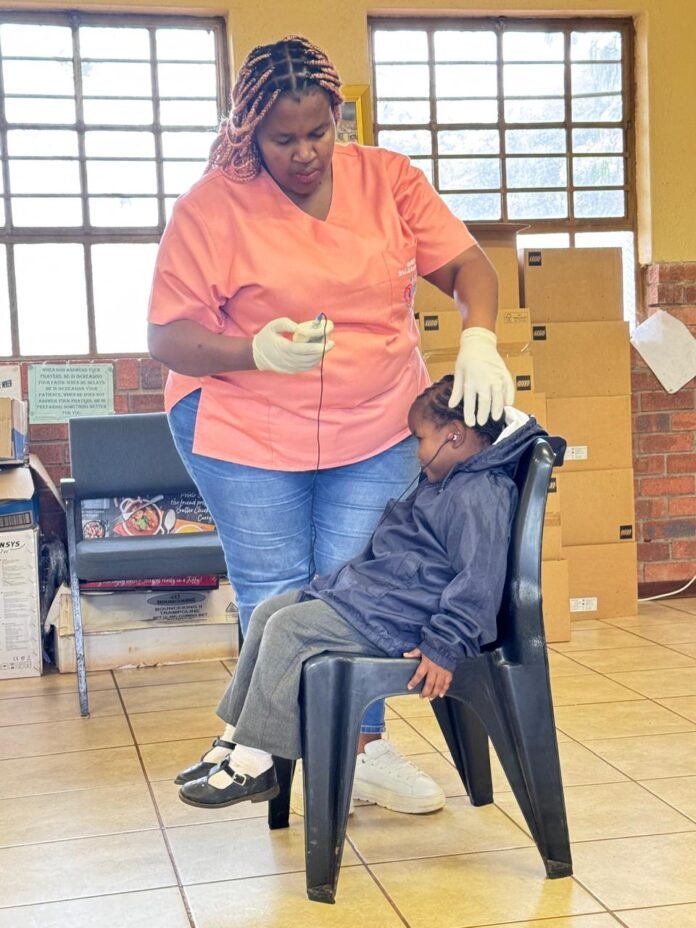
Learners in Limpopo’s Vhembe District have recently undergone screening to determine whether they have hearing problems.
Audiologist Nonhle Mokwena from the South African Association of Audiologists visited Matshavhawe Primary School near Witvlag Munzhedzi Primary School.
During the visit, Mokwena screened 83 learners at Matshavhawe Primary School and 112 learners at Munzhedzi Primary School, with a focus on Grade R and Grade 1 pupils. Each learner underwent an otoscopic examination, in which the ear canal was inspected. The learners were also tested to assess how the inner ear responds to sound.
All the learners who were screened passed the hearing tests, and none required immediate medical referral.
Hidden issue
However, the screenings revealed another issue that could potentially affect learning.
Sixteen learners at Matshavhawe Primary School and 27 at Munzhedzi Primary School were found to have impacted earwax, a condition where wax builds up and blocks the ear canal.
While earwax is a normal and protective substance, excessive build-up can reduce hearing ability. Mokwena explains that impacted earwax can lead to conductive hearing loss, which may start mildly but worsen over time if left untreated.
“If untreated, it can affect a child’s hearing ability and impact speech, language learning and cognitive development,” she says.
According to Mokwena, hearing problems in children are often mistaken for behavioural or learning difficulties. Children who cannot hear clearly may appear distracted, frequently ask for repetition, struggle in noisy classrooms or show signs of frustration and withdrawal.
These behaviours are sometimes interpreted as poor concentration or learning problems, when in reality the child may simply be struggling to hear.
Hearing loss prevalence in foundation phase
According to the Ear Institute, 6000 children are born with hearing loss in South Africa and 2 out of every 100 have profound hearing loss. Experts at the Department of Speech-Language Pathology and Audiology at the University of Pretoria conducted a study on hearing loss in urban South African schools. The results show that 2.2% of learners in grades 1 to 3 had hearing loss. The study also suggested that many children need some form of follow-up service.
Early detection and prevention is key
Early detection of hearing challenges is critical because hearing plays a key role in language development and learning. If a child cannot hear properly during important stages of development, it may affect their speech, literacy and academic performance. Professor Katijah Khoza-Shangase of Wits University says there is little progress in implementing early detection and prevention programmes. She attributes this to:
- no standard practice of screening newborn babies;
- limited number of audiologists;
- hearing impairment is identified late;
- limited schools that accommodate learners with hearing impairment;
- lack of awareness and skills in healthcare workers working with newborn babies and infants;
- and lack of awareness in communities.
The right to equal education
To ensure the rights of children with hearing loss to education, the government introduced Inclusive Education, making it possible for such children to be integrated into mainstream schools. But children with hearing loss are facing an uphill battle; not all of them have access to resources like hearing aids or teachers who have been trained adequately to incorporate their needs into teaching and learning.
Schools and parents are key
Mokwena emphasised that schools play an important role in identifying hearing problems, especially for children who may not have been screened at birth or during early childhood.
“Schools are often the first point of access for children who may have missed newborn hearing screening, so they play a transformative role in identifying hearing issues early,” she says.
She advised parents to pay attention to possible warning signs, such as children asking for things to be repeated, turning up the television volume, delayed speech development, or appearing withdrawn in conversations.
Parents are also urged to avoid inserting cotton buds or other objects into the ear canal, as this can push wax deeper and cause further blockage or injury.
“As parents, we sometimes think that when a child struggles at school, it is because they are not paying attention or not trying hard enough. I did not realise that something as simple as earwax could affect a child’s ability to hear and learn properly,” says Thinandavha Chauke, a parent of one of the learners who took part in the screening.
Hearing services are available in the Vhembe District through public healthcare facilities and private audiology practices. However, Mokwena noted that challenges such as poor road infrastructure in remote areas and the need for parental consent for school screenings can sometimes limit access to these services.
This is why school-based initiatives like the World Hearing Day screening are important, as they bring hearing care directly to learners.
The screenings in Vhembe may have found no serious hearing problems, but they highlighted how simple checks can identify issues early and prevent future learning difficulties. For many children, something as small as earwax could make the difference between struggling in silence and thriving in the classroom. – Health-e News