



12/03/2026 – 7:15 GMT+1
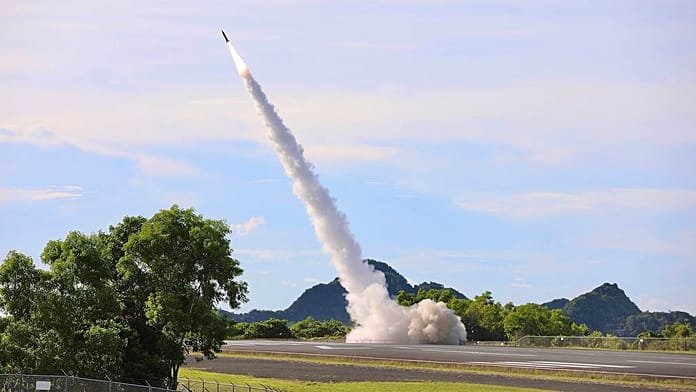
The US Army’s new Precision Strike Missile, or PrSM for short, is a medium to long-range weapon meant to replace the ageing Army Tactical Missile System (ATACMS).
The ongoing Iran war has seen a lot of new weaponry deployed, from cutting-edge fighter jets to low-cost drones.

ADVERTISEMENT
ADVERTISEMENT
One of the latest weapons to debut on the battlefield is the Precision Strike Missile (PrSM), which just saw its first action when the US deployed it to strike Iranian military targets in the ongoing US-Israeli intervention in the country.
US Central Command (CENTCOM) chief Admiral Brad Cooper said following its debut that the PrSM provides the American military with “an unrivalled deep strike capability”.
The PrSM is a surface-to-surface weapon system capable of striking targets from 60 to 500 kilometres away, far beyond the range of any artillery or conventional missile system. The missiles are rocket-powered, guided by a GPS-supported inertial navigation system.
They can be launched from M142 HIMARS or M270 MLRS vehicles, carrying 91-kilogram blast-fragmentation warheads designed to destroy large or hardened targets.
Incremental missile launcher
Each PrSM is just under 4 metres long and 43 centimetres in diameter, weighing in at up to 817 kilograms. This sleeker design allows the launchers to carry two missiles instead of one, as previous generations of launchers did.
The PrSM comes in four “increments”, some of which are still in development. Increment One is the standard system currently used by the US and Australian armies. Increment Two is an anti-ship missile system with a range of up to 1,000 kilometres and a faster missile, expected to be delivered in 2028.
Increment Three builds on the previous increments and will specialise in destroying fortifications and launching specialised drones and glide bombs.
Increment Four aims to increase the range beyond 1,000 kilometres, and there is even talk of a fifth increment featuring an autonomous launch vehicle.
Produced by Lockheed Martin’s Missiles and Fire Control division, they describe the PrSM as a “next-generation, long-range precision-strike missile”.
Development began in 2016 in response to a US Army call as part of its Long Range Precision Fires initiative, with the first delivery made in August 2023.
The initiative aimed to replace the ageing Army Tactical Missile System (ATACMS) with a system ready for the 21st century, offering greater capabilities, enhanced precision and flexible payloads.
The PrSM meets these requirements while also achieving lower radar visibility, reduced maintenance and greater compatibility with existing weapon systems such as HIMARS and MLRS.
So far, Australia has joined the PrSM programme and purchased several launchers in 2024, while the UK considered joining in 2021. Norway’s bid to purchase several was declined by the US in January 2025.
Why does the introduction of the PrSM matter?
The US deployment of the missile became possible only in 2019, when the first Trump administration suspended US participation in the Intermediate-Range Nuclear Forces Treaty (INF) with Russia.
The decision to abandon the agreement, which aimed to prevent both countries from proliferating long-range missiles, was in response to prior Russian violations.
“We can no longer be restricted by the treaty while Russia shamelessly violates it,” said US Secretary of State Mike Pompeo at the time.
The deal had imposed a 500-kilometre range limit on land-launched missiles, in an effort to eliminate missiles with greater range and nuclear capability.
While the PrSM cannot carry nuclear warheads, by developing at scale a missile system capable of medium to long-range strikes, the US may be setting a dangerous precedent.