



10/04/2026 – 15:06 GMT+2
The fragile US-Iran ceasefire is already faltering, with Tehran still blocking the Strait of Hormuz navigation in protest against Israel’s attacks in Lebanon. A leading Iran expert indicates Tehran’s Hormuz strategy could be part of a well-established strategy.
Iran’s strategy on the Strait of Hormuz is most likely shaped by a crucial security decision-making body within the Revolutionary Guards (IRGC), according to a Middle East expert and Iran observer.

ADVERTISEMENT
ADVERTISEMENT
Professor Mehran Kamrava of Georgetown University in Qatar has pointed to an often overlooked institution, the Khatam al-Anbiya, which may hold the key to understanding Iran’s plans for the Strait of Hormuz and the war in general.
Kamrava told Euronews in Doha that “most likely Iran’s Hormuz Strait strategy and its broader strategy is shaped and influenced by the headquarters of Khatam al-Anbiya which is the central key security decision making within the Revolutionary Guards.”
“During wartime, the Khatam al-Anbiya’s job is to coordinate war effort. In peacetime, its job is to run scenarios and determine possible strategies for Iran,” Kamrava said.
That makes it a key force shaping Tehran’s Hormuz policy, alongside the Supreme National Security Council, which coordinates Iran’s overall foreign and security decisions.
A ceasefire that still feels temporary
As to Iran’s strategy ahead, Kamrava believes that “the war footing continues as far as the Revolutionary Guard is concerned, because there is a history of Israel repeatedly sabotaging negotiations between Iran and the United States, and there is every likelihood and possibility that Israel will do so again by attacking Iran or by provoking Iran into some sort of retaliatory attack.”
“The strategy now is vigilance and only of an assumption of a temporary pause in the war until the formal ceasefire agreement is signed,” the Iran analyst added.
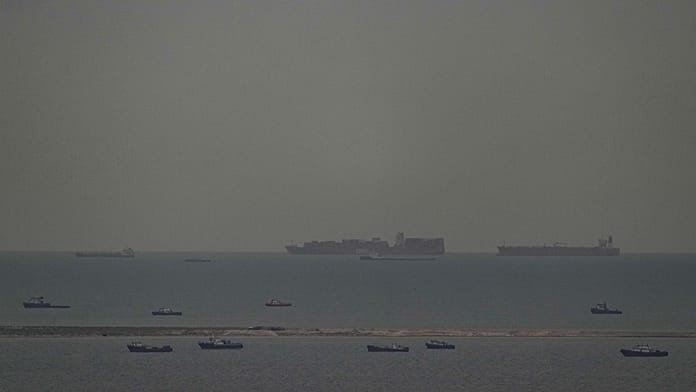
Ship traffic data reflects that caution, with only limited bulk cargo vessel movement through the strait since the pause in fighting began.
Iran’s suggestion that it could charge ships to pass through Hormuz has become a focal point.
Kamrava says the more immediate question is practical, and points to early signs of enforcement.
“It appears that the Iranians have now hit on something that they are not willing to negotiate over,” the Doha professor said, while leaving room for “some measure of coordination with Iranian authorities.”
To the Iranians, such a model could involve regional countries like Oman and “that would give the Iranians something of a fig leaf in which they can say that Arab partners are involved.”
“They are keen to make sure that Iran has a say and probably can collect fees from passage most likely in coordination with Omanis,” Kamrava explained, adding that “we have seen over the last week or so, they have collected money from ships… from the Philippines, from Thailand, and probably from Japan.”
Kamrava believes Iran formulates its Hormuz narrative is based on its own assumptions on international legal arguments.
“According to international law, territorial waters extend 12 (nautical) miles beyond the shoreline. At its narrowest, the strait is 22 km, which means that both Iran and Oman have control over the Strait of Hormuz,” Kamrava said.
“And that’s what the Iranians are basing their arguments on in terms of legal argument. They are basing their assumptions on international law.”
Iran has framed the funds as necessary for post-war reconstruction following widespread infrastructure damage.
Oman quickly rejected Iran’s claims that the two countries would collect transit fees during the two-week ceasefire, underlining that it respects international maritime transport agreements and the Law of the Sea principles, which state that ships do not have to pay to pass through natural waterways.
“The Strait of Hormuz is a natural passage, not created by human intervention, and therefore, no fees can be imposed on it according to the international agreements signed by the Sultanate,“ Oman’s transport minister said on Wednesday.
Global effort to keep Hormuz open
World leaders are now focused on restoring confidence in the route.
The UAE and Qatar have also firmly stated that there can be no Iranian control over the Strait of Hormuz.
EU foreign policy chief Kaja Kallas and UK Prime Minister Keir Starmer both toured the Gulf countries over the last few days for talks on cooperation to reopen navigation in the Strait of Hormuz.
Kallas met UAE leaders in Abu Dhabi on Thursday and warned against Iran’s control of Hormuz.
“We are really focusing on the freedom of navigation in these waters,” Kallas told the UAE media.
“If we go down that slippery slope of giving the right to ask tolls or taxes over these waters that have been open before, then I think we will see this elsewhere in the world as well, and this is a very dangerous development.”
Starmer also visited Saudi Arabia and Qatar this week, saying that “it’s very important we get the Strait of Hormuz open,” warning of the impact on energy markets.
Starmer has convened multinational meetings to discuss how allies can support reopening the strait, which is crucial to global energy flows.
In Paris, French Foreign Minister Jean-Noël Barrot announced that European and other partners are “finalising” plans to set up a mission to escort ships in the Strait of Hormuz as soon as fighting effectively ends.
Barrot said Thursday that “planning for this mission is currently being finalised between French military officials and countries that have volunteered,” speaking on France Inter radio, while French President Emmanuel Macron announced on Wednesday that about 15 nations are ready to participate in such a mission.
“No, it is not acceptable,” Barrot stated as to Iran’s claims of charging transit fees, underlining that “freedom of navigation in international waters is a common good, a common good of humanity that should not be hindered by any obstacles or passage rights.”
And in a speech to the Italian parliament on Thursday, Italian Prime Minister Giorgia Meloni warned that any extra Iranian duties in the Strait of Hormuz would have “unpredictable economic consequences.”
“Full restoration of freedom of movement in the Strait of Hormuz is needed, and it must not be subject to any restrictions, as appears to have happened in recent hours,” Melon said.
Pakistan is expected to host Iranian and US delegations in Islamabad on Friday, offering a potential path forward.