



15/03/2026 – 15:28 GMT+1
South Korea’s military said Saturday it detected about 10 ballistic missiles fired from North Korea’s capital region toward the eastern sea. The launch coincides with US-South Korean Freedom Shield training, a computer-simulated command post exercise.
North Korean leader Kim Jong-un, accompanied by his teenage daughter, observed a live-fire test of multiple rocket launch systems, state media reported on Sunday, a likely response to ongoing US-South Korean military training that North Korea views as an invasion rehearsal.

ADVERTISEMENT
ADVERTISEMENT
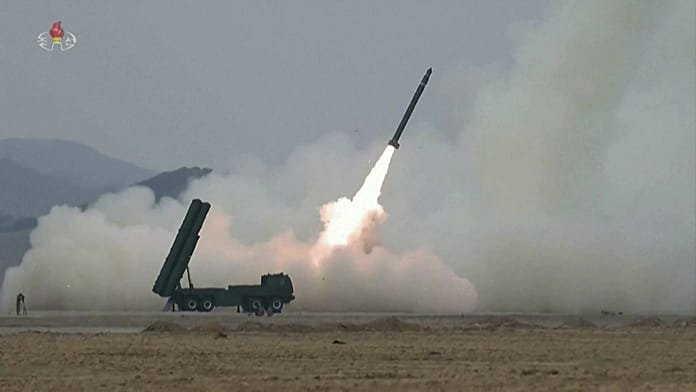
The official Korean Central News Agency reported that Kim watched the strike drill involving twelve 600mm-calibre, ultraprecision rocket launchers off North Korea’s east coast on Saturday.
South Korea’s military said it detected about 10 ballistic missiles fired from North Korea’s capital region toward the eastern sea. South Korea’s national security council called the launches a provocation that violated UN Security Council resolutions that bans any ballistic activities by North Korea.
KCNA cited Kim as saying that the drill would expose enemies within the 420-kilometre striking range, to “uneasiness” and give them “a deep understanding of the destructive power of tactical nuclear weapon.”
“If this weapon is used, the opponent’s military infrastructure within its striking range can never survive,” Kim said, according to KCNA.
What is the MLRS 600mm (KN-25) missile system?
Experts say North Korea’s large-sized rocket launchers blur the boundaries between artillery systems and ballistic missiles because they can create their own thrust and are guided during delivery. North Korea has said some of these systems are capable of delivering nuclear warheads.
The system used, known in the West as the KN-25, is technically a hybrid category of short-range ballistic missile and multiple rocket launcher.
600 millimetres in diameter, eight metres long and weighing three tonnes, it flies on a controlled ballistic trajectory and can carry a conventional warhead of between 300 and 500 kilogrammes, or a Hwasan-31 nuclear warhead, as confirmed by Pyongyang in March 2023.
Its operational range, around 380 kilometres, covers almost the entire South Korean territory from positions in the north of the country. Kim Jong-un stated during the exercise that there is no tactical weapon that surpasses the performance of this system and warned that any enemy military infrastructure within its range will not be able to survive once it is used.
Theoretically, and according to official figures, the accuracy range of this strike system is around 80-90 metres at a distance of more than 360 kilometres.
In February this year, 50 new five-tube launchers were formally handed over to the army in a ceremony presided over by Kim himself. Mass production of the system has been ramping up since 2023.
Kim described the exercise as a routine exercise aimed at verifying the country’s defensive capabilities, and announced that it would be repeated frequently. In his speech, he insisted that the goal of the weapons programme is to maintain what he called lasting peace through deterrence, not aggression.
The launch came at the same time as the springtime US-South Korean Freedom Shield training, a computer-simulated command post exercise, which is to run through 19 March.
Kim’s comment on the rockets suggested it was in response to the ongoing exercise, according to Hong Min, a senior analyst at the Korea Institute for National Unification.
“The launch pattern…is closely synchronised with the schedule” of the joint drills, he said.
“This suggests the weapons system is being operated as a means of nuclear deterrence and practical demonstration” against the alliance.