


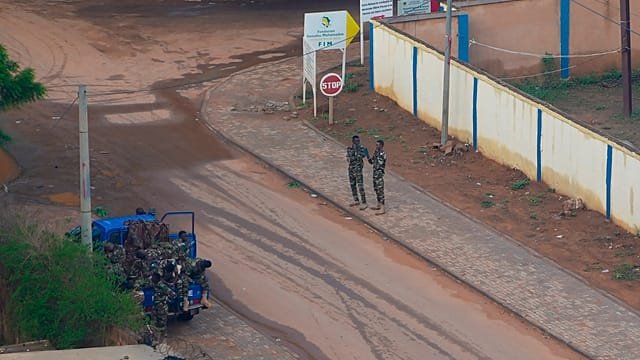
In less than a decade, the Tillabéri region in western Niger has become the bloody frontline of a conflict between Niger and its neighbours against jihadist groups linked to Al-Qaeda and the Islamic State group.
Located along the porous border areas between Niger and its instability-hit neighbours, Mali and Burkina Faso, the region has become a place where jihadists “kill, loot and extort,” Amadou Arouna Maiga, coordinator of the Union of Tillabéri for Peace and Security, told AFP.
Despite coming to power through a 2023 coup promising to curb violence, Niger’s military junta has struggled to contain fighters from the Islamic State and the Group for the Support of Islam and Muslims (JNIM), Al-Qaeda’s Sahel affiliate.
Years after jihadists first arrived in the region in 2017, the vast Tillabéri area had become by 2025 the deadliest part of the central Sahel for civilians, according to the conflict monitor ACLED.
That makes it the most lethal region in an area that the Global Terrorism Index has described as the “global epicentre of terrorism” for two consecutive years.
“The situation remains very serious… Schools and health centres are closed, and markets are no longer active,” Maiga said.
Nearly 1,300 deaths last year
Of the 1,939 deaths recorded in Niger last year by ACLED, nearly 1,300 occurred in the Tillabéri region.
About half resulted from clashes between jihadist groups and Nigerien forces, while the other half came from attacks targeting civilians, ACLED analyst Heni Nsaibia told AFP.
Among the deadliest incidents were:
- an attack on a baptism ceremony that killed 22 civilians,
- another that killed 71 people during a Muslim sermon,
- and an attack on a mosque that left 44 dead.
Thirty-four soldiers were also killed in another attack, while two mayors were assassinated.
Although ACLED attributes most of the violence to jihadist groups, it has also accused the Nigerien army in some cases of violence against civilians. To protect themselves, many residents have formed self-defence militias.
However, these volunteer fighters, often poorly trained and less well armed, have frequently been overwhelmed by better-equipped jihadists. At least 25 members of a civilian militia were killed near the Malian border in an attack at the end of February.
“Executed in public”
The surge in violence in Tillabéri is partly explained by its strategic location at the crossroads of Niger, Mali and Burkina Faso, where jihadists also move freely, Nsaibia said.
While local militias were formed with good intentions, their proliferation has also intensified communal tensions and local rivalries, he added.
Other factors, including counter-offensives by Niger’s army, a bloody rivalry between Islamic State fighters and JNIM, and the latter’s expansion southward toward the capital Niamey, have also contributed to the deadly situation.
“Terrorists target state symbols, burn and loot schools and health centres, and persecute or even assassinate civil servants and local leaders,” said a nurse from the region who told AFP she had fled to Niamey after receiving death threats.
Several political officials, as well as religious and traditional leaders, have also left Tillabéri.
“Stubborn people and those suspected of collaborating with the army are whipped or executed in public,” the nurse added.
“No work, no money”
Residents living in areas controlled by jihadists are forced to pay tribute and accept rulings from improvised courts enforcing Islamic law, according to a local official in Makalondi, near Burkina Faso.
Insecurity also dominates the region’s main roads, where travel often takes place under heavy military escort, he added.
The army also believes that the dozens of illegal gold mining sites scattered across the region’s 100,000 square kilometres provide a major source of income for jihadist groups, enabling them to buy weapons and pay fighters.
Meanwhile, the region’s economy has collapsed due to anti-jihadist measures imposed by authorities, including a state of emergency, a ban on motorcycles — a preferred mode of transport for militants — and the closure of many markets and petrol stations.
“No work, no money, life is very hard,” complained a taxi driver in Téra, a town in Tillabéri.
Nsaibia fears a future where violence against civilians continues, local militias keep multiplying, and jihadists expand further south from Tillabéri.
If that happens, he warned, “it is unlikely that Tillabéri will see any significant reduction in violence in 2026.”