



10/04/2026 – 19:23 GMT+2
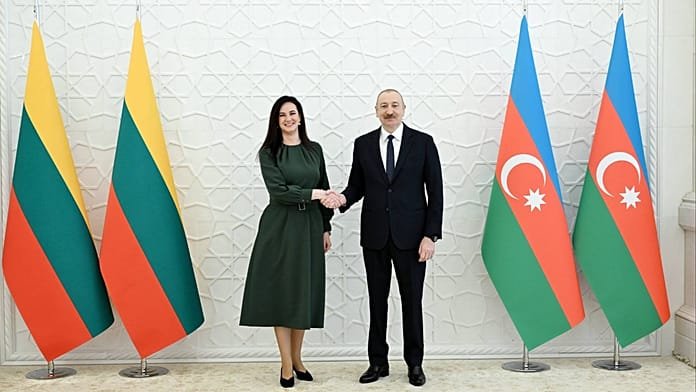
Lithuania is strengthening economic and political ties with Azerbaijan through Prime Minister Inga Ruginienė’s visit to Baku, focusing on energy, trade and transport connectivity, and aiming to deepen cooperation within the EU framework.
Lithuania’s prime minister Inga Ruginienė visited Baku to develop Lithuania’s economic and political engagement with Azerbaijan through cooperation across energy, trade, security and transport connectivity, as both countries seek to strengthen sector-based ties between the South Caucasus and the European Union.

ADVERTISEMENT
ADVERTISEMENT
During her visit to Baku, Prime Minister Inga Ruginienė stressed the importance of closer political and economic ties in a volatile geopolitical environment.
“The key priority of visiting Azerbaijan is to stenghten our friendship because today when we have a very dynamic geopolitical situation, it is crutial to have more friends close to each other,” the Lithuanian leader said.
She also underlined the breadth of cooperation between countries’ ministries, spanning multiple sectors including energy, education, agriculture and defence.
“Each of our ministers has a lot of topics to speak with Azerbaijan’s different sectors’ ministers. We can start from energy then education also agriculture sector and defence,” Ruginienė said.
“Security is important to both countries, so we are investing in defence a lot, and we know that Azerbaijan has improved technologies in that area,” she explained.
“Sharing experience, sharing technologies, it is very, very important, and I think this is an area where we can have good discussions.”
“The future is very strong friendship when you have a tough period it is very useful to have a friend whom you can call and support each other,” Ruginienė stated.
Trade, energy and transport cooperation
Economic cooperation remains a central pillar of bilateral relations, with both sides exploring opportunities to expand trade and cooperation in logistics, agriculture, digital services and industrial development.
Azerbaijan’s role as a regional transit hub connecting Europe and Asia remains seen as strategically important to Lithuanian economic interests.
Energy remains one of the most significant areas of cooperation, particularly in the context of European energy diversification efforts.
Alongside traditional energy supplies, discussions are increasingly focused on renewable energy, energy efficiency and green transition technologies.
Transport connectivity is also gaining importance, particularly through the development of the Middle Corridor, seen as a key East–West logistical gateway, as part of the long-term connectivity engagement between the South Caucasus and the EU.
Azerbaijan’s position as a regional hub connecting Europe and Asia continues to be highlighted as a strategic opportunity for Lithuanian businesses seeking access to wider markets.
Lithuania’s ambassador to Baku Kęstutis Vaškelevičius told Euronews on Thursday that Vilnius will push for broader engagement with Azerbaijan during Lithuania’s next EU presidency.
“Lithuania as a member of European Union contributes a lot, and for us the dialogue between EU and Azerbaijan is a very important one,” Vaškelevičius said.
“Next year, 2027, Lithuania will be President of EU Council and we try to use this momentum and this time to further strengthen and advance European union and Azerbaijan relations, which is very important for both, for EU and Azerbaijan,” the ambassador said.
Energy remains one of the most important areas of collaboration, particularly in the context of Europe’s diversification strategy.
Azerbaijan’s role as an established energy supplier to European markets continues to underpin bilateral ties.
Alongside traditional energy cooperation, both sides are increasingly discussing opportunities in renewable energy, energy efficiency, and green technologies, all aligned with broader EU climate and transition goals.