



10/04/2026 – 15:12 GMT+2
Antisemitic offences in Germany have risen significantly in recent years, reaching a new peak in 2024. Authorities recorded 6,236 cases, including 173 violent incidents, according to available data.
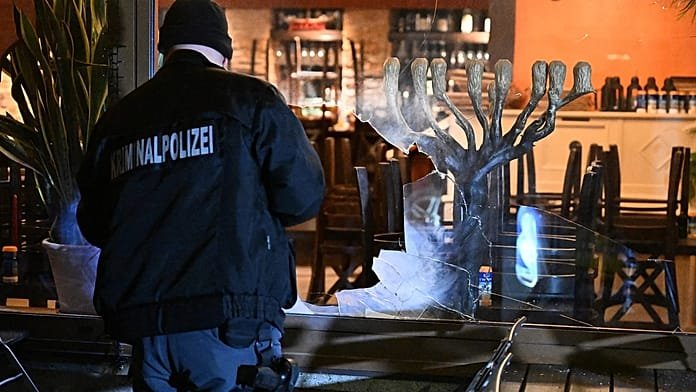
An Israeli restaurant in Munich was targeted in a suspected antisemitic attack overnight on Friday, with police looking into the unidentified perpetrators and their motive, authorities said.

ADVERTISEMENT
ADVERTISEMENT
Witnesses reported hearing three loud bangs around 0:45 am local time. According to police, unknown individuals threw pyrotechnic devices into the dining area of the Eclipse restaurant. The exact type of device is still being examined by forensic experts.
The suspected arson attack caused several thousand euros in damage. No one was injured as the premises were empty at the time of the incident. Two front windows were broken, and a third was damaged.
The motive remains unclear. An immediate search for suspects did not yield any results.
Munich’s criminal police have since taken over the investigation, also involving Andreas Franck, the Bavarian justice system’s antisemitism commissioner.
Owner vows to continue despite attack
The restaurant said it had not received any prior threats. However, owner Grigori Dratva suggested a possible political motive.
“We don’t want to make accusations, but we are a visible Israeli restaurant, so the assumption is obvious,” he told German press agency dpa.
Despite the attack, the restaurant plans to reopen later the same day. The damaged windows have been temporarily secured and will be replaced.
“We will not be intimidated. We will open,” Dratva said.
Meanwhile, the restaurant has received an outpouring of public solidarity. A rally is scheduled for 5 pm local time near the venue, with a number of organisations and individuals expected to attend.
The attack also prompted political reactions. “The best and most sensible response to this attack is to visit the restaurant and eat there,” Israel’s Consul General for southern Germany, Talya Lador-Fresher, wrote on Instagram.
Ludwig Spaenle, the Bavarian government’s antisemitism commissioner, described the incident as an attack on intercultural dialogue: “You can criticise the Israeli government, but you cannot attack such institutions.”
Antisemitic offences at record levels
Antisemitic offences in Germany have risen significantly in recent years, reaching a new peak in 2024. Authorities recorded 6,236 cases, including 173 violent incidents, according to the Mediendienst Integration.
Security officials attribute around half of these offences to the far-right spectrum, while roughly 31% are linked to what authorities classify as a “foreign ideology”.
The number of offences related to the Middle East conflict had already nearly doubled between 2022 and 2023.
In the wake of the Hamas-led attack on Israel on 7 October 2023 and the subsequent Israeli military offensive in Gaza, Germany’s Federal Criminal Police Office (BKA) recorded 15,900 politically motivated offences by the end of September 2025.
Around 6,400 of these cases were classified as antisemitic. In 2023 and 2024, most offences were attributed to what authorities describe as “foreign” or “religious ideology”.
Antisemitic crimes in Germany range from incitement to hatred under Section 130 of the Criminal Code to property damage, verbal abuse and physical attacks on Jewish individuals.
Police also report a growing number of cases involving the use of symbols of unconstitutional organisations (Section 86a StGB).
In some instances, this has included the slogan “From the river to the sea”. German courts have issued differing rulings on whether its use constitutes a criminal offence.
Civil society groups also report an increase in attacks on memorials and sites of remembrance.
Criticism of official data
Official police statistics have long faced criticism, and experts believe many incidents go unreported.
A study by Bielefeld University found that only around one in four people affected by antisemitic incidents report them to authorities.
Reasons cited include a lack of trust in institutions and doubts that reporting will lead to meaningful consequences.
Independent organisations in some cases report significantly higher numbers.
The Research and Information Centre on Antisemitism (RIAS) recorded 8,627 antisemitic incidents nationwide in 2024, a rise of around 77% compared to 2023 (4,886 cases). The data is based on reports submitted to its federal and regional offices.
However, RIAS methodology has also faced criticism, with some observers arguing that its definition of Israel-related antisemitism may be too broad.