



12/03/2026 – 11:56 GMT+1
Europe faces rising terror threats to Jewish communities, with synagogue attacks, foiled plots and experts warning the Iran war is fuelling radicalisation even further.
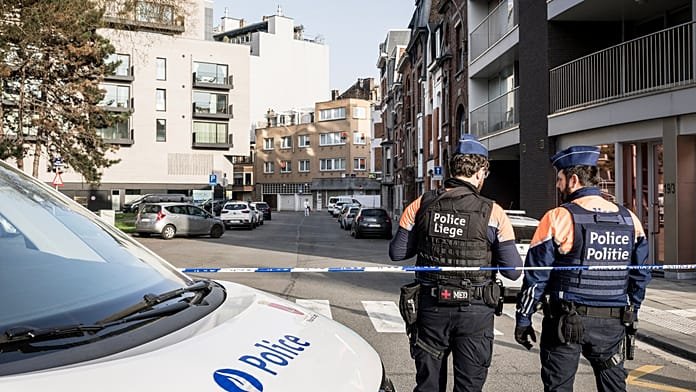
A historic synagogue in Liège was hit by an explosion at 4 am Monday, with authorities investigating the incident as a potential terrorist attack.

ADVERTISEMENT
ADVERTISEMENT
On Tuesday, Cyprus arrested a suspected Hamas arms smuggler whose weapons were allegedly intended for attacks on Israeli or Jewish institutions in Germany and Europe, according to Germany’s Federal Prosecutor’s Office.
Experts warn that the escalating Iran war and broader regional conflict are heightening terror threats against Jewish communities across Europe.
“It’s clear that threats against Jews and Israelis in Europe have increased over the past two and a half years — and continue to rise,” Lorenzo Vidino, director of the Program on Extremism at George Washington University, told Euronews.
Hans-Jakob Schindler, senior director at the Counter Extremism Project, warned of new radicalisation fuelled by the Iran war. “Both online and offline, we are seeing further radicalisation across the entire spectrum of violent Islamist extremism,” he said.
Spike in attacks on Jewish sites
Europe has witnessed a sharp rise in attacks on Jewish and Israeli institutions since October 2023, particularly in Germany.
In May 2024, there were eight known attacks or thwarted plots, including attempts on synagogues and embassies. A Hamas plot targeting the Israeli Embassy in Berlin was foiled that month. In September 2024, a suspected Islamist opened fire on an Israeli consulate in Munich.
French authorities recorded 92 incidents near synagogues and Jewish schools in October 2023, including Molotov cocktail attacks and threats. Antisemitic acts in France quadrupled in 2023 compared to the previous year.
In the UK, a terrorist attack on Heaton Synagogue in Manchester on 2 October 2025 killed two people. According to the Community Security Trust, there were 562 incidents targeting synagogues in the UK between 2023 and 2025.
Last week, Azerbaijani authorities said they had foiled multiple attack plots linked to Tehran, including plans to use C-4 explosives against Jewish community institutions.
Vidino said perpetrators come from diverse backgrounds. “We’re dealing with a very complex and heterogeneous threat landscape,” he said.
Some are lone actors with extreme anti-Israel or antisemitic views, while others are affiliated with jihadist groups, Iran-backed networks or Russian operatives, according to Vidino.
Extremists working together, experts say
Schindler said radicalisation is spreading beyond the Shiite Islamist circles usually linked to Iran.
“The threat is not limited to Shiite extremists,” he said, highlighting that Tehran’s support for both Shiite groups like Hezbollah and Sunni groups like Hamas is creating a solidarity effect within the broader extremist network.
“More effective monitoring of relevant networks on social media and messaging platforms is now more critical than ever,” Schindler said.
Rebecca Schönenbach, a counterterrorism adviser, warned the Iran war has expanded potential targets.
“The danger is now higher because the Iranian regime has always carried out attacks on Israeli and Jewish targets — and now Saudi and Emirati targets could be added,” she said.
Schönenbach said Iran has built a network including its own agents linked to embassies, freelance operatives trained by the Revolutionary Guards and contracted assassinations through organised crime.
“For individuals, lone actors are the most dangerous. For institutions, organised criminal agents pose the greatest threat,” she said. “The threat level will remain high as long as the Iran conflict and the regime exist.”