


A crucial early warning radar plane, used to provide commanders with a real-time picture of war, was destroyed in an Iranian attack on the Prince Sultan air base in Saudi Arabia on Friday. PHOTO/UGC.
By PATRICK MAYOYO
The Iranian Embassy in Nairobi has confirmed that maritime traffic through the Strait of Hormuz “has not been suspended or closed” and continues to operate under measures adopted in the current wartime environment.
In a statement released on 27 March 2026, the embassy said that non-belligerent states and vessels may continue to transit the strategic waterway under specific conditions, a position that has been formally communicated to the International Maritime Organization (IMO).
According to the embassy, vessels navigating the strait must not participate in what Iran describes as unlawful aggression against the country, must adhere to prescribed safety and security measures, and are required to coordinate with the relevant Iranian authorities in advance.
Conversely, ships linked to the “aggressors”, particularly those belonging to the United States and Israel, or supporting the ongoing conflict, will not be treated as enjoying normal transit rights. Such vessels, the statement added, would be handled in accordance with Iranian authorities’ decisions within the legal framework governing armed conflict.
The embassy categorically rejected reports suggesting the Strait of Hormuz had been closed, describing such claims as false and misleading. It also dismissed media narratives that linked alleged maritime restrictions to rising living costs in countries such as Kenya, calling them “biased propaganda” aimed at distorting public opinion and shifting responsibility for regional instability.
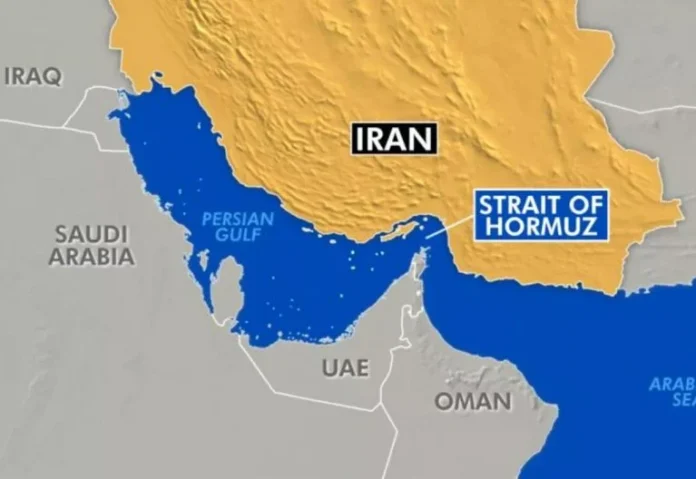
The Strait of Hormuz is one of the world’s most critical shipping lanes, facilitating a significant portion of global oil exports and international maritime trade. Any disruption in this narrow waterway, which connects the Persian Gulf with the Gulf of Oman and the Arabian Sea, has the potential to impact global energy markets and regional security.

The Strait of Hormuz, channeling about one-fifth of the world’s oil supply. PHOTO/@Glenn_Diesen/X.
Tensions in the Persian Gulf have escalated sharply following recent military actions by the United States and Israel targeting Iranian assets. Iran’s statement described the regional situation as “highly unsafe, volatile, and unpredictable,” attributing the instability to what it calls illegal military aggression by the US and Israel, assisted by certain littoral states in the Gulf.
The embassy further asserted that these actions constitute a violation of Article 2(4) of the United Nations Charter, which prohibits the threat or use of force against the territorial integrity or political independence of a state. It warned that the conflict has already begun to affect maritime safety, security, and international shipping throughout the region.
Despite the heightened tensions, Iran emphasised its continued commitment to international obligations, including respecting freedom of navigation. Historically, Iran has played a role in maintaining maritime security in the Persian Gulf, the Strait of Hormuz, and the Gulf of Oman, and it reaffirmed that its current wartime measures are designed to ensure the safety of all vessels not involved in the conflict.
The ongoing conflict threatens to destabilise energy markets and complicate shipping logistics in one of the world’s busiest maritime corridors. Analysts warn that while Iran maintains open navigation for neutral parties, the risk of confrontation remains high, particularly for vessels associated with US and Israeli interests. This dynamic underscores the fragile balance in the Persian Gulf, where military actions by external powers have immediate global repercussions.
The Strait of Hormuz holds immense strategic importance, accounting for approximately 20–25 percent of global oil trade. Even minor disruptions in this narrow waterway can trigger significant spikes in oil prices and reverberate across international markets.
Iran’s control over maritime coordination in the strait gives it considerable leverage, allowing the country to grant selective access while signalling strength to both regional and global actors.

Mojtaba Khamenei, the son of Iran’s Ayatollah Ali Khamenei, who was killed in US-Israeli strikes, has been chosen as his successor. PHOTO/UGC.
The dynamics between the United States, Israel, and Iran have further heightened tensions. The US and Israel characterise their recent strikes on Iranian targets as preventive measures against perceived threats, whereas Iran portrays these actions as violations of international law, specifically Article 2(4) of the United Nations Charter.
Tehran is seeking to mobilise international sympathy and challenge US–Israeli actions on a diplomatic front. The risk of escalation remains high, with the potential for Iran to retaliate against regional US or Israeli interests, including commercial shipping or energy infrastructure.
Regionally, Gulf littoral states such as the UAE, Saudi Arabia, Oman, and Qatar face a delicate balancing act. They must navigate security alliances with the United States while maintaining economic and political ties with Iran. Smaller Gulf states may come under pressure to align with US–Israeli positions, heightening the risk of regional fragmentation and instability.
The global implications of the conflict are significant. Any disruption to shipping or oil flows through the strait could have serious consequences for energy prices and international trade logistics. This has prompted concern from international actors, including the International Maritime Organization and European powers, who may intervene diplomatically to prevent escalation and ensure the security of commercial shipping.
In the short term, Iran is likely to continue exercising control over transit rules in the Strait of Hormuz, carefully avoiding a total closure while projecting power. Long-term stability, however, depends on sustained diplomatic engagement and restraint from both the US–Israel axis and Iran, with the risk of miscalculation remaining a persistent threat.