


In Ghana Town, a ‘stateless’ future for hundreds born and raised in Gambia
In a small Gambian village founded decades ago by Ghanaian fishermen, many of their descendants languish without ID documents.
Save

 By Kaddy JawoPublished On 7 Apr 20267 Apr 2026
Ghana Town, The Gambia – As dawn breaks over Ghana Town, a fishing village along The Gambia’s Atlantic coast where hundreds of residents live without official documentation, Marie Mensah moves quickly through her morning routine: dressing her children, preparing breakfast and checking their schoolbags before walking them to the roadside.
Three of her four children – aged between six months and 10 years – attend a fee-paying private school, not by choice, but by necessity. Without national identity documents, enrolment in tuition-free public schools is nearly impossible.
Recommended Stories
list of 3 itemsend of list
“They ask for documents we don’t have,” Mensah, 30, told Al Jazeera. “So the public schools refuse them.”
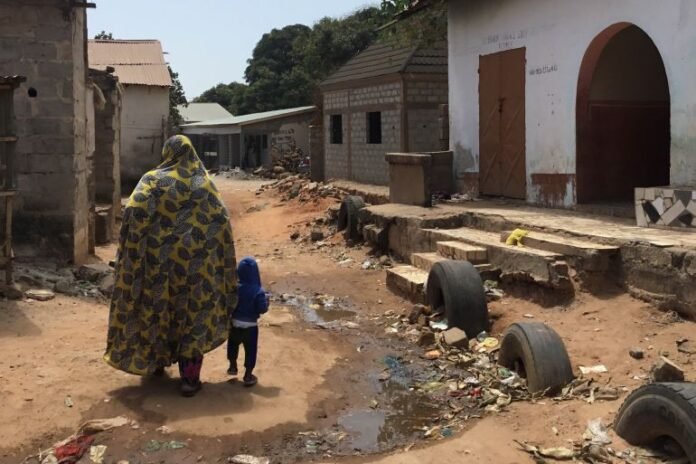
From a distance, Ghana Town, about 35km (22 miles) from the capital, Banjul, looks like any village in coastal Gambia, with fishermen untangling their nets and mounting wooden boats towards the sea. But for most of the people living here, each day begins with uncertainty: the question of whether they legally belong to the only country they have ever known.
About 850 of the town’s 900 residents lack citizenship, passports, and even national identification, according to the Village Development Committee (VDC), which oversees community matters in the town.
Ghana Town was founded in the late 1950s by 10 Ghanaian fishermen who sailed from what was then the Gold Coast (now Ghana) to eventually settle along The Gambia’s coastline. Over the years, their families grew. More people were born and raised here, learning local languages and forming a close-knit community. But even though this is the only home they have ever known, most of the descendants of the original fishermen remain trapped in a legal grey zone.
Advertisement
According to Gambian law, a person born to non-Gambian parents is not recognised as a citizen, even if born in the country. Those who have one Gambian parent have attained official paperwork. For other residents, it has been a series of failed applications to the government.
After Mensah sees her older children off to school, she takes her six-month-old to the nearest immigration office, about 15km (9 miles) away in Kanifing. She will once again try to apply for a national identity card, something she first attempted when she was 18.
“I know they may reject me,” she told Al Jazeera. “But I still have to try.”
After hours of waiting and paying 500 dalasi ($7) for an application form, which she fills out with supporting documents, officials turn her away, citing that her birth certificate, which classifies her as non-Gambian, disqualifies her.
Other residents told Al Jazeera their applications were also rejected on similar grounds.
“If I cannot get an ID where I was born,” lamented Mensah, visibly emotional, “where else will accept me?”

‘We are all stateless’
Under Section 9 of The Gambia’s 1997 Constitution, citizenship by birth is determined by descent. Being born in the country alone does not confer nationality; at least one parent must be Gambian.
For many Ghana Town families – who lack both Gambian and Ghanaian citizenship – the law has shaped and roadblocked their lives for generations.
Amina Issaka, 64, traces her family’s presence in Ghana Town back nearly seven decades.
Her grandparents were among the earliest settlers. Today, she, her six adult children, 11 grandchildren, and four great-grandchildren are all undocumented.
“We are all stateless,” she said. “If we cannot get Gambian citizenship, where else would we go?”
From a small roadside stall selling cooking ingredients and children’s items, Issaka earns just enough to survive. But building a real business is impossible without identity documents.
“I cannot even register my shop,” she said. “Without papers, you cannot grow.”
To formally register a business or even open a bank account, an individual is typically required to present a valid national ID card or passport, along with a Tax Identification Number. In Ghana Town, the general lack of documentation means that business activity operates largely within the informal sector.
Advertisement
Those who are employed but do not have bank accounts often rely on informal arrangements based on trust; some receive their salaries through a friend’s bank account, while others, particularly daily wage earners, are paid in cash at the end of each workday.
“You can work and even receive a cheque. But without ID, the bank will not recognise you,” said Emmanuel Dadson, a 36-year-old teacher and secretary of the VDC, who is also undocumented.
Dadson told Al Jazeera that the Gambia Commission for Refugees had promised to regularise their status in February this year. February came and passed, but officials never showed up in Ghana Town.
Madi Jobarteh, a human rights expert, told Al Jazeera that Gambian law provides citizenship by birth, descent, registration, or naturalisation – but significant gaps leave many at risk of statelessness. Without a national ID or birth certificate, individuals are excluded from education, formal employment, healthcare, property ownership, and even legal protection.
“The residents of Ghana Town have lived here for decades, integrated fully, and contributed to the country. There is absolutely no reason why they should still be treated as noncitizens,” he said.
He recommends reforms, including guaranteed nationality for children who would otherwise be stateless, stronger birth registration, simplified ID processes, and adherence to international statelessness conventions.
Al Jazeera reached out to the Ministry of Interior, which oversees this matter, as well as the Gambia Immigration Department, but neither responded to our questions. Meanwhile, the Ministry of Justice reiterated that a person born to non-Gambian parents is not recognised as a citizen, even if born in The Gambia.

Identity under pressure
While most residents battle with daily bureaucratic setbacks, others told Al Jazeera they have faced even tougher consequences: police questioning or detention during immigration operations for failing to produce valid identification.
Residents say many Gambians, including immigration officials, are aware of the circumstances of Ghana Town residents, so people are released once they explain the situation.
But many, like Dadson, are worried for themselves and their families.
In 2014, he was temporarily able to get documentation after former President Yahya Jammeh issued a directive allowing some Ghana Town residents to obtain national identity cards.
But the measure lacked permanent legal backing, and did not continue after Jammeh lost power in 2017. When the residents’ documents expired years later, renewals were refused.
Dadson is now undocumented again.
Fearing what may lie ahead, he recently sent his wife and three children to Ghana.
Without passports, they travelled overland for nearly a week across several West African countries. Within the region of the Economic Community of West African States (ECOWAS), residents say, it is possible to move across some land borders without a passport, depending on the discretion of border officials.
Advertisement
“The future here is uncertain,” Dadson said, talking about his choice to send them to Ghana, where it is possible to apply for citizenship based on descent. “I didn’t want my children to remain trapped.”
For others, the struggle extends beyond bureaucracy and law.
Some residents say they have been encouraged to adopt more Gambian-sounding names and surnames to improve their chances of acceptance. Emmanuel Arkoh, 36, refuses.
“Our identity is not negotiable,” he said.
“We are born here, but we belong nowhere.”
Benjamin Amoah, 44, a fisherman, said three of his children have reached adulthood without documentation, and an application for his sons was rejected because officials considered the family name foreign.
“What hurts most,” Amoah added, “is that their mother is Gambian, yet they are still denied.”
Though Gambian citizenship may be acquired through birth and descent, residents say navigating official processes requires documentation that many families simply do not possess after generations of administrative exclusion.

Dreams interrupted
All across the village, the lack of proper paperwork has caused delays and frustrations. For some, this has put a stop to their future plans and dreams.
Joseph Oddoh was among the region’s top performers in the 2017 West African Senior School Certificate Examination. He earned a scholarship to study medicine abroad.
Years later, he has not left Ghana Town.
“He had no travel documents,” community leader Alex Mensah explained.
Though the VDC tried to intervene on his behalf, the situation remained unresolved. And Oddoh is not the only one. Others from the settlement, including some university graduates, are unable to pursue master’s programmes abroad because they lack essential documentation, such as passports.
Now 28, Oddoh works as a fisherman along the same coastline where he grew up.
After nearly a decade, he has largely given up on pursuing further academic goals, describing himself as pragmatic and focused on marrying a Gambian to build a stable future for the next generation.
“My dream of becoming a medical doctor ended because of a single paper,” he said. “I worry my future children will face the same problem.”
While most people here have faced roadblocks, many residents say there is one unexpected exception: political participation.
Several people told Al Jazeera they had voted in national elections despite lacking citizenship documentation, often using community attestations confirming residency.
“If we can vote,” one resident asked, “why can’t we have Gambian IDs?”
The Independent Electoral Commission (IEC) denied registering noncitizens.
“We do not issue voter cards to noncitizens,” IEC spokesperson Pa Makan Khan told Al Jazeera, adding that it remained unclear how undocumented individuals might obtain registration.
During a town hall meeting last year, Fatou Cham, the area’s member of parliament, raised the same concern. “If they are foreigners, then why are they voting?” she asked, promising to pursue a solution.

The question of belonging
Citizenship provisions in The Gambia’s Constitution have changed little despite more than 50 amendments over nearly three decades.
A 2024 assessment by the Gambia Commission for Refugees found that most stateless individuals identified were born locally. Of 686 people assessed, only 53 possessed Gambian passports, documents obtained under former President Jammeh’s 2014 directive.
Advertisement
Assistant Commissioner for Refugees Omar Camara told Al Jazeera authorities are working with the United Nations refugee agency to regularise residents’ status, though limited funding continues to slow progress.
The Gambian Ministry of Justice told Al Jazeera that citizenship law remains governed by the 1997 Constitution, which bases nationality on descent.
“The Constitution does not grant automatic citizenship solely for being born in the country,” a ministry spokesperson said.
The ministry acknowledged that neither the Constitution nor the Gambia Nationality and Citizenship Act provides automatic safeguards for children born to noncitizen or undocumented parents, gaps that can contribute to statelessness.
While no legislative amendments have expanded eligibility, the ministry said existing legal provisions offer pathways to address practical challenges, including cases involving expired identity documents.
Outside the immigration office in Kanifing, Marie Mensah gathers her papers, including her birth certificate and an old Gambian voter card, and begins the journey home.
Tomorrow, she will again wake before sunrise, prepare her children for school and encourage them to study for futures she cannot guarantee.
For the hundreds of stateless people in Ghana Town, citizenship is not an abstract legal debate. It determines whether a child can attend school, open a bank account, travel or dream beyond the shoreline where generations have lived.
“We are not asking for special treatment,” Mensah said. “We are simply asking to exist.”