


In Gaza, Trump’s Board of Peace met with deep scepticism, little hope
In war-ravaged Gaza, residents question whether Trump’s Board of Peace will deliver real safety, rebuilding, or become merely another unfulfilled promise.

 By Maram HumaidPublished On 20 Feb 202620 Feb 2026
Save
Deir el-Balah – As United States President Donald Trump convened the first meeting of his Board of Peace (BoP) in Washington, DC, on Thursday, Palestinians in the Gaza Strip were not debating diplomatic language or political frameworks.
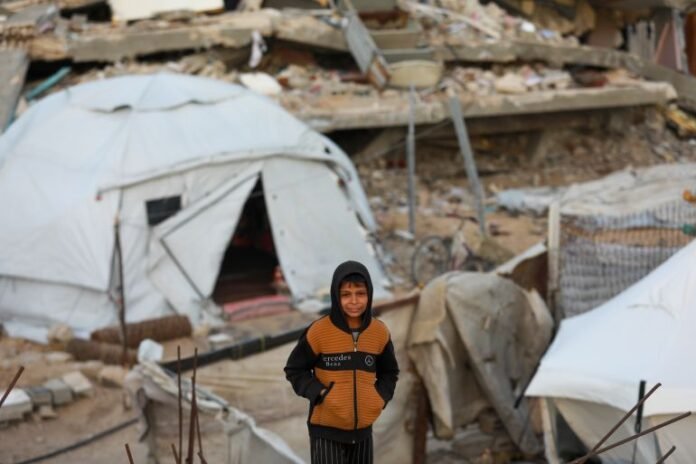
On the streets and in tents across central and southern Gaza, where hundreds of thousands of displaced Palestinians are struggling to survive, one simple question dominated: Will anything actually change in the harsh reality on the ground?
Recommended Stories
list of 3 itemsend of list
“I’ve heard about money being collected for Gaza, but we see nothing. This has happened many times, but nothing ever changes,” said 43-year-old Amal Joudeh, who lives in a tent in Deir el-Balah.
“I am one of the people whose house is gone. I still have no home. My husband is injured, and my children are injured. We want any support or reconstruction … any solution,” said the mother of eight, who had been displaced from the northern Gaza town of Beit Lahiya.
Addressing the meeting in Washington, DC, Trump announced that nine member nations have pledged $7bn to a reconstruction fund for the Gaza Strip, with five countries agreeing to deploy troops to an International Stabilisation Force for the Palestinian territory.
He said the US will also make a contribution of $10bn to the BoP, although he didn’t specify what the money will be used for.
The pledges, however, remain far below United Nations estimates of up to $70bn needed for rebuilding the Palestinian territory, destroyed by nonstop Israeli bombardment during more than two years of a genocidal war.

Very little has changed since the “ceasefire” agreement brokered by Trump went into effect in October last year.
Advertisement
Most Palestinians are still struggling to feed their families, while health, education and sanitary services are almost nonexistent.
Gaza’s Ministry of Health has said that more than 600 Palestinians have been killed by Israeli gunfire since the truce, which Palestinians had hoped would end more than two years of genocidal war that has killed more than 72,000 people, according to official statistics.
“Israel kills, bombs, violates the ceasefire agreement daily and expands the buffer zone without anyone stopping it,” said Awad al-Ghoul, a 70-year-old Palestinian displaced from Tal as-Sultan in Rafah and who now lives in a tent in the town of az-Zawayda.
“If a peace board of this size cannot force Israel to stop its attacks in a small place like Gaza, how will it fix conflicts across the world?” al-Ghoul says, referring to Trump’s stated intention that the board would not be limited to Gaza but would extend to intervening in resolving other international disputes.
Funds allocated: Genuine support or rhetoric?
Many people in Gaza who had pinned their hopes on international donor conferences in the past without any tangible results were sceptical about the figures.
Al-Ghoul said he does not believe these sums will entirely go to Gaza.
“A small part will go to Gaza, and the rest will be administrative expenses and luxurious salaries for top officials and presidents. A small portion will come to Gaza so they can say they supported Gaza and justify the continuation of their luxury club called the Board of Peace .”</ p>
“So this project is a failure from the start and unclear in vision, like the failure of the aid distribution foundation established by America a year ago, which became death traps for thousands.”

Jamal Abu Makhdeh agrees.
“They won’t do anything for Gaza. It’s all lies,” the 66-year-old man says. “Anything Israel agrees to certainly won’t be in our interest,” he tells Al Jazeera in Deir el-Balah.
“Trump, together with Israel, wants to use the Board of Peace to impose their decisions on the world by force. This is about power, control, and domination, without regard for weaker nations like us,” he added.
Over the past two years, reconstruction plans have been discussed after every ceasefire deal in Gaza. However, Israeli restrictions on the entry of construction materials have hindered the full implementation of those pledges.
Advertisement
“Even if the board decides to rebuild Gaza, this is unlikely and won’t happen. We’ve heard this many times and nothing happened,” he adds.
“How can we trust a peace board in which Israel is a member? It is the one that killed us, destroyed us, and committed genocide.”
While Abu Makhdeh insists he is not optimistic about the board’s decisions, he also expresses concern about Trump and Israel’s insistence on disarming Hamas. Under the truce accord, Hamas is required to hand over its weapons.
“Their main goal is to disarm Hamas so that we drown in internal and civil disputes,” he adds.
He said he sees talk of peace as deceptive, pointing to ongoing violations in the occupied West Bank, including the destruction of Palestinian houses and property, settlement expansion, and restrictions on normal life, alongside the deepening tragedy in Gaza.
“There is no optimism in American decisions. This is just media talk.”
Al-Ghoul expressed cautious optimism over the idea of sending an international peacekeeping force to Gaza.
“Personally, I hope this force is sent, but it must act as a deterrent to Israel’s continued attacks, like UNIFIL in Lebanon. I don’t imagine Israel would attack a force imposed by a Board of Peace managed by Trump,” he says.

Reconstruction: The biggest absence in the speech
Despite talk of “stability” and “peace”, the board’s announcement did not include any concrete decision on reconstruction in Gaza or its infrastructure destroyed over two years of war.
For al-Ghoul, reconstruction is not the priority if Israel continues to violate the truce.
“Reconstruction has no value if Israel’s hand continues destroying and killing. What’s the point of rebuilding while Israel destroys?”
Jouda, however, said she hopes to see an improvement in life for herself and for her children, “like it used to be”, including for schools to reopen, children returning to classrooms after a long interruption, and to move out of the tent into a sturdy home.

Far from international boards, people’s demands in Gaza are summarised in short phrases: safety , peace, and a return to their homes.
“My demand is to return to my neighbourhood in Rafah, which has been occupied for a year and a half … even if in a tent,” says al-Ghoul.
“What matters is that the army withdraws and we return to our places.”
Abu Makhdeh summarises his demands as wanting these assembled nations to achieve justice for Gaza, even once.
“We are exhausted. They must show mercy. We demand what is good for our people, to live in peace and be granted a simple life with our basic right to safety.”