


If Jamaat comes to power, Bangladeshi Hindus will be safe. I am the proof
Bangladeshi minorities have been told that Islamic politics means their persecution. That’s a lie. The opposite is true — Jamaat will govern by justice for all.


Bangladeshi businessman and politician from the Jamaat-e-Islami.
Published On 6 Feb 20266 Feb 2026
Save
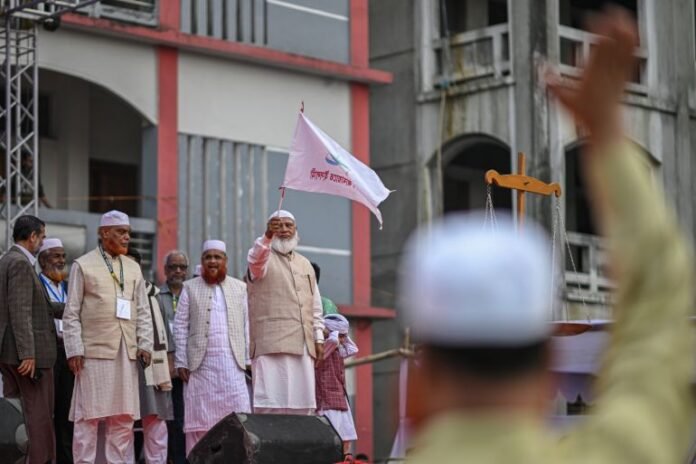
My name is Krishna Nandi. I am a Hindu. I am a businessman. I am also a parliamentary candidate of Bangladesh Jamaat-e-Islami.
For many readers, this combination appears unusual. For me, it reflects a deeper truth about politics in Bangladesh that has long been obscured by fear, misinformation and political convenience.
My nomination has generated national debate because it challenges a long-held assumption that an Islamic political party cannot genuinely represent religious minorities. I welcome this debate. My candidacy exists precisely to confront this assumption directly and openly.
I want to state clearly what I have said repeatedly to people across my constituency. If Jamaat-e-Islami comes to power, no Hindu will have to leave Bangladesh. No Hindu will be forced to go to India. Instead, Hindus will live in this country with dignity, safety and respect. When I say that Hindus will be treated with honour, I am not speaking symbolically. I am talking about concrete guarantees of security, justice and equal citizenship under the law.
For decades, fear has been deliberately planted in the minds of minority communities. Hindus have been told that Islamic politics automatically means their persecution. This narrative has been politically useful for some but deeply harmful for national unity. My nomination itself is a living contradiction of this claim, and it has already restored confidence among many who had lost faith in politics altogether.
I joined Jamaat-e-Islami in 2003, not out of convenience but out of conviction. I found discipline, accountability and moral clarity within the party. Jamaat does not buy votes with money. It does not rely on intimidation, extortion or violence.
Advertisement
These are not rhetorical claims. They are principles enforced internally. That is why many ordinary citizens, including minorities, are now reassessing their political choices.
People are losing confidence in traditional political parties. This includes parties that once spoke the language of democracy but gradually normalised corruption, violence and impunity. Citizens are not simply voting against something. They are searching for an alternative that is serious about justice, governance and moral responsibility.
Jamaat is increasingly being seen as that alternative. In my constituency of Khulna-1, people have suffered for years due to extortion, political violence and fear. Hindus, in particular, have faced targeted attacks, discrimination and economic marginalisation. Many have lost jobs unfairly. Families have lived under constant pressure.
I have said clearly that these injustices will not be ignored. Those dismissed unfairly will receive justice through lawful procedures. Violence and intimidation against any community will not be tolerated.
I do not believe in broker-based politics. I do not operate through intermediaries. My phone number is with the people, and it will remain so. Representation should be direct, accountable and continuous — not something activated only during election seasons.
There have been attempts to intimidate me. Local power structures, including figures linked to established parties, have tried to apply pressure. My response has been firm. I cannot be silenced and I cannot be pushed aside. Fear has dominated our politics for too long. If we surrender to it, nothing will change.
Another issue that deserves honesty is history. I do not deny that minorities in Bangladesh have suffered at different moments under different governments. That suffering cannot be erased by rhetoric. What matters is whether a political movement is willing to confront injustice rather than deny it.
My presence within Jamaat-e-Islami is not an attempt to rewrite history but to shape the future. Many ask whether Jamaat is only for Muslims. My answer is straightforward. Jamaat is an Islamic party in values but a national party in responsibility. Justice, accountability and human dignity are not owned by any one religion.
During the July 2024 uprising in Bangladesh, naturally many amongst minority religious communities felt unsafe and insecure. However, it was members of organisations like Jamaat-e-Islami who gave us protection and safe guarded our temples and places of worship.
Advertisement
A state governed by justice protects minorities better than a state governed by slogans. When families fall into poverty, Jamaat-linked welfare networks step in without asking about religion or political loyalty. This culture of service explains why many citizens see Jamaat not as a party of slogans but as a party of discipline, structure and responsibility.
For international observers, I want to be equally clear. This election is not about importing ideology or exporting fear. It is about restoring trust between citizens and the state.
Bangladesh is a plural society by reality, not by charity. Any political force that ignores that fact cannot govern sustainably. My candidacy is not only about winning a seat, it is also about opening a new political conversation in Bangladesh. A conversation beyond fear, beyond communal suspicion and beyond the idea that identity must divide us.
I stand as a Hindu candidate, not in spite of Jamaat-e-Islami but because I believe its principles can help build a safer, fairer Bangladesh for all. This country belongs to all of us.
The views expressed in this article are the author’s own and do not necessarily reflect Al Jazeera’s editorial policy.