



10/04/2026 – 6:38 GMT+2
In an opinion piece for Euronews, former Israeli Prime Minister Ehud Olmert says the central objectives of the war were not met: the regime did not collapse, enriched uranium remains in Iran’s hands, and it still dominates the Strait of Hormuz. But despite this, there is still a chance for peace.
The combined airstrike by the United States and Israel on Iran on February 28 was powerful, swift, and highly successful.

ADVERTISEMENT
ADVERTISEMENT
In one crushing blow, several leaders of the Iranian leadership were eliminated, headed by Ayatollah Khamenei, the Supreme Leader of Iran for 37 years.
Perhaps this is not an accepted move in international relations, but Khamenei deserved the punishment he received. He was directly responsible for the murder of over 30,000 of his country’s citizens, who lost their patience with the coercive, radical religious regime of the Islamic state and took to the streets in the hope that they might undermine the stability of the regime.
After the joint declaration by the United States and Iran of a two-week ceasefire, an interim summary can be made.
Since February 28th, the Iranian leadership has been eliminated, twice, and today at the head of the Islamic Republic stands a Khamenei who is not 86 years old, but rather 56. The Iranian leadership today is extreme, at least as radical as the one that preceded it.
The air forces of the United States and Israel rained down countless bombs on military targets and civilian infrastructure. The Iranian Air Force was severely beaten, the Navy was almost entirely destroyed; bridges and central transportation arteries were eliminated by the Israeli Air Force, which demonstrated remarkable capability and effectively controls the skies over all of Iran, and the capital, Tehran.
Iran’s radical-fundamentalist regime did not collapse
However, alongside the severe blows Iran absorbed, the radical-fundamentalist regime remained stable and did not collapse; Iran’s missile launching capability is still active, and until the final seconds before the ceasefire, millions of Israelis ran to shelters and safe rooms in the face of Iranian fire that reached every important target in the north, the south, and primarily in the center of Israeli life – in Tel Aviv.
The enriched uranium, which was ostensibly the main target of the American operation, and certainly the main target for Israel, remains under the control of the Iranian government, and there seems no reasonable chance that it will be transferred to the possession and safeguarding of at least another country acceptable to Trump and Netanyahu.
In other words: the two central objectives regarding the Iranian threat, which were the primary cause for starting the war, were not achieved.
The enriched uranium is still in Iran’s hands
Iran received a significant extension of time to treat the severe wounds it suffered; the enriched uranium is in its hands, the missiles are ready to be fired, and the Strait of Hormuz is under the absolute control of Iran, which has the power to decide how and when it will be opened for the passage of oil and under what conditions this will happen.
Meanwhile, the straits have not yet been opened to the free movement of ships, and it is entirely unclear if they will be opened soon. The Iranian leadership demands the inclusion of Lebanon in the ceasefire agreement, and at these very hours, northern Israel is a target for rocket and missile fire while Israeli planes continue to strike targets in Lebanon.
Trump and his Israeli partner Netanyahu may declare that the events up to now attest to an absolute victory. Trump can certainly declare that never in the last 3,000 years has there been such a crushing victory.
However, for such a declaration to have tangible validity, the Americans ought to conduct negotiations focused on reaching an arrangement regarding the future of the Iranian nuclear program.
Iran remains dominant in the Strait of Hormuz
If, at the end of the two weeks allocated for the temporary ceasefire, the parties reach an agreement on a framework for overseeing uranium enrichment in Iran, within a similar framework to what formed the basis for the agreement achieved at the time by President Obama – this would be a positive achievement, and could serve as a basis for a permanent ceasefire and the return of the Middle East to calm.
Beyond such an understanding, I struggle to see additional goals that are attainable. The passage in the Strait of Hormuz will be opened to ships as it was before February 28th, perhaps with supervisory measures operated in coordination between Iran and the United States, but Iran will continue to be the dominant factor that at any given moment can block them and prevent passage, which would lead to a dramatic rise in oil prices.
The main goals of the war were not archieved
In other words: the expectation is that at the end of the two weeks, another extension of the ceasefire might be agreed upon, and ultimately, after a month or perhaps later, the situation will return more or less to what it was before the war broke out.
Then, of course, the question will remain: Was the elimination of Iran’s first tier of leadership, the severe damage to military targets, and the thwarting of some of this country’s civilian infrastructure a worthy achievement given the shockwave that passed through the global economy, the severe blow to the Gulf States aligned with the United States, the disruption of life in the State of Israel, the cessation of air ties between Israel and most countries of the world, and the immense damage caused by Iranian missiles to many places in Israel – all this, without achieving the main goals declared by Trump on February 28th when he heralded the opening of the war to the world?
Could the limited goals that can be achieved now have been attained even without being dragged into this martial adventure, whose damages are greater than its achievements?
Is there the chance to make peace in the Middle East?
Given the possibility that President Trump will free himself in the coming days from his preoccupation with Iran, which is not unexpected knowing the American President’s patterns of action, one might recommend that he return to the central pursuit which, according to his own declarations, was his main goal from the start: the chance to make peace in the Middle East.
After the war in Gaza has nearly ended following the President’s admirable action, the security arrangements must be completed: the establishment of a multinational force composed of Palestinians and soldiers from the armies of Egypt, Jordan, the Emirates, and perhaps also from European countries.
The establishment of an effective governing mechanism in Gaza to replace the Hamas mechanism, which will contribute to stability and the beginning of the rehabilitation of the Gaza Strip.
Trump could force Netanyahu to negotiate with Palestinian Authority
Given that this will be on Trump’s agenda, he could, in the current situation, force Netanyahu – who is completely dependent on Trump’s support given Israel’s absolute isolation in the international arena—to begin negotiations with the Palestinian Authority on a peace agreement, on the basis of two states between Israel and Palestine.
If Trump does so, the next step will be normalization between Israel and Saudi Arabia, and then normalization between Israel and Indonesia, and perhaps also with additional Arab and Muslim countries.
It is doubtful whether Trump could achieve the goals he set for the war with Iran; yet specifically in the Middle Eastern arena, he has great power and unprecedented influence the likes of which no American president before him in the last 50 years has possessed.
New Agenda in the Middle East
It is very difficult to assess the conduct of the American President. Many who follow him closely and over time struggle to decipher his reactions and his agenda. However, the enormous influence he has on setting the agenda in the international arena must not be underestimated at all, and certainly not his ability to force the Netanyahu government to comply with a new agenda in the Middle East.
If Trump decides to return and engage in peacemaking between Israel and Palestine, and has the necessary patience for it, he is destined to win the Nobel Peace Prize. If he does so – he will also deserve it.
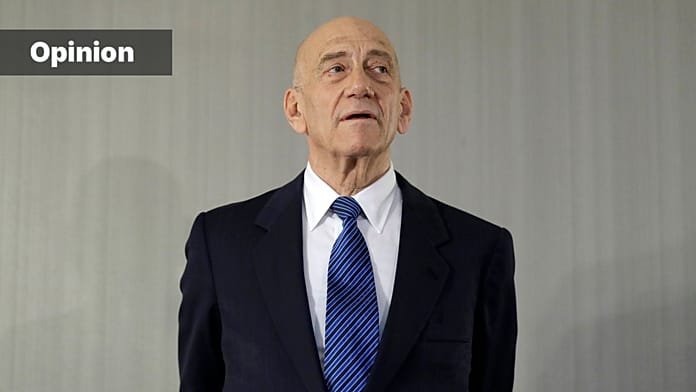
Ehud Olmert, former Prime Minister of Israel, former Minister of Strategic Affairs, Minister of Industry and Trade, and Mayor of Jerusalem.